



Modernism left Teruel with a valuable architectural legacy that can now be explored in its streets and relived every year during Modernist Week
Teruel is often referred to as the city of Mudejar architecture and the Lovers. And with good reason: its towers, declared a World Heritage Site, and the tragic medieval legend are its calling card to the world. However, anyone who stops to stroll leisurely through the historic center will discover another lesser-known but equally fascinating facet: Teruel’s Modernism, an architectural legacy that flourished in the early 20th century and is now being revived with a vengeance thanks to Modernist Week, a festival that turns the city into a living stage of the Belle Époque.
The arrival of modernity in a provincial city
At the beginning of the last century, Teruel was undergoing a silent transformation. The arrival of the railroad, running water, and electricity changed everyday life. The local bourgeoisie, merchants, and liberal professionals eager to show their status wanted to leave a mark of that optimism in architecture. Thus, between 1905 and 1915, the first Modernist houses appeared on the main streets of the city center.
The architect of this aesthetic revolution was Pablo Monguió, an architect from Tarragona who trained in Barcelona and brought the spirit of Catalan Modernism to the capital of Teruel. Monguió held the position of municipal architect and, in just a few years, designed the most representative buildings of the style in the city. His signature style combines sinuous lines, plant motifs, and ornamental exuberance with traditional materials such as brick and glazed ceramics, achieving a unique synthesis.
 Casa el Torico. Source: Teruel Tourism
Jewels in the heart of Teruel
A modernist tour of Teruel should begin in the Plaza del Torico, the epicenter of city life. There stands the Casa El Torico, built in 1912 for a wealthy local family and now an urban icon. Its violet façade, decorated with white details, wrought-iron balconies, and ceramic pieces, immediately catches the eye. It is one of the best examples of Modernism in Aragon and currently houses the Caja Rural de Teruel bank.
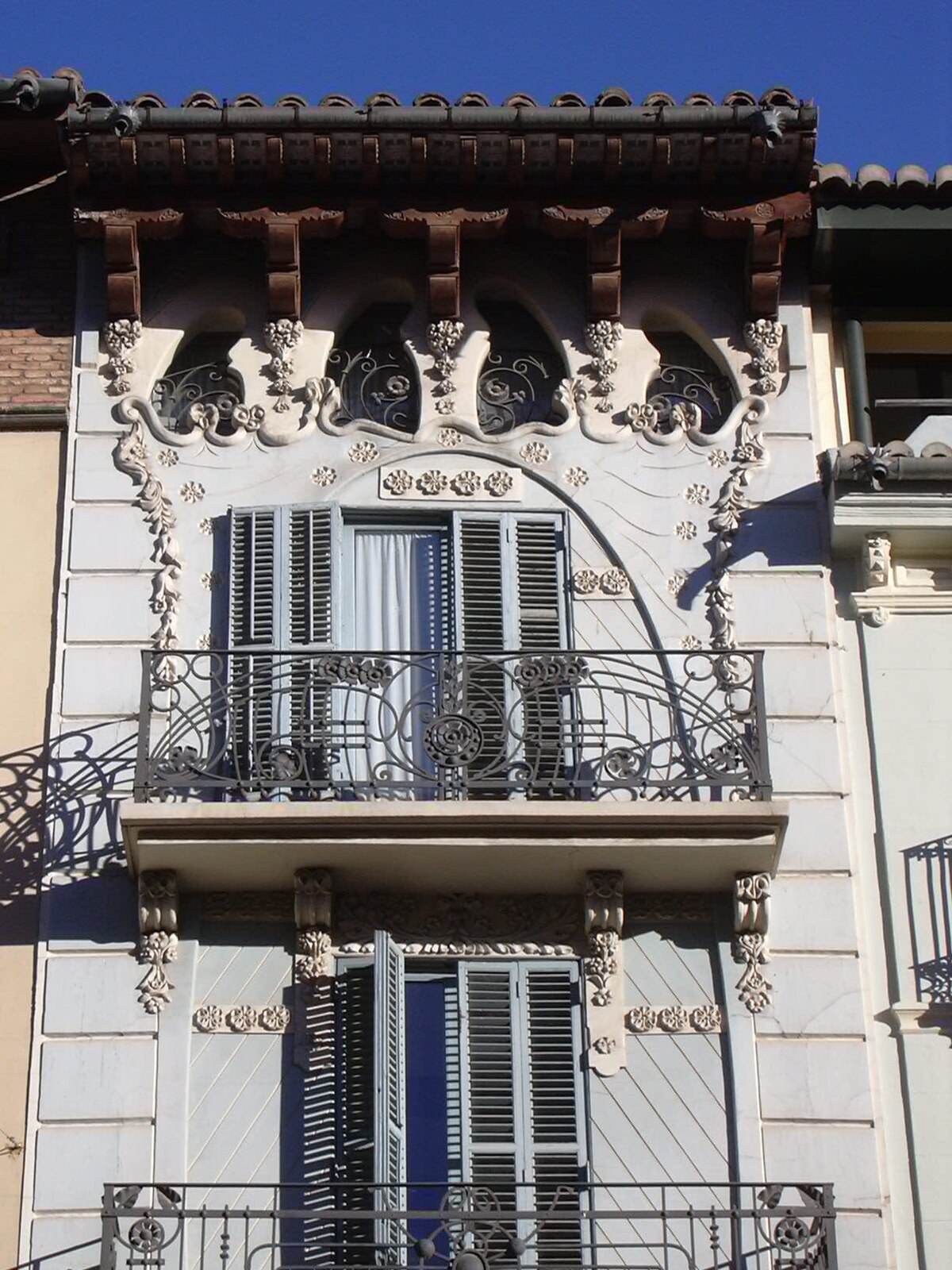
A few meters away, Casa La Madrileña demonstrates how Modernism could be adapted to narrow plots of land. Its light blue façade, adorned with garlands and decorative ovals, reveals the attention to detail that characterized Monguió. It is not a monumental construction, but it is exquisite, an architectural treat that surprises passersby.
 Modernist Week 3. Source: Fundación Bodas de Isabel
The third vertex of this triangle is Casa Ferrán, built in 1910. With seven floors, a chamfered viewpoint, and plant-inspired decoration combining stone, wrought iron, and ceramics, it was the city’s first fully Modernist building. The interior still retains its original railings, marble, and coffered ceilings, transporting visitors to a time when the bourgeoisie wanted their homes to be authentic manifestos of modernity.
Other examples complete the route: Casa Bayo or Casa de los Retales, with its characteristic ultramarine blue and central courtyard; Casa Escriche; and even the Escalinata, which combines Neo-Mudéjar and Modernist influences and has become one of the most photographed symbols of Teruel.
Look up: keys to enjoying Teruel’s modernism
Walking through the streets of the historic center is an exercise in observation. It is worth looking up and stopping to admire the details: balconies with iron railings that look like intertwined leaves, oval windows, floral garlands in plaster or glazed ceramic that add a touch of unexpected color. Inside some buildings, if you are lucky enough to gain access, you can also see hydraulic floors, wooden coffered ceilings, and period lamps.
This heritage, now protected as a Site of Cultural Interest in several cases, comes as a surprise to those who are attracted by the Mudejar style and discover that Teruel is also a Modernist city.
 Casa Ferrán. Fuente Ferrán 1820
Modernist Week: Teruel travels back in time
If travelers want to experience the city at its best, the ideal time is during Modernist Week, which this year will be held from November 11 to 16. Since 2012, the Fundación Bodas de Isabel has organized this historical reenactment that takes the city back to those years.
For several days, Teruel is transformed: residents dress in period costumes, shop windows are decorated as they were at the beginning of the 20th century, and the streets are filled with parades, live music, troupes of giants and big-heads, dramatized tours, and scenes of local customs. Each edition revolves around a theme: in 2022, for example, the visit of King Alfonso XIII to the city was recreated; in 2024, the central theme was the fears and celebrations surrounding Halley’s Comet in 1910.
The public can thus immerse themselves in the mentality of those years, when technological progress coexisted with superstitions and high hopes. The squares become open stages where dances and everyday scenes of bourgeois families or workers are performed, with massive citizen participation and a festive and educational atmosphere. There is also a cultural side to the event, with conferences, photographic exhibitions, and workshops for all ages.
 Modernist Week 2. Source: Isabel Wedding Foundation
An experience for the senses
Traveling to Teruel during Modernist Week is much more than just looking at facades. It means listening to pasodobles performed by bands in the Plaza del Torico, watching shiny vintage cars parade under the cold November sky, and being enveloped by the theatricality of actors playing merchants, doctors, and maids from 1910. In short, it means experiencing the city as its inhabitants did more than a century ago.
 Casa Escriche. Source: Teruel Tourism
Modernism and Mudejar: two sides of the same city
The appeal of Modernism in Teruel is best understood in contrast to its other great jewel, Mudejar architecture. While the medieval towers show the Islamic and Christian heritage, the Modernist houses speak of a time when the city looked to Barcelona, Paris, or Brussels for inspiration. This dialogue between tradition and modernity makes Teruel a culturally rich and diverse destination.