


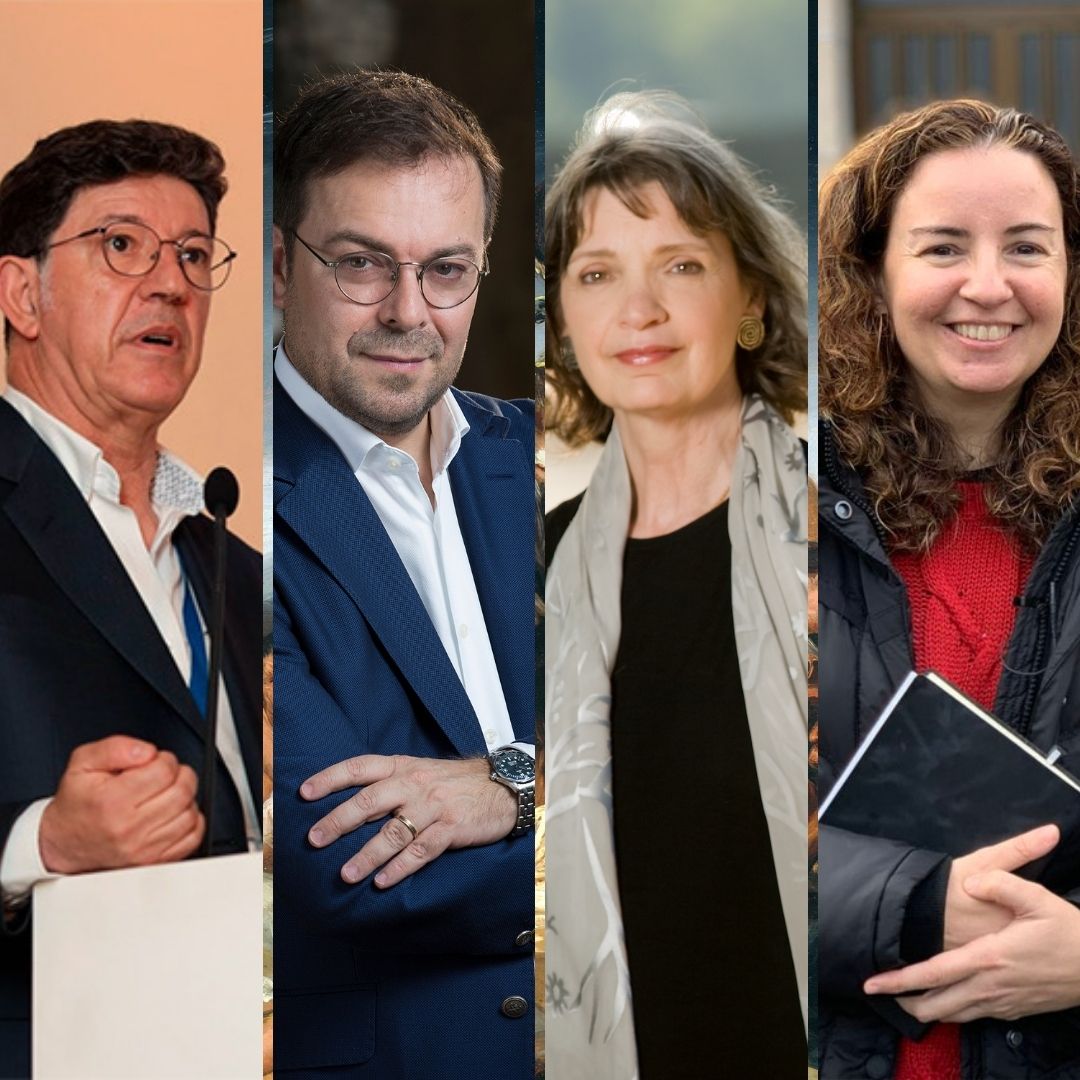
Zaragoza is preparing to become the epicenter of mystery and art with the eighth edition of Ocultura, taking place from October 29 to 31, 2025, dedicated to the enigmas of Francisco de Goya on the eve of his bicentennial. Directed by writer Javier Sierra, this international gathering blends history, esotericism, and creativity, attracting experts who unveil the hidden layers of the Aragonese genius. At GoAragon, we have compiled highlights from four exclusive interviews with its key speakers: Katherine Neville, Javier Sierra, Dr. Florencio Monje Gil, and Clara Tahoces. Their insights reveal a multifaceted Goya, from his psychological torments to his connections with witchcraft, inviting us to rediscover the painter as a bridge between reason and mystery.
Katherine Neville: Exporting the Renaissance Spirit
The American author of The Eight, a star guest for the closing event, shares her fascination for Ocultura, a festival that, in her view, could be exported worldwide to renew the spirit of the Renaissance. Neville, who attended as an audience member in a previous edition during a secret research on artists, highlights the sprezzatura — that natural harmony with the universe — present in both their works and in events like this. Excited to return to Zaragoza, she evokes lasting impressions such as the retrospective of Francisco Pradilla Ortiz and her personal connection to Spain, from the Balearic Islands to the Pyrenees. Regarding Goya, she confesses that paintings like Saturn Devouring His Son gave her childhood nightmares, while others, like La Poupee, inspired mystical themes in her novels. In her talk «Memories of the Future: Art and Memory,» she will explore how memory and imagination, analog tools in a digital world, connect us to the past. «Art is a hand that reaches out from the past to our time,» she reflects, underscoring the value of Ocultura in celebrating a kaleidoscopic universe.
Javier Sierra: Witchcraft and the Aragonese Legacy
As the driving force behind Ocultura, the winner of the Planeta Prize emphasizes the influence of witchcraft in Goya’s work, «more than present,» navigating between reason and superstition. Sierra, whose novel The Master Plan delves into secrets of the Prado, announces a program featuring lectures, guided tours of the Aljafería, and the live recording of Espacio en Blanco. He highlights speakers such as Dolores Redondo and Clara Tahoces, who will analyze Goya’s ties to the witchcraft in the Pyrenees, and Montse Aguer, who will connect the Aragonese with Dalí as heirs of alchemy and the supernatural. «Behind every cultural activity, there are hidden elements that deserve to be explored,» asserts Sierra, celebrating the support of the Caja Rural Foundation and the «Aragonese atmosphere» of this edition. In his book, he reveals Goya’s interest in astrology in works such as an overlooked tondo and Tobias and the Angel, exploring contacts with the supernatural.
Dr. Florencio Monje Gil: Faces as Clinical Stories
The maxillofacial surgeon and author of The Sick Face offers a unique medical perspective in his talk «The Cursed Faces of Goya.» He analyzes how the faces in Goya’s work — terrifying, pathological, or psychological — act as «clinical stories in potential,» reflecting past societies. A friend of Sierra since 2013, Monje merges art and science, inspired by the phrase «The doctor who knows only medicine knows nothing of medicine.» He highlights paintings such as The Madhouse and The Shipwreck for their emotional impact, and The Crucified Christ for its infinite nuances. In Vicente López’s portrait of Goya, he sees serenity and intuition. He anticipates a new project on Goya’s faces, possibly audiovisual, and advocates for a «Humanism 2.0» that prioritizes quality over data in the age of AI.
Clara Tahoces: Hidden Planning in the Witch Matters
A descendant of the IX Duchess of Osuna, Goya’s patron, Tahoces debunks myths in her talk «The Witches of Goya.» She reveals that the six canvases of «Witch Matters» — such as The Witches’ Sabbath and Flight of Witches — were not a «derangement» due to illness, but a planned collection with hidden geometry, like invisible pentagrams. Inspired by real cases like Zugarramurdi, they reflect the esoteric interest of the duchess, whose secret library housed forbidden treatises. Tahoces, a paranormal researcher and collaborator of Cuarto Milenio, connects these works with intellectual gatherings in the Alameda de Osuna, a garden filled with initiatory symbols. She sees Goya as contradictory, critical yet fascinated by the irrational, influenced by dreams and the subconscious, similar to Dalí. «Goya captured raw realities and fantasies of the mind,» she says, honored to participate in Ocultura.