



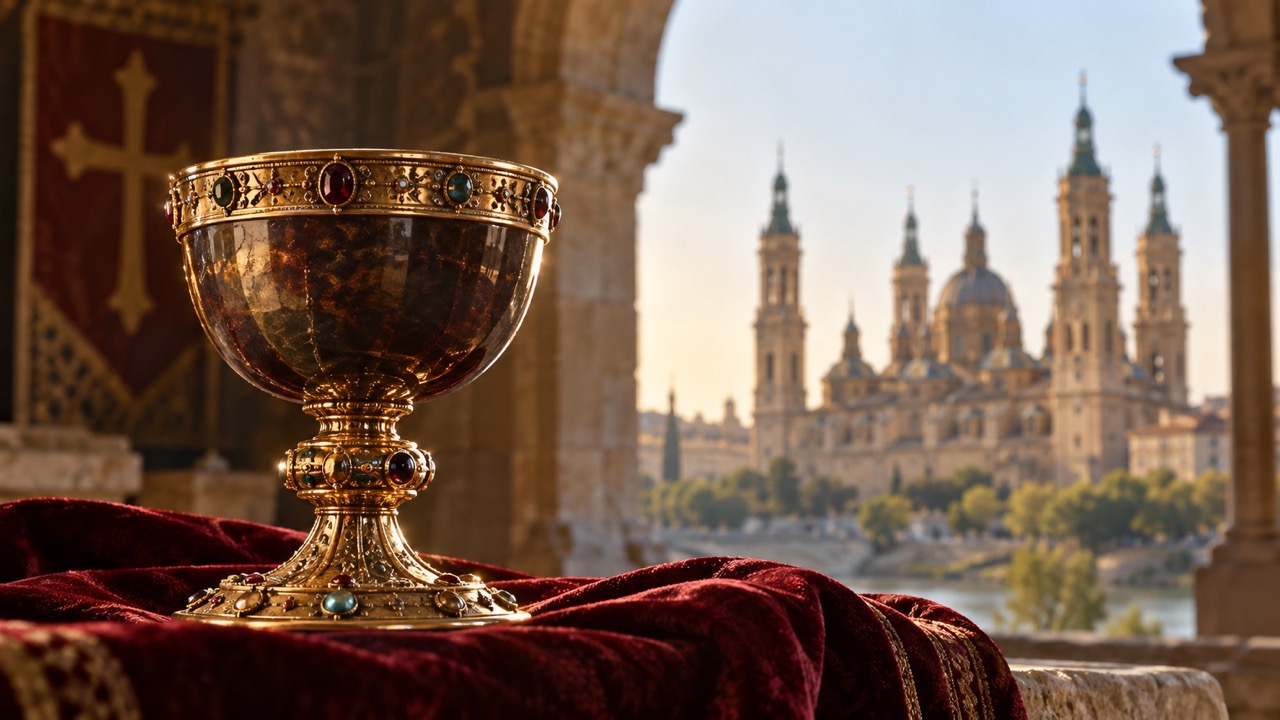
The ninth International Ocultura Conference will bring together seven specialists in history, philology, literature, heritage, and public outreach in Zaragoza. Directed by Javier Sierra, the event will examine the Grail through historical, religious, literary, and cultural perspectives.
The program will feature a wide range of experts, from scholars of medieval literature and early Christianity to researchers of Aragonese and Leonese traditions, as well as voices associated with the Holy Grail Route.
Victoria Cirlot: the literary Grail
Victoria Cirlot, emeritus professor of Romance Philology at Pompeu Fabra University, will open the conference series with an examination of the Grail quest in medieval literature.
A specialist in medieval culture, mysticism, and the Arthurian tradition, Cirlot is the author of Grial, poética y mito. Her presentation will trace the Grail’s literary origins and explain how an object born in medieval European tales came to acquire a religious, symbolic, and cultural dimension that has endured to the present day.
José Luis Corral: the Aragonese tradition
The Aragonese dimension will feature prominently with José Luis Corral, professor of Medieval History at the University of Zaragoza and author of an extensive body of nonfiction and historical fiction.
Corral will address the connection between the Grail and San Juan de la Peña, one of the central themes of this edition. The medievalist has examined the issue in his recent book Mitos y leyendas de Aragón, which reviews some of the accounts, traditions, and historical episodes that form part of Aragon’s cultural imagination.
Belén Luque and Cristina Monzó: the Holy Grail Route
Belén Luque, an art historian and managing director of the Diocesan Museum of Jaca Cathedral, will participate from Jaca. She will join Cristina Monzó in a discussion of the Holy Grail Route.
Monzó has traveled the route on foot and shared her experience through articles, videos, and the series La senda del Grial, produced for Aragón TV. The discussion will explore the route’s contemporary dimension, linking heritage, religious tradition, cultural tourism, and territory.
Antonio Piñero: the Last Supper
Antonio Piñero, emeritus professor of Greek Philology at the Complutense University of Madrid, will offer a historical reading of the Last Supper episode and its subsequent connection with the Grail tradition.
A specialist in early Christianity and the canonical and apocryphal Gospels, Piñero will place the debate in the context of the available sources. His lecture will distinguish between religious accounts, ancient texts, and the later medieval construction that turned the Grail into one of the most evocative relics of the Western tradition.
Margarita Torres: the León case
The counterpoint to the Aragonese tradition will come from Margarita Torres, professor of Medieval History at the University of León. In 2014, Torres took part in research linking the so-called chalice of Doña Urraca, kept at the Basilica of San Isidoro in León, to the Holy Grail.
Her participation will make it possible to compare the different interpretations associated with the chalices of León and Aragon. The debate does not seek to establish a definitive answer, but rather to show how historical sources, religious tradition, and contemporary research have produced different readings.
Javier Sierra: direction and context
Javier Sierra, writer, journalist, and founder of the International Ocultura Conferences, completes the group. Winner of the Planeta Novel Prize and the Aragonese Literature Prize, Sierra will once again direct and host an event now in its ninth edition and its sixth held in Zaragoza.
His role will extend beyond introducing the sessions: he will serve as the guiding thread of a program designed to bring different disciplines and approaches into dialogue.
A program with different perspectives
Ocultura does not approach the Grail through a single discipline, nor does it confine it to its legendary dimension. Medieval literature, historical documentation, Christian tradition, heritage, public outreach, and cultural routes will converge over three days to explain why the quest for the Grail continues to draw interest centuries after its myth was created.
The diversity of backgrounds is precisely one of the edition’s main strengths: the goal is not merely to answer the question of where the Grail is, but to understand why that question remains alive.