


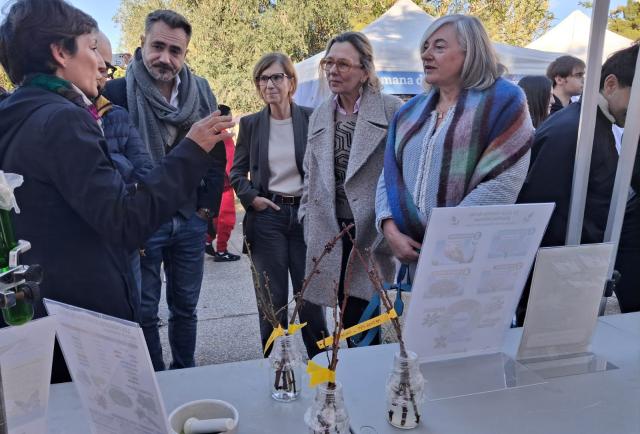
More than 200 elementary and secondary school students took part this Friday in a new edition of the Science Corner, held at the University of Zaragoza’s San Francisco Campus. The event featured 25 educational stands designed to bring Aragonese research closer to students through experiments, workshops, and demonstrations.
San Francisco Campus hosts 25 workshops on science being researched in Aragon
The event ran from 10:00 a.m. to 1:00 p.m. and featured initiatives from universities, institutes, and research centers across the region. In all, more than 15 organizations took part, showcasing how scientific teams work and the everyday applications of their research.
The program combined games, demonstrations, and experiments related to fields including health, technology, the environment, food, social sciences, and heritage. Pilar Gayán, director general for Science and Research, visited the event, which focused on sparking scientific curiosity among young people through a participatory experience.
Robotics, cancer, climate change, and hydrogen among activities for students
The Aragon Institute of Technology presented activities on smart mobility, cities of the future, and robot design, featuring remote-controlled vehicles, IndustrialVille characters, and demonstrations with a robotic dog. Meanwhile, the Aragon Health Research Institute offered a detective activity on biomarkers and cancer research, as well as an initiative focused on spaces, well-being, and mental health.
Health was also featured in anatomy games and activities organized by the Aragon Institute of Health Sciences, while the Aragon Engineering Research Institute explained the behavior of light, its applications in fiber optics, and the electrical signals of the heart, brain, and muscles. The Aragon Institute of Nanoscience and Materials explored hydrogen’s potential as a clean energy source.
The Aragon Agri-Food Institute introduced topics including food, human and animal health, the microbiota, food safety, wine aromas, and the effects of climate change on wine production. In addition, the Pyrenean Institute of Ecology conducted torrential-rain simulations to examine the influence of soil and vegetation on flooding, while the University Institute of Environmental Sciences demonstrated the properties of water and its relationship with ecosystems.
The program also included fossil teeth from extinct animals, Aragonese women who made their mark between 1800 and 1970, advanced microscopy, woody plant cycles, strength measurement, and citizen science projects. Among the latter, the Ibercivis Foundation invited participants to explore nighttime images of Earth taken from space and help classify scientific research.
Science Week 2026 will continue through November 29
The Science Corner is part of Science Week 2026, scheduled from November 16 to 29 to promote research, innovation, and the work of Aragonese scientific teams.
The agenda will continue with the Aragón Investiga Awards, scheduled for November 25, and the Second Aragón Knowledge Transfer Agents Network Conference, to be held on November 27. The latter event will include new knowledge-transfer initiatives and a closing presentation on success stories.