


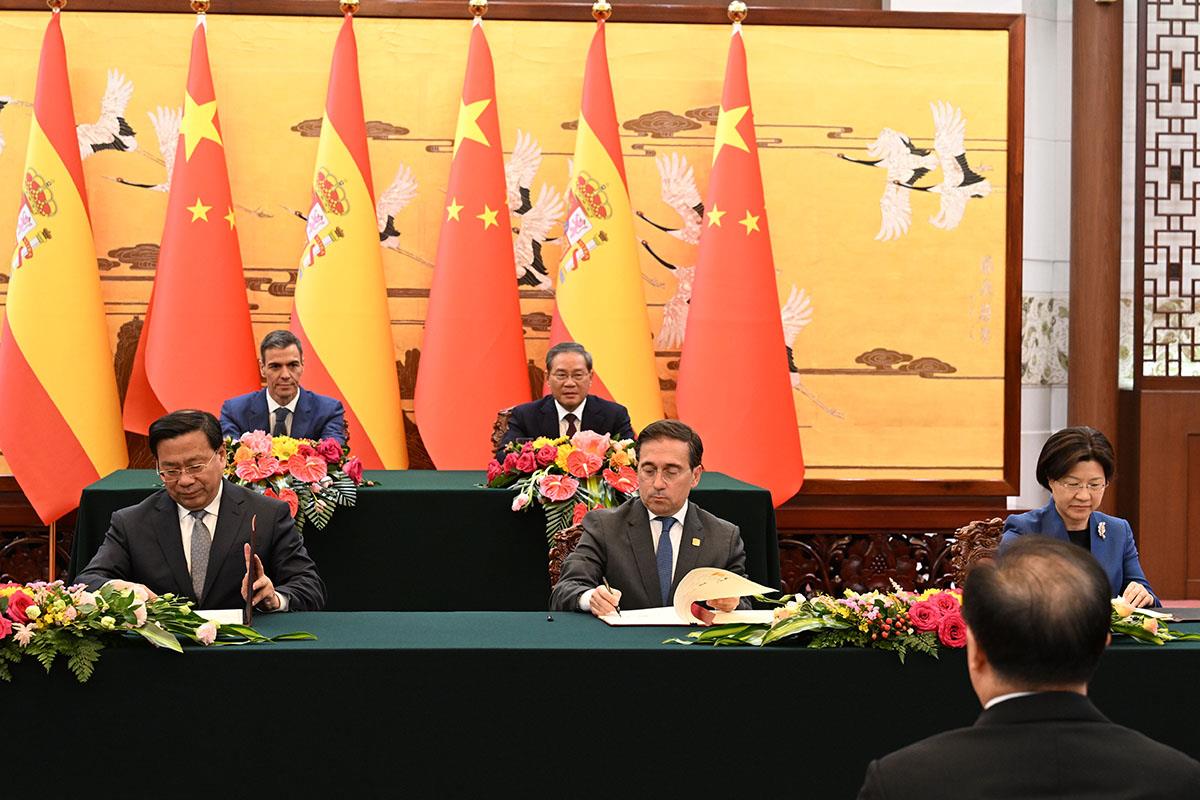
Spain and China have today signed six new agreements in the agro-food sector during the official visit of the Prime Minister, Pedro Sánchez, to the People’s Republic of China. The signed protocols and memoranda expand the export opportunities for high value-added Spanish products and consolidate the bilateral sanitary and phytosanitary framework.
The six agreements include five sanitary and phytosanitary protocols and one memorandum of understanding:
- Regionalization protocol for the export of poultry in the event of avian influenza and Newcastle disease.
- Phytosanitary protocol allowing the export of pistachios and dried figs to China.
- Two protocols related to the pork sector, including the modification to allow the export of cooked products and the use of processed animal proteins.
- Protocol on the use of processed animal proteins as fertilizer.
- Memorandum of understanding on geographical indications and designations of origin.
These instruments establish stable frameworks that facilitate bilateral trade and reinforce Spain’s position as a reliable and competitive supplier in the Chinese market, one of the most important globally.
The Minister of Agriculture, Fisheries and Food, Luis Planas, has positively evaluated the signing of these agreements, highlighting that “they consolidate mutual trust between both countries and Spain’s prestige as a source of safe food.” Planas added that they represent “a strategic step to promote bilateral relations, market diversification, and the strengthening of the Spanish production sector.”
With these six new texts, Spain and China have now signed a total of 22 agro-food agreements since 2018.
Among the most relevant advances are:
- The recognition by China of regionalization in the event of avian influenza and Newcastle disease, which guarantees the continuity of poultry exports from disease-free zones.
- The opening of the Chinese market to Spanish pistachios and dried figs.
- The expansion of pork exports with cooked products and the valorization of meat by-products as fertilizers, improving the sustainability of the sector.
These agreements are part of the Spanish strategy to reinforce the Comprehensive Strategic Partnership with China and to diversify and consolidate foreign markets for the national agro-food sector.