



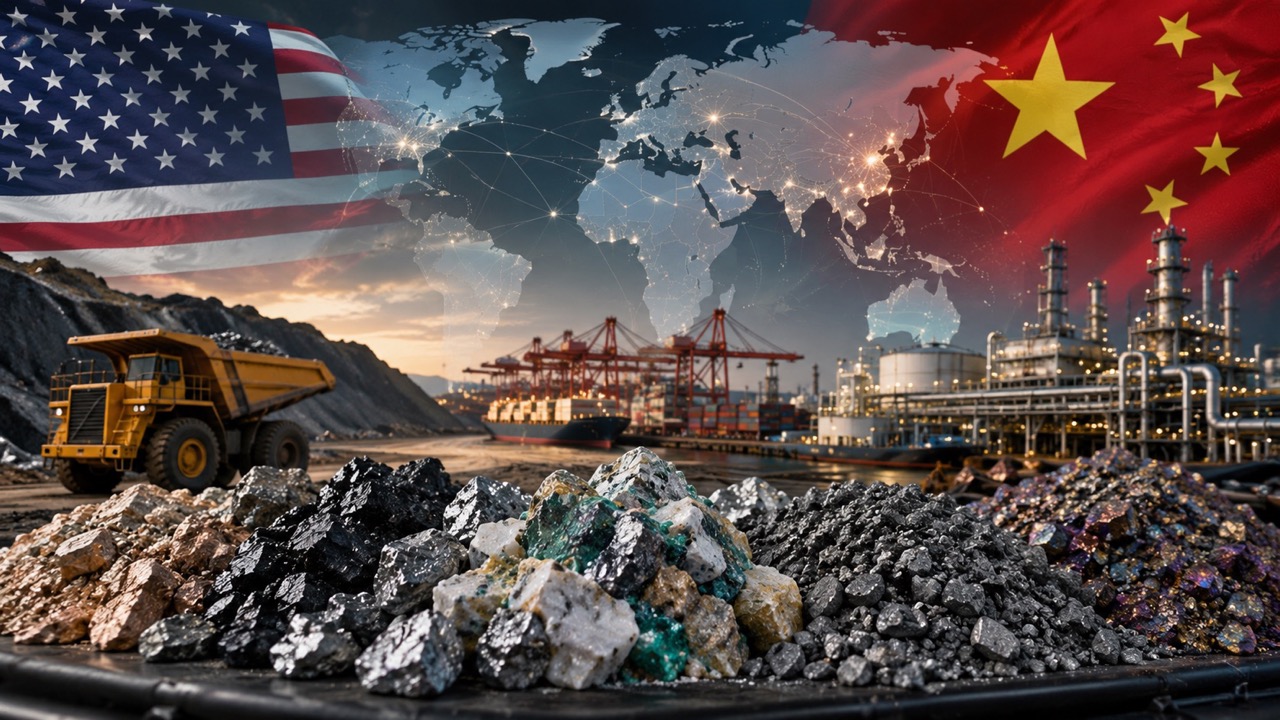
The technological competition between the United States and China is not just centered around semiconductors, artificial intelligence, or electric vehicles. Long before a chip, a battery, an airplane, or a missile is manufactured, there exists another, less visible industrial chain: one that begins in the mines and continues at plants where minerals are processed and transformed into materials usable by industry.
Bauxite is one of them. The United States has recently launched a project that connects the reserves of Guyana with new U.S. industrial facilities through a joint investment of approximately $150 million. Of that amount, $85.5 million will come from U.S. public funding and another $64.5 million from private capital. The goal is to develop an integrated supply chain for refractory bauxite that reduces reliance on external sources for materials deemed necessary for certain industrial and military applications.
The operation includes the acquisition and expansion of a mine in Guyana operated by First Bauxite, the development of calcination capacity, and the subsequent construction of a facility in the United States to produce brown fused alumina. According to information released about the project, once fully developed, it could meet U.S. military needs for refractory bauxite and this type of alumina.
From a Mine in Guyana to the U.S. Military Industry
Bauxite is primarily known as the raw material used to produce aluminum, but certain varieties have more specialized applications. Refractory bauxite enables the production of materials capable of withstanding extremely high temperatures, a property necessary in various industrial processes and also in certain defense and aerospace equipment.
Its applications include thermal barriers and coatings, protective shields, and components used in systems exposed to extreme temperatures. Fused alumina is also employed as an abrasive and refractory material in numerous industrial activities.
The strategic importance of the Guyana project is better understood when the complete chain is observed. Extracting the mineral is only the first step. After that, it must be selected, treated, calcined, refined, and transformed into a material with the properties required by the manufacturer that finally incorporates it into a product.
This distinction is fundamental to understanding the current competition for critical minerals. One country may have significant mineral reserves and still depend on foreign sources to process them. In the same vein, another country may have limited mining production but hold a dominant position in the subsequent industrial phases.
The Real Value Also Lies in Processing the Mineral
Over the last several decades, China has built extensive industrial capacity related to numerous raw materials. Its international position does not solely derive from the reserves available within its borders. In various supply chains, its weight increases significantly when examining the phases of processing, refining, and material manufacturing.
It is precisely this dependence that the United States and other Western economies are attempting to reduce. The strategy involves diversifying suppliers, developing new mines, and reclaiming industrial capacity to transform certain raw materials outside of China.
The sequence can be simply summarized: having access to a mine does not guarantee the availability of the material a factory needs. Between these two extremes, there can be a complex technological and industrial chain that requires facilities, energy, specialized knowledge, machinery, and capital.
This issue is clearly observed in the case of rare earths, but it extends to other materials used in batteries, electronics, renewable energies, aerospace, and defense. Gallium, germanium, graphite, tungsten, antimony, or magnesium are part of a list of materials whose availability has become increasingly important to governments and companies.
Guyana Enters the New Map of Raw Materials
Guyana is particularly interesting in this transformation. The South American country has gained extraordinary international relevance in recent years due to the development of its large oil reserves, but it also possesses significant mineral resources and a long-standing bauxite industry.
The new U.S. initiative aims to leverage those reserves to create a supply chain that connects extraction in Guyana directly with industrial transformation in the United States. The project plans to increase the mine’s capacity and develop the necessary facilities to produce higher value-added materials.
However, the United States is not the only international player interested in the sector. China also maintains a business presence in Guyanese mining. Bosai Minerals Group has been operating for years in the country’s bauxite industry, and the U.S. commercial guide for Guyana outlines investment plans related to new processing capabilities.
Thus, Guyana appears in a scenario that is already observable in other resource-rich countries: companies and governments from different powers seek to establish stable relationships with producers and participate in various stages of the industrial chain.
China Also Needs to Import
China’s position in critical minerals also presents a characteristic that sometimes remains hidden. China is a major producer of certain raw materials, but its vast industry requires importing equally substantial amounts of resources from other countries.
Bauxite is a good example. The Chinese aluminum industry requires external supplies and has developed significant relationships with producing countries. Guinea, in West Africa, has become one of the key centers of this chain, with a prominent presence of Chinese companies in operations and infrastructure related to mineral export.
The model shows that supply security does not necessarily depend on producing everything within one’s own borders. It can also be built through investments in producing countries, long-term supply contracts, participation in mines, infrastructure construction, and the capacity to later process the materials.
This logic has been applied by China for years in different regions and is being reinforced by the United States through new investments and agreements with countries deemed strategic.
From Minerals to Chips, Batteries, and Military Systems
The race for raw materials is directly related to some of the major economic transformations currently taking place. An electric vehicle requires minerals for its batteries and motors; an electrical grid requires copper and other materials; a data center uses enormous amounts of electronic equipment; semiconductors depend on extremely specialized materials, and military systems incorporate components made with metals and minerals exhibiting very specific properties.
That is why industrial policies are beginning to look further back within the supply chain. For decades, many companies optimized their suppliers primarily seeking cost, specialization, and efficiency. Geopolitical tensions, trade restrictions, and logistical disruptions have now added other factors: where the supplier is located, who controls the technology, and what alternatives exist if a particular route is interrupted.
The U.S. response is combining different instruments. Washington is supporting new mining operations, financing processing facilities, and seeking agreements with producing countries to diversify supply chains. The Guyana initiative is part of that process.