



History backs up the slogan of Zaragoza, City of Cinema because the first documented Spanish film was shot here. It was October 1896 when Eduardo Jimeno set up his camera in the heart of the city to film the Exit from the Noon Mass at the Pilar in Zaragoza. Thirteen decades have passed since then, and many other film shoots have come to the Aragonese capital. Some have featured Hollywood stars, as was the case in the 1950s with the film Solomon and the Queen of Sheba, while others have been recent and successful Spanish productions, such as Las niñas or La Estrella Azul.
It’s not just movies—TV series, commercials, documentaries, and all kinds of audiovisual productions also choose locations in Zaragoza. Without even leaving the city, there are historic settings in the Old Town and at landmarks such as the Paraninfo or the Aljafería. There are also futuristic settings, such as the area around the Expo grounds. Not to mention the versatility of natural landscapes, which range from desert-like to lush and green. In short, there are settings for all kinds of storylines.
In recent years, the Zaragoza Film Office (ZFO), part of the Department of Culture, Education, and Tourism of the Zaragoza City Council, has been responsible for promoting film and video production in the city. The office serves as a one-stop shop to address the needs of companies and activities related to film and video production within the municipality.
As Adriana Oliveros, president of the Aragón Audiovisual Cluster, explains, the ZFO has recently facilitated the arrival of productions such as the American science fiction series Murderbot from Apple TV and the filming of Por cien millones, a Movistar Plus+ miniseries directed by Nacho García Velilla. “We’ve received very positive feedback from them and other film crews about the city’s conditions. And also about the online service offered by the Zaragoza Film Office, since various administrative tasks can be handled online—such as applying for permits or contacting various municipal services, like the police or parks and recreation—all of which are essential before starting any shoot. This is a novel approach, and very few film commissions offer this option.”
This innovation makes sense given that the ZFO was established relatively recently. In contrast, the Aragón Film Commission—sponsored by the regional government and operating throughout the entire region—has a somewhat longer history. Its director is David Lozano, and the work of this office is key to attracting an increasing number of international film shoots to Aragón. So, just as Ridley Scott arrived a few years ago to film his Kingdom of Heaven in Loarre, major Marvel productions—such as the third installment of Venom and the film Spider-Man: Far From Home—have recently been filmed in Riglos and Belchite.
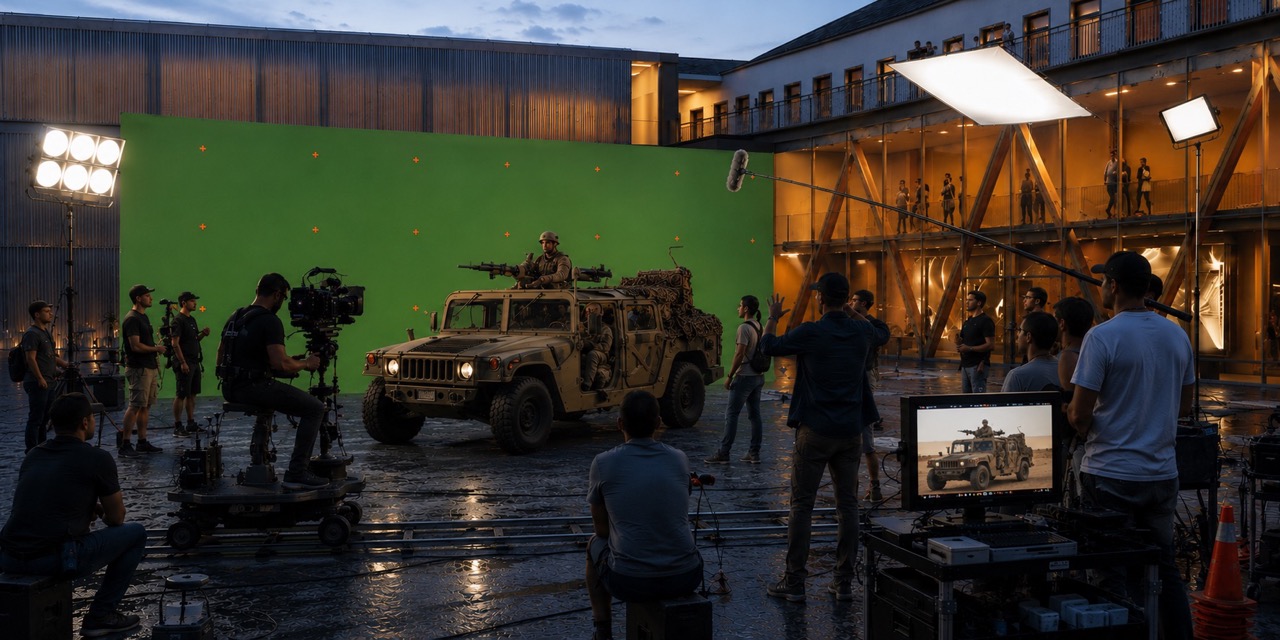 Reconstruction of a scene from *District 7*. Photo created with AI
Lozano notes that: “At the Aragón Film Commission, we directly manage film shoots. For example, over the past year and a half, we’ve been involved in around 40, while inquiries have far exceeded a hundred. However, it’s important to note that these figures include both small projects and more ambitious film, television, and advertising productions.”
But the Aragón Film Commission’s work goes beyond simply contacting audiovisual production companies. “We also coordinate a valuable network of local film offices. This creates a multiplier effect. The offices in Zaragoza, Teruel, and Monegros do invaluable work in their respective regions, and it’s a privilege to collaborate with them.”
This collaboration extends beyond official agencies. A key part of this unique ecosystem is the private companies that support these film shoots—sometimes from a more technical perspective, but primarily in the area of services. The company Rodar en Aragón has extensive experience in this field, led by entrepreneur Fernando Monzón.
Monzón has worked, for example, on the filming of the British series Vampire Academy and has collaborated in Belchite with the producers of the famous Walking Dead. “As a local production company, we try to provide services to major film production companies from abroad. We supply everything from the essential tinted-window vehicles for the stars to the catering they request, as well as staff to direct traffic and extras. All of this is very important on a film set and is what major productions seek most, since, as a general rule, they tend to bring a huge cast of actors and crew members with them.”
A glance at all those internationally renowned movie and TV series titles confirms the appeal of Aragón’s filming locations. Spanish productions also take advantage of this. One need only recall that the opening scenes of Sirat—the latest Spanish film nominated for an Oscar—were filmed in Teruel, or that directors such as Berlanga, Vicente Aranda, Bigas Luna, and even Almodóvar, who chose Fanlo as the setting for his Julieta, have worked here. And without a doubt, Aragonese filmmakers have also been prophets in their own land, with various films shot in Zaragoza—including works by the aforementioned Nacho García Velilla, as well as Paula Ortiz, Pilar Palomero, Miguel Ángel Lamata, and Javier Macipe.
However, the aim now is to take it a step further. This coming September, the Distrito 7 project—driven by the General Directorate of Strategic Projects and International Outreach, which reports to the Mayor’s Office—will get underway. As for its management, it has been assigned to the Department of Economy, Digital Transformation, and Transparency of the Zaragoza City Council.
Ángel Lorén, the City Council’s Chief of Staff, describes the project as follows: “The goal of Distrito 7 is to create an ecosystem of industrial specialization that brings together the various activities along the audiovisual sector’s value chain—from training to exhibition, encompassing research, entrepreneurship, business, and production—and that positions the city of Zaragoza within the national and international audiovisual landscape.”
To achieve this, the first step was to reclaim the abandoned building of the former Giesa factory, located in the Montemolín neighborhood, where elevators were manufactured until a few decades ago. Now, the entire site will be transformed into Distrito 7.
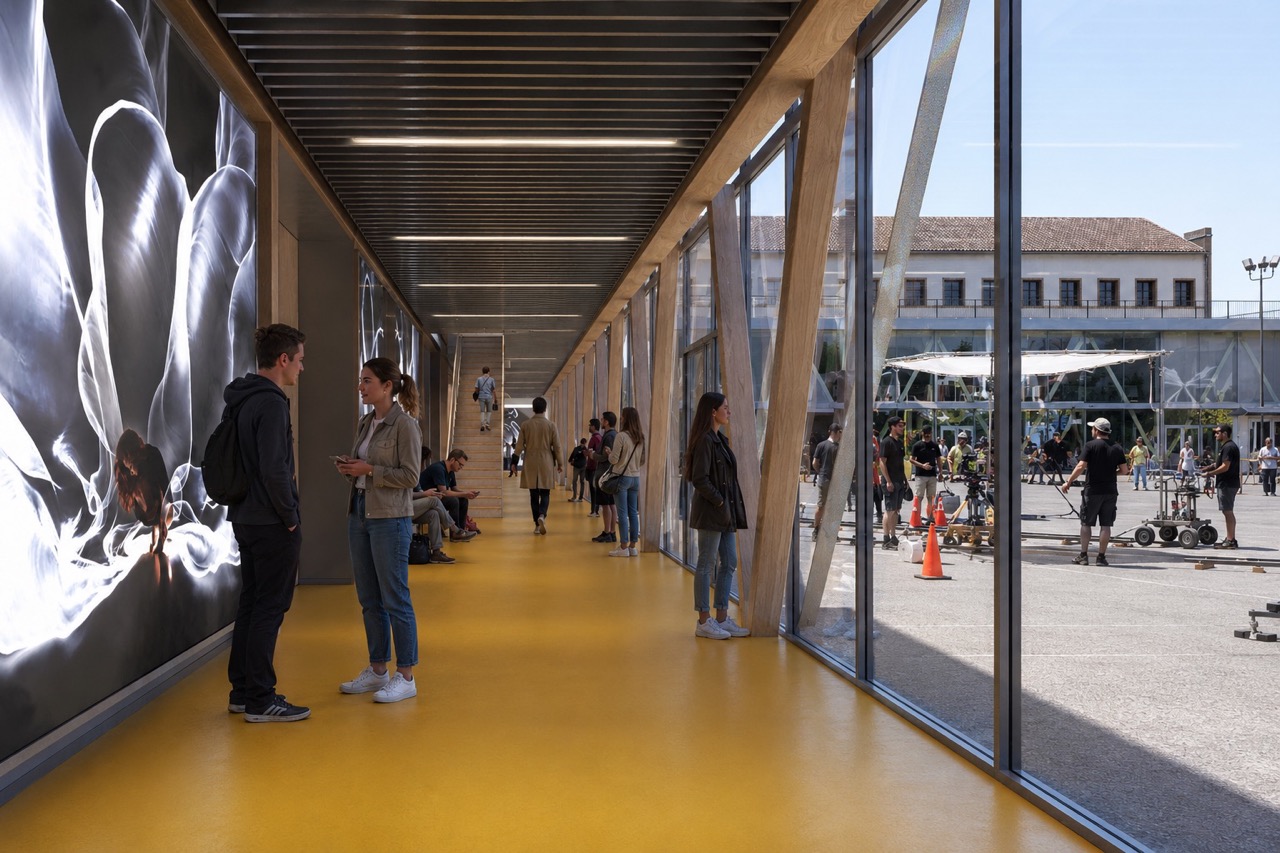 Interior of Distrito 7. AI-generated image
It will have a total area of more than 15,000 square meters, of which nearly one-fifth will be a large outdoor set. Meanwhile, the architectural restoration project envisions that the old building, inaugurated in 1945, will house, among other things, two exhibition halls and an entrepreneurship area dedicated to audiovisual production in the broadest contemporary sense—that is, film, television, video games, and VFX production. It will also include an entire area of classrooms for specialized training. In fact, it has already been announced that this training component will be managed by the San Valero Group, which has designed the training programs—both intermediate and advanced levels—that will be offered at Distrito 7 starting next academic year.
This marks the end of Phase 1 of the project, but in a second phase, a new space will be built to house three indoor soundstages measuring 800, 1,000, and 1,300 square meters, as well as an outdoor soundstage in the adjacent plaza.
All the professionals consulted have high hopes for this new technology hub. Lorén himself notes that: “It was created with the aim of facilitating and generating a large number of interactions with various entities—whether municipal or not—always focused on the audiovisual sector.”
For his part, David Lozano is convinced that: “Distrito 7 will mark a turning point because it solves problems we’ve faced until now, such as the lack of soundstages or virtual production capabilities. Furthermore, the existence of this infrastructure helps round out our range of services and better positions the community for the future of the audiovisual sector in terms of technology. In short, and without a doubt, the launch of Distrito 7 is good news.”
Monzón, for his part, after many years working on film shoots both here and outside of Aragon, has also placed his hopes in this project: “We have some wonderful locations. Now we can have sets that are literally fit for the big screen. All of that is very important for attracting major foreign productions, which are the ones that bring in a lot—a great deal—of money. But we also need to address a third, very important aspect: the staff. As for technical staff, we already have outstanding professionals, and there will be even better ones with proper training. But a key factor is having a good network of services to support production companies. That is, addressing not only their needs for lodging or catering, but also their travel arrangements, crew coordination, good tents for breaks during shoots, and a myriad of service details that local producers have to handle. It may not be as glamorous as training screenwriters or outstanding camera operators, but it’s vital for the city’s audiovisual sector to grow.”
Adriana Oliveros is very familiar with the project; as President of the Audiovisual Cluster, she has participated in various meetings regarding District 7 and also views it favorably. “At the Cluster, we believe that such technological infrastructure will be important for generating quality jobs. But we also have to view it as the spearhead. In other words, we need to link it to a strategic plan for the audiovisual sector in which we work together across all levels of government.”
 Exterior rendering of Distrito 7. Photo created with AI
Her theory is that infrastructure like this is what anchors talent to the community and fosters businesses. “But we need to go further. For example, through a policy to improve incentives, among other things, to compete with neighboring regions. And also because these types of incentives generate returns. It’s not just my opinion. A study conducted by Olsberg SPI for the Spain Film Commission concludes that for every euro invested through tax incentives, an additional nine euros are generated in the economy.”
Currently in Aragón—and indeed throughout Spain—the national government has approved a 30% tax incentive for international productions. Meanwhile, the Autonomous Community of Navarre has expanded these incentives to 50%, and even higher in certain situations in the Basque Country or the Canary Islands.
“How can we top that?” asks Oliveros. “By highlighting other strengths. Starting with our geographic location between the country’s two major audiovisual hubs, Madrid and Barcelona. These are two places where there are so many film shoots that they even face overcrowding issues. That’s where we come in, offering a more welcoming city, with all kinds of infrastructure and services, and far fewer problems. Take something as simple as traffic, for example. Closing a street in Barcelona can be an ordeal, whereas here it’s much simpler.”
On the other hand, both Adriana Oliveros and David Lozano agree that there is already a strong network of audiovisual technical professionals in the Autonomous Community, but that the training program offered by Distrito 7 will represent a significant leap in quality. Lozano explains: “For years now, Aragón has built up a pool of professionals capable of meeting the needs—both technical and service-related—generated by a high-budget film shoot, a fact we want to highlight so it becomes better known outside our region. “Our goal, furthermore, is for this stable pool of talent to continue growing so that eventually no one will need to leave Aragón to advance their career in the audiovisual sector,”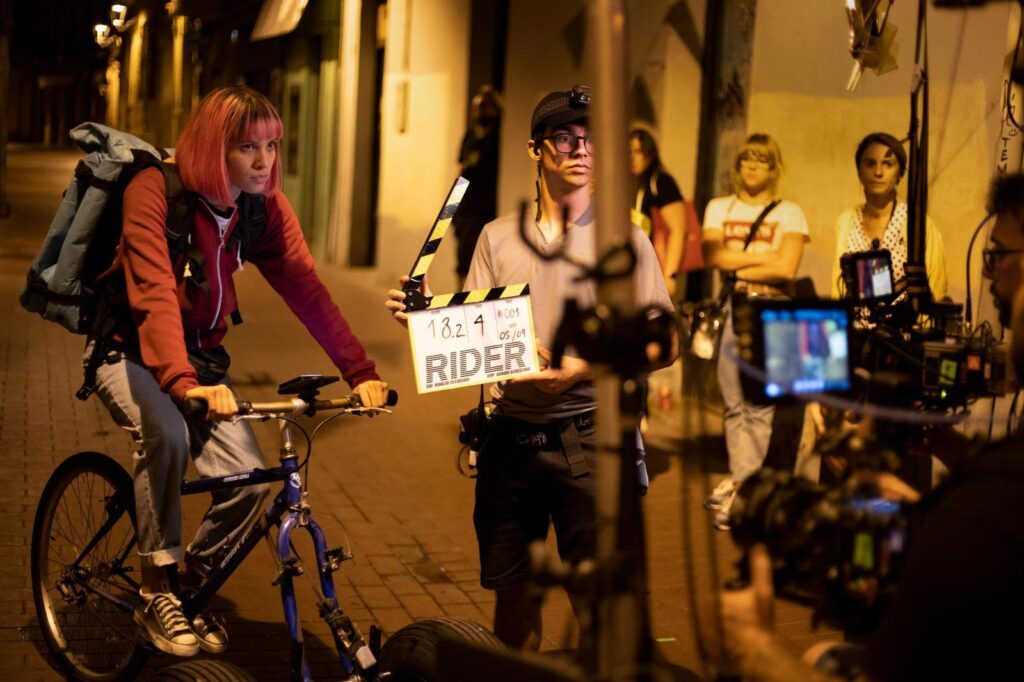
“In the Audiovisual Cluster alone, we have 57 companies—some closely tied to film, but also specializing in audiovisual engineering, conferences, concerts, or services. All of them are committed to growing and participating in this ecosystem that Distrito 7 will bring together,” says Adriana Oliveros.
One of these companies is Rodar en Aragón, and Fernando Monzón hopes that all of this will truly bear fruit and that efforts will be made to attract major international film productions. “We’re businesses—in other words, we want to make money. And that’s where the significant revenue lies. To achieve that, we all need to pull together and avoid obstacles—for example, certain administrative red tape that we’ve sometimes had to deal with.”
The economic importance of the audiovisual industry is well established. Sources at the Zaragoza City Council estimate that film shoots over the past five years have had an impact of approximately 6 million euros on the city. This ripple effect extends to hotels, restaurants, transportation, retail, technical suppliers, and support services. Not to mention the reputational value of putting the Aragonese capital and the entire autonomous community on the international map of audiovisual production—that is, on screens around the world—which represents an opportunity from a tourism promotion perspective.
“This is another benefit brought by major film and television series productions, because screen tourism is booming more and more,” reflects Fernando Monzón. Adriana Oliveros agrees: “There’s enormous potential there. In fact, Zaragoza already has a film trail. But as far as I’m concerned, that’s no longer within our scope of responsibility. For now, we have enough on our plate coming up with ideas for the future of Distrito 7 and making new film shoots possible.”
The next one is coming up in September. It will be the feature film Perseidas, directed by Ignacio Lasierra and starring actress Natalia Huarte. They and the rest of the crew will shoot in Zaragoza, in the Monegros region, and in Huesca, and then they’ll cross the ocean to film in Uruguay.