



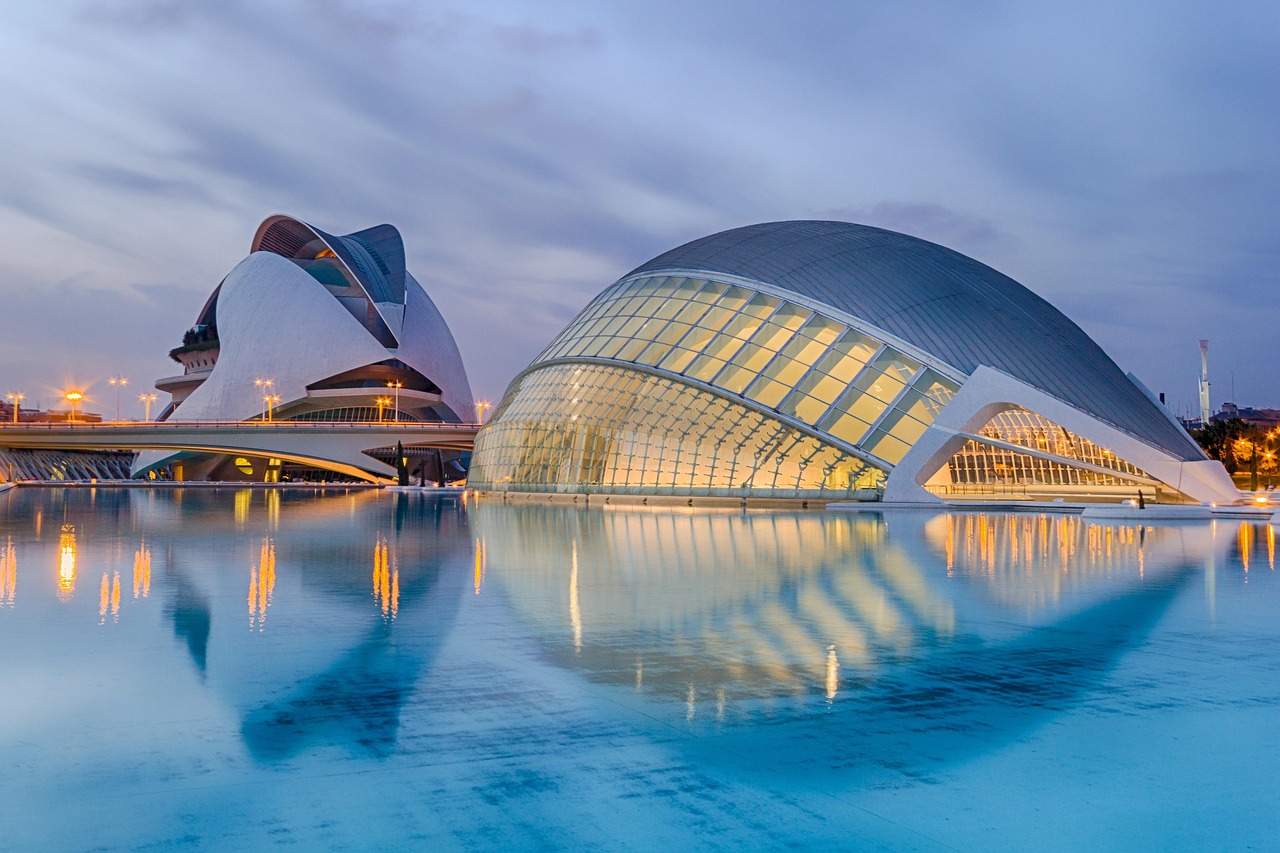
March is the month of Las Fallas in Valencia. Throughout the month and until the 19th, the capital hosts a multitude of events linked to these celebrations, which have been declared by UNESCO as Intangible Cultural Heritage of Humanity. So, one of the best times of the year to visit Valencia is approaching. Especially if overcrowding and noise are not an issue (the famous mascletás are essentially that—explosions of gunpowder).
However, to enjoy the many charms of this city, you don’t have to wait until March. Any time of year is fabulous to take the A-23 motorway and head to the Valencian capital. A city that showcases a unique blend of tradition and modernity, combining local Mediterranean essences with more cosmopolitan influences from afar.
Perhaps the Valencian area where this amalgamation of influences can best be observed is the former riverbed of the Turia. Valencia, like many other cities, arose on the banks of a river. However, some time ago, its course was modified, and the old route was transformed into a recreational area for citizens and visitors. Along this green area, historic bridges such as the ones from Trinidad, Real, and Serranos connect to one of the fortified gates that the city had in the Middle Ages. There is also a much more modern bridge, Peineta, which serves as a sort of appetizer to the iconic City of Arts and Sciences.
This monumental showcase of fiercely contemporary architecture is not just a space to enjoy visually and take a thousand and one photos. Here, all senses are delighted. For example, in a Science Museum where it is forbidden not to touch, or in an Auditorium where music is the highlight. Not to mention the Oceanogràfic, which is one of the most visited gems in the city for both young and old.
The futuristic nature of this architectural ensemble contrasts with the historical area of Valencia, which also has much interest and deserves a lengthy stroll through its labyrinth of streets. In the heart of them lies the Plaza de la Reina, the chosen location for the Cathedral, beside which stands the octagonal tower of its bell tower, known as the Miguelete, where it is possible to climb for a panoramic view of the entire historic ensemble. Therefore, climbing its more than 200 steps allows you to spot the following places to visit in the old town.
And there are many places to go! For example, regarding interesting temples, there are other churches to admire in addition to the spectacular Cathedral. It is also worth heading to the revered Basilica of the Virgin of the Forsaken, which houses the image of the city’s patroness. Likewise, one can visit the church of Santos Juanes or the Convent of Santo Domingo, not to mention the church of San Nicolás, whose walls, vaults, columns, and chapels overflow with Baroque painting. So much so that it is known as the Sistine Chapel of Spanish art.
But it’s not all churches. It is also worth visiting the grand mansions of other times, such as the Palace of the Admirals of Aragon or the façade of the Marquis of Dos Aguas, where it is impossible not to be mesmerized by such a rococo decorative delight. Much more restrained, but equally beautiful, is the Gothic architecture of the Silk Exchange (Lonja de la Seda) and the Almudín, which was an old grain warehouse transformed into an exhibition hall. And one should not miss the imposing medieval fortress of the Towers of Quart or those of Serrano that bring us back to the shores of the Turia.
Both the towers of Quart and those of Serrano mark the edges of the popular El Carmen neighborhood. A perfect place for leisurely wandering, taking a break while enjoying a drink at any time of day (or night). Furthermore, in El Carmen is another one of those places that embodies the fusion of the old and the modern that characterizes the atmosphere of Valencia. There lies the IVAM, or the Valencian Institute of Modern Art. A space where the latest in artistic creation gathers, surrounded by an environment that emanates all the traditional substance of the city.
And if you are looking for something essential to Valencian character, then you need to seek the sea, the Mediterranean Sea. Especially at times when good weather is on the horizon. In other words, it’s possible to go to the beach without leaving a big city, spending a few hours away from the hustle and bustle of the capital. The options are various. The most urban beaches are in the popular neighborhood of El Cabanyal, and of course, the beach of Malvarrosa, a sandy shore that has been immortalized by artists such as the painter Joaquín Sorolla or more recently, writer Manuel Vicent.
But these are not the only beaches. On the other side of the city, away from the more central core, lies Pinedo beach. By the way, it is an ideal spot to sit in one of the various beach bars with views of the Mediterranean and indulge in a rice dish, whether in the form of paella or another typical recipe. One shouldn’t think that this is a “touristy” thing, as many locals also frequent this place. Likewise, many Valencians venture even further to the sands of El Saler beach, which has a nearly wild appearance. After all, it is very close to a protected and unique area like Albufera, a place that is also worth visiting on any getaway to Valencia, and much better if done in the afternoon to enjoy its beautiful sunsets. A perfect concluding point for this journey.