


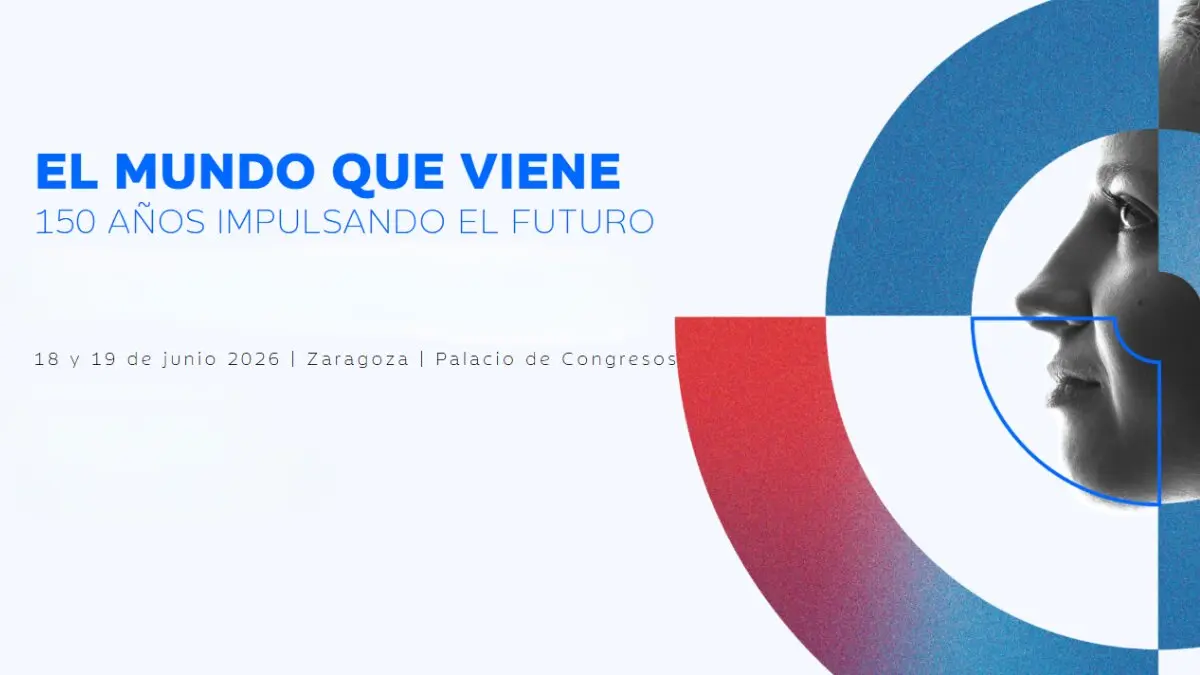
In just a few days, Zaragoza will host one of the most ambitious gatherings organized in Spain this year. On June 18 and 19, the Palacio de Congresos will serve as the venue for The World to Come, the international congress with which Fundación Ibercaja celebrates its 150th anniversary by looking forward, not just back.
For the business leaders reading this — whether from Madrid, Bogotá, Mexico City, Buenos Aires, or Miami — such events are becoming increasingly valuable. In a global environment rife with uncertainty, hearing firsthand from those shaping major trends is almost a strategic necessity.
Fundación Ibercaja has chosen not to limit itself to an internal celebration. Instead, it has opened the debate to society, especially to those decision-makers whose choices affect thousands of individuals and organizations. «Celebrating 150 years is not just about looking back. It’s about pausing, understanding the path traveled, and taking on the responsibility for what comes next,» the organization explains.
A program that combines global vision and practical focus
The congress is divided into two days with complementary focuses. The first day, June 18, is titled Where Are We Going? and focuses on the geopolitical context, values, and major technological and social transformations. The second day, June 19, is titled The Opportunity of the Future and dives deeper into concrete issues such as education, talent, health, well-being, and the design of the environments where we will live.
Among the most notable speakers are three Nobel laureates: Christopher Pissarides (Economics 2010), Mohan Munasinghe (Peace 2007), and Tawakkol Karman (Peace 2011). They will be joined by high-profile figures such as Josep Borrell, Felipe Calderón (former President of Mexico), José Manuel Durão Barroso (former President of the European Commission), Un-Chan Chung (former Prime Minister of South Korea), executives from Google and NASA, world-renowned architects like David Chipperfield (2023 Pritzker Prize winner) and Carlo Ratti (MIT), as well as notable figures in health, culture, and personal development such as María Neira (WHO), Marian Rojas, Pedro Cavadas, Teresa Perales, and Jesús Calleja.
It is not common to gather such a high caliber of voices in a single city over two days. Even less so, with a format that combines keynote addresses with more open dialog sessions.
Aragón as a setting and a message
The fact that this event takes place in Zaragoza is no coincidence. Aragón has been consolidating its status as a strategic territory for years: excellent logistical position, industrial capacity, growth in innovation, and, above all, a quality of life that facilitates attracting and retaining talent. Fundación Ibercaja, deeply rooted in the region, utilizes its anniversary to put Aragón on the map of major global conversations.
For the Hispanic American business community, the added value is twofold. On one hand, the presence of leaders like Felipe Calderón allows for a direct connection with Latin American realities. On the other, issues such as ethical artificial intelligence, energy transition, mental health in high-demand environments, and new urban leadership models are equally relevant in Santiago, Lima, or Monterrey as they are in Zaragoza.
In times of fragmentation, initiatives like this — driven by civil society and the private sector — help build bridges and anticipate scenarios. They do not solve all problems, of course, but they do contribute to providing decision-makers with a better compass.
An event worth marking on your agenda
If your schedule allows, «The World to Come» is one of those opportunities that is worth marking. Registration is free, although space is limited, so I recommend formalizing it as soon as possible through the official congress website.
In the end, beyond the illustrious names, what matters is the ability to leave with clear ideas about where the world is headed and, above all, how to position our businesses and teams within this emerging landscape.
For two days, Zaragoza will become a privileged observatory of the future. Those who understand that the future is not something to wait for but something to be built, already know where to be.