



The renovation work at the Museum of Zaragoza in Plaza de los Sitios has kept it closed to the public for months, but this does not mean that activity has ceased at this cultural institution. Much of its staff continues to work on daily tasks that are unknown to the general public. This is the case with the conservation and restoration work of the artistic jewels housed in the museum. And it is precisely performing these types of functions that we find Sayuri Pompa Fujimura.
Sayuri, first of all, you are a heritage conservator and restorer. Explain to us what the difference is.
Restoration is more widely known; it involves intervening on the work to recover colors, materials, or forms that are in poor condition. But that is the last step. It is better to focus on conservation, which serves to prevent damage. For example, by making a plan to control the environment, temperature, light, or relative humidity of the place where a work is exhibited or stored. This is what we call preventive conservation. But it is not the only form. For instance, dusting a painting from time to time is to conserve it and prevent dirt from accumulating and causing damage.
And in your specific case, you dedicate yourself to conserving and restoring works of Japanese origin. Like you, tell us how a Japanese person ends up in Zaragoza.
In reality, I have spent a large part of my life here. It’s true that I was born in Japan, but my mother already lived here, so we returned soon after. I attended school here, and I spent my entire childhood and adolescence here.
But after those early years, how did you train to develop your current profession?
At that time, I went to study Cultural Heritage Conservation and Restoration at Complutense University of Madrid and obtained a degree. There, I received quite general training in various specialties. After that, I returned to Zaragoza and continued doing things like studying at the school of Eduardo Jiménez, a very well-known bookbinder in Spain. In fact, I was very interested in the topic of paper and documents.

A material very typical of Japanese art; you seemed destined for this, didn’t you?
A bit, because then I decided to go to Japan. To try my luck. Since we have family there, it was quite simple. The truth is that I was interested in studying something about Japanese art that would complement my training. In the end, I ended up in a traditional workshop with an artisan specialized in a discipline called hyogu.
Hyogu? What is that?
It is the craftsmanship of “framing” kakejikus or hanging scrolls, byobu which are painted folding screens, and fusuma which are sliding paper doors in a very peculiar and traditional way. They do not create the painting itself, but rather everything that surrounds it and enhances its value. A folding screen or a hanging scroll is like a collaboration between an artist and a master of hyogu who mounts it onto the structure, so to speak. Additionally, many of these artisans also restore ancient works of this kind. So I ended up there for four years as an apprentice.
Four years! Would you be something more than an apprentice?
In reality, it takes more time to become a master there. But during those four years, I learned the entire process of creating these types of works and also restoring them, which was what interested me most. I decided to return because, in Spain and Europe, there aren’t many people who know how to do that work.
A very artisanal job; do you not think that this artisanal labor is valued much more in the East than in the West?
Yes, sometimes artisanal work here is undervalued. This is evident in my field. Restoration in the West has much more of a scientific aspect, while in the East, the manual, artisanal aspect prevails.
You bring together both worlds. Which one do you lean towards more?
I try to balance a bit of everything, although sometimes it’s difficult. I want to think that I’m somewhat in the middle, but I don’t know. It is clear that in my work, I lean towards the knowledge of tradition. It is the heritage of four years with a master learning ancestral and artisanal techniques.
With all that background, you start working at the Museum of Zaragoza.
Yes, here I work with Nerea Díez de Pinos, conservator and restorer of graphic works at the Museum. Because the Eastern works I intervene with fall into that category since they are generally on paper. Although there are also some on textile materials such as silk.

Now that the museum is closed, all those works you restore are being stored.
And they are also exhibited. For example, this summer, the exhibition Treasures was organized at La Lonja with a good part of the museum’s collection of Asian art. Last year, many Japanese lacquers and prints were also prepared for an exhibition in Oviedo.
Could it be said that the collection of Oriental art at the Museum of Zaragoza is a national reference?
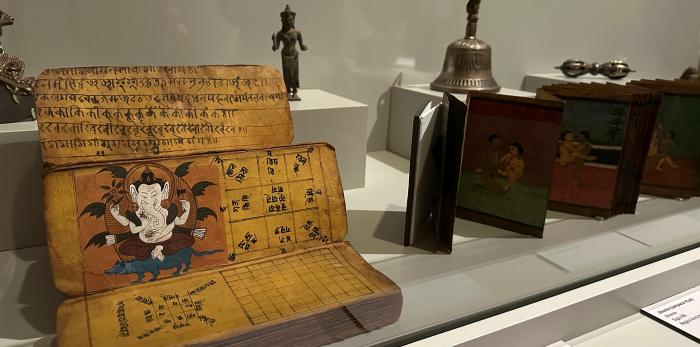
Yes. It is one of the most important in Spain, especially in Japanese art. It is true that there are other prominent museums, for example, in Valladolid. But there, Chinese art predominates. In contrast, here we have many works of Japanese origin and from other places in Asia. There are the funds from the Federico Torralba collection and collaboration with the Torralba-Fortún Foundation, as well as contributions from other collectors like Víctor Pasamar or Miguel Ángel Gutiérrez, and the museum itself is concerned with incorporating new works.
On the other hand, do you not think that the general public knows little about this wealth?
Yes, that is possible. But we hope that when the Museum of Zaragoza reopens, this collection will be very well represented in the new museographic display because it can indeed be something distinctive, as well as a wonderful surprise for the visitor.