


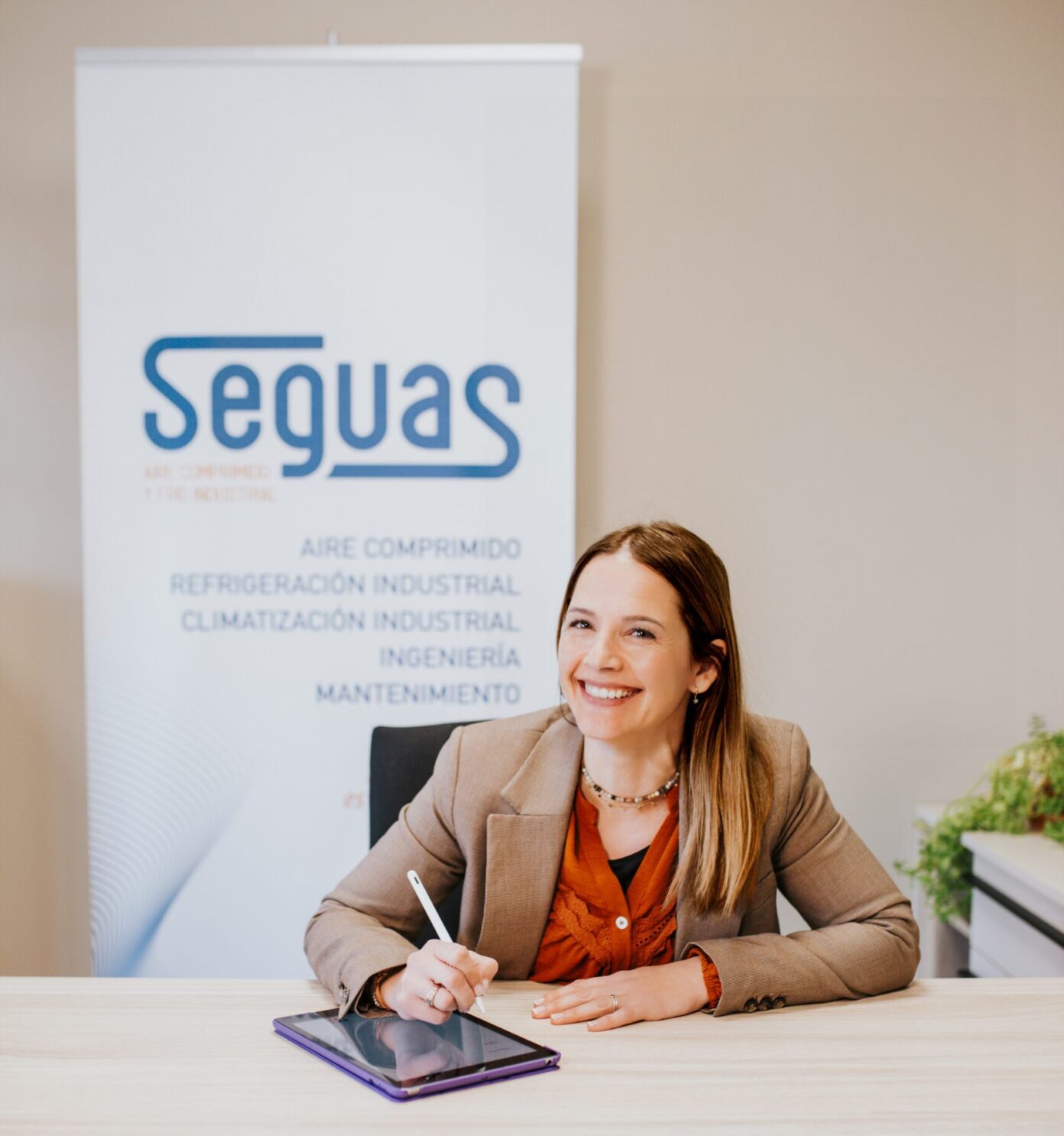
At the helm of SEGUAS, an Aragon-based company specializing in compressed air, refrigeration, and industrial air conditioning, Rocío Tapias represents a new generation of female leadership in the sector. With more than 40 employees, Tapias advocates a management model based on innovation, proximity, and the value of people. Rocío runs a family business founded by her father and other partners in 2003, facing the challenges of a male-dominated sector, the industrial sector, which is unknown but essential. “If there are problems with a compressor,” she explains, “it may be necessary to shut down an entire factory.” Between digital transformation, emotional management, and the constant search for improvement, Tapias champions the presence of women in industry and recounts her experience without filters. “I’ve been in the industrial sector since 2010 and I’ve never met a female refrigeration engineer: I’d love to,” she adds. This Thursday, November 13, she will participate in the Aragón Business Summit, organized by the Aragonese Institute of Development (IAF) and a benchmark in the Aragonese business ecosystem.
 Receiving the ARAME Business Excellence Award
How was SEGUAS born and how has it evolved to date?
The company was founded in 2003, when my father, Juan José Tapias, together with Juan Matías López and Tomás Ruiz, decided to create SEGUAS. They came from the sector, but wanted to offer a more comprehensive service, integrating compressed air, refrigeration, air conditioning, and engineering. They started in La Puebla de Alfindén, where we are still based today. Since then, we have grown, maintaining that spirit of comprehensive service to the industry.
What need did it meet?
In the industry, there are many companies that specialize in a single area: compressed air, refrigeration, or air conditioning. They wanted to bring everything together to offer a complete solution, including the design and engineering of the facilities. It was an important step, because few companies offered that comprehensive service.
What does it mean for you to lead an Aragonese family business in such a technical sector?
I am proud to have been able to continue the project that my father and his partners started. SEGUAS is a medium-sized Aragonese company with more than 40 employees, and we continue to grow without losing that close-knit character. It is a challenge to maintain independence in the face of large corporations, but it is also enormously satisfying.
“We have opened a branch in Catalonia and we want to continue growing, to be leaders in the northeast, to become even more technological, without losing the closeness and care for our staff that characterizes us.”
What has your experience been like as a woman in a traditionally male-dominated environment?
I have been treated very well, I have no complaints. It is true that when I started out, I had to prove that I was not “the daughter of,” but just another professional. I am very demanding of myself, and I think that has helped me to see things as challenges and to look for solutions. I’ve had anecdotes, yes, but I take them as such, as anecdotes. For example, one day someone asked me if I was still visiting clients with my father. I took it that way, and then I explained that I had been in management since 2018. The person completely changed their mind.
Do you think that female perspective can contribute something different?
Yes, definitely. I have three male partners, and I think we make a good team. I bring a more emotional, people-centered vision. That combination is what enriches us. Extremes are never good: diversity of perspectives makes the company stronger.
«I had to prove that I wasn’t a daddy’s girl, but just another professional. I’m very demanding of myself, I’ve learned a lot, and I’ve had to assert myself.»
What sets SEGUAS apart from other companies in the sector?
I don’t like to talk about differences, but I do like to talk about values. We have three important pillars that we’ve been working on recently: innovation, technology… always with the idea of not settling and doing things better, questioning ourselves over and over again. And the third pillar is people. I firmly believe that a company is made up of the people who work there. And you have to take care of your team. If your team is happy, they work hard and everything works better.
What are the biggest challenges in the industrial sector right now?
The first is human resources, qualified personnel. All companies have the same problem. There is a shortage of technicians, refrigeration engineers, maintenance professionals… and that affects us all. Then there is technology, which is advancing faster than we can sometimes keep up with. You have to make it work: adapt to technology and ensure that change management within the organization is consistent with the people you have. Another major challenge is regulations and bureaucracy, which can sometimes slow down innovation.
«I am convinced that people make the company and that you have to take care of the team
At SEGUAS, you have committed to digital transformation. What advances have you implemented?
Yes, in the last two years we have worked intensively on innovation: we have created a data lake, we are automating processes, improving connectivity, automating processes and saving time, and looking for ways to bring more value to customers through technology. We even have someone dedicated to R&D, looking ahead and exploring what’s coming. And it has given us a lot of momentum.
Do you think Aragonese society perceives the value of your sector?
I think it’s unknown. When I tell people what I do for a living, they don’t understand. It’s something I’m working on: how to raise awareness, even among children, because if you learn about this sector at a young age, you can focus on it as an adult. Only if you work in a factory can you understand the impact of whether or not these types of systems work. A failure in one of our facilities or processes can mean that an entire factory has to shut down. This sector is not well known, but its impact is huge. During COVID, we were an essential company. We have 24-hour service precisely for that reason.
«Climate change affects us a lot. The climate is changing, but industrial processes need to maintain the same temperature and humidity conditions. This forces us to adapt equipment, rethink facilities… and increases the need for professionals.»
You mentioned climate change as a relevant factor… How does climate change affect your sector?
A lot. The climate is changing, but industrial processes need to maintain the same conditions (temperature, humidity, etc.). This forces us to adapt equipment and rethink facilities. Refrigeration in Norway is not the same as in Zaragoza. And all this increases the need for specialized professionals. It is a sector with a bright future. We need a lot of refrigeration engineers in particular. And here’s a message: I would love to meet a female refrigeration engineer one day. I have been in the sector since 2010 and have never met a female refrigeration engineer. Never.
What advice would you give to young people who want to work in this sector or start their own business?
Get started. Ask yourselves where you see yourselves in five years and seek support: today there are networks, associations, and mentors that did not exist before. If you want to enter this world, the ideal thing is to study a technical degree or industrial vocational training and approach companies like ours. It is a sector that needs talent and offers many opportunities.
“It’s a little-known but essential sector. All industries need compressed air, and almost 80% need industrial refrigeration. Only if you work in a factory can you understand the impact that these types of systems have when they work or don’t work.”
You’ve also worked hard on your personal development as a leader.
Yes, in 2019 I took a coaching and leadership course at CEPYME that helped me a lot. Developing personal self-awareness and emotional management skills is very important for oneself, but even more so when managing 40 people. People with lives and problems.
How do you imagine SEGUAS in ten years’ time?
I imagine it will be similar to how it is now, but more technological and consolidated. We have opened a branch in Catalonia and we want to continue growing. I imagine us in slightly larger facilities, being leaders, especially in the northeast. And very technological, even more technological. We have many ideas, but we don’t have time to implement them all. Often, our minds work faster than we are able to execute. Furthermore, for me it is essential that, even as we grow, we continue to be a company where people want to come to work, without losing the human touch that characterizes us.