



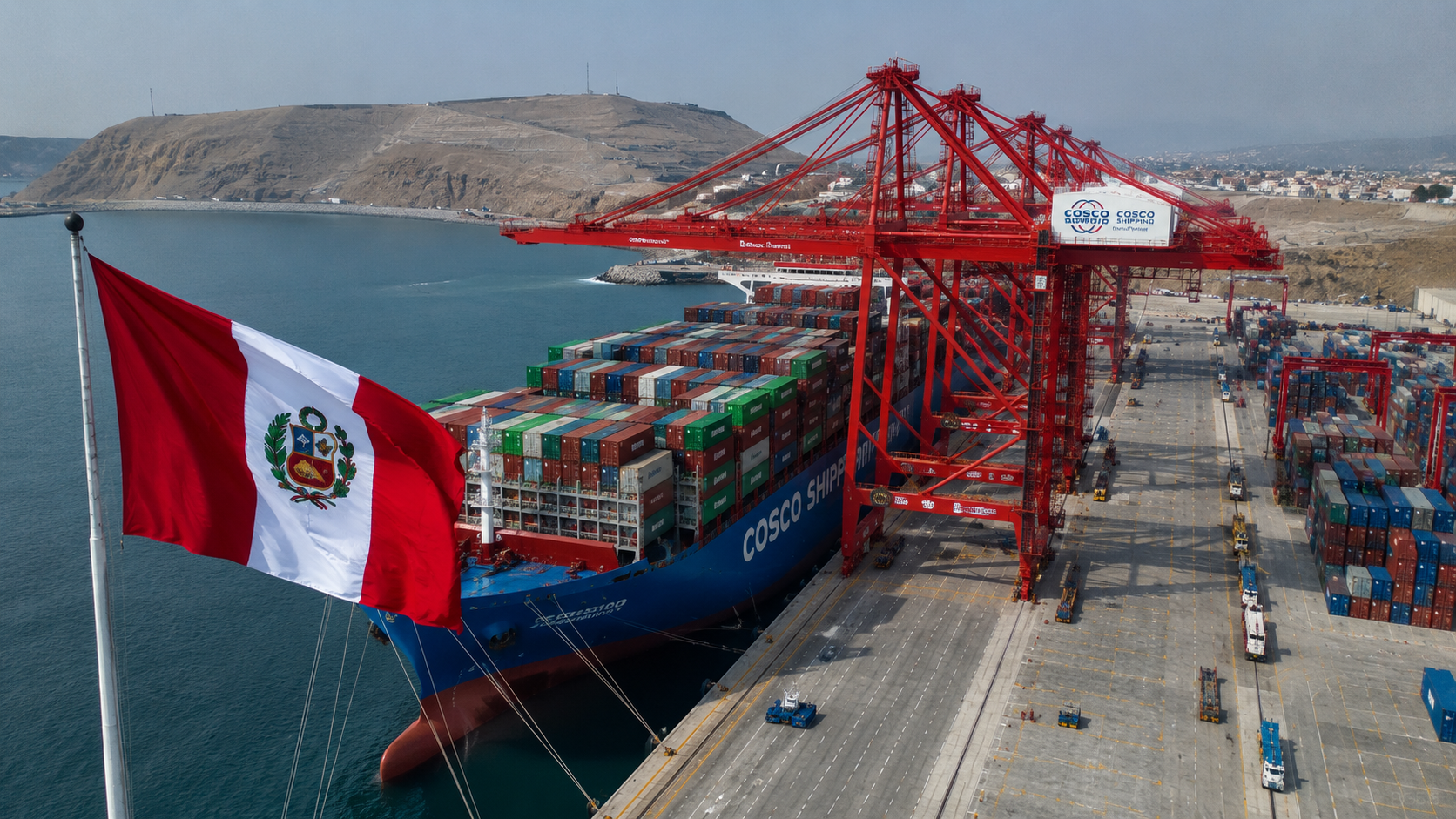
In the Pacific coast of Peru, an infrastructure is being consolidated that is set to modify part of the trade routes between South America and Asia. The Port of Chancay began its operations in late 2024 with a defined goal: to establish a direct maritime connection with China and progressively become a distribution center for goods for other countries in the region.
The project is located in Chancay, in the province of Huaral, approximately 80 kilometers north of Lima. It is a private investment whose operating company is predominantly owned by the Chinese company COSCO Shipping Ports. The company holds 60%, while the remaining 40% is in Peruvian hands through a stake originally linked to Volcan. COSCO Shipping Ports is part of the state-owned group China COSCO Shipping, one of the major global operators of marine transportation and port terminals.
This corporate structure makes Chancay a unique infrastructure within the Latin American logistics map: a major South American port developed and operated by a company belonging to one of the main state-owned Chinese transportation groups.
A more than 3 billion dollar investment
The complete development of Chancay involves an investment of over 3.4 billion dollars, according to figures released during construction by Peruvian authorities. The first phase represented around 1.3 billion.
The port was officially inaugurated in November 2024, coinciding with the celebration in Peru of the Asia-Pacific Economic Cooperation (APEC) summit. The presidents of China, Xi Jinping, and Peru, Dina Boluarte, participated virtually in the inauguration.
Its design meets the requirements of large-scale international maritime transportation. Chancay has deep waters and is prepared to receive large container ships, a fundamental factor for establishing transoceanic routes without relying on intermediate stops.
The port started with a direct connection between Chancay and Shanghai, to which other Asian destinations could subsequently be added based on demand.
From 35 days to about 23 between Peru and China
One of the main advantages of the new infrastructure lies in transportation times.
Prior to the operation of Chancay, a portion of goods between Peru and Asia required transshipments at other ports. The direct connection allows for completing the maritime journey to China in approximately 23 days, compared to about 35 days on some of the previous routes.
This reduction is particularly relevant for Peruvian exports and for Asian companies sending products to South America. Logistics costs and transportation time are decisive factors for agricultural, industrial, mineral, or manufactured products.
However, the scope of Chancay is not limited to bilateral trade between Peru and China.
A port designed to receive goods from other countries
The project was conceived as a regional hub. This means that part of its activity can come from goods originating outside of Peru.
Since its launch, connections have been proposed using smaller vessels from Chile, Ecuador, and Colombia. These goods can be consolidated in Chancay to then be shipped on large container ships to Asia.
Thus, the infrastructure allows for the development of…