



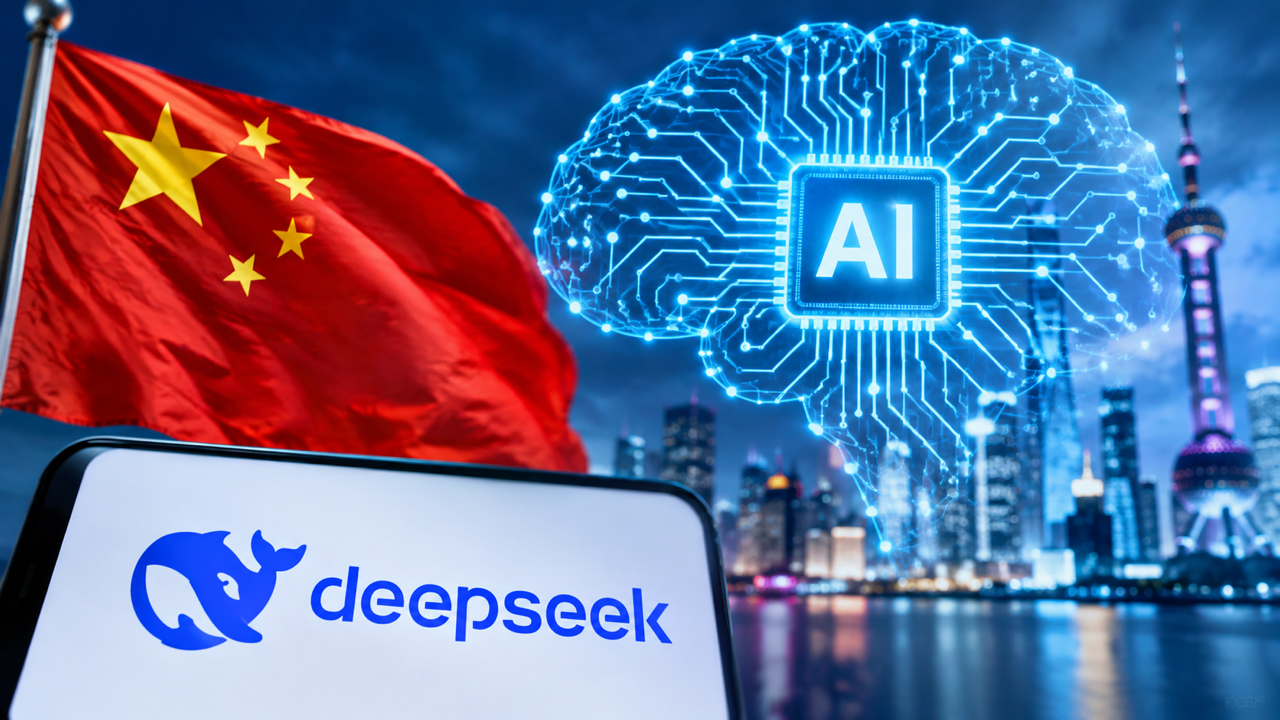
The company founded by Liang Wenfeng in 2023 surprised the global tech sector when it demonstrated that it was possible to develop advanced artificial intelligence models using fewer resources than some of its American competitors. Following this breakthrough, DeepSeek is entering a new phase characterized by a quest for funding, an increase in its computing capacity, and the development of commercial applications.
Until early 2025, DeepSeek was virtually unknown outside Chinese tech circles. Its name suddenly emerged on the international stage when it presented an artificial intelligence model capable of competing in certain reasoning tasks with some of the most advanced systems developed in the United States. The attention was not only on its capabilities but also on the resources used to achieve them.
The Chinese company claimed to have developed its models with infrastructure and costs significantly lower than those employed by some of its main competitors. Its emergence immediately sparked a debate within the industry about how much capital and computing capacity were truly necessary to develop advanced artificial intelligence and the technological gap that exists between China and the United States.
In a matter of weeks, DeepSeek went from being a little-known lab to becoming one of the most watched companies in the Chinese tech ecosystem.
From an investment fund to an artificial intelligence lab
Behind DeepSeek is Liang Wenfeng, a computer engineer educated at Zhejiang University and specialized in algorithms. Before founding the company, he built his career at High-Flyer, a quantitative investment fund that used mathematical models and computer systems to analyze large amounts of financial information and identify opportunities in the markets.
This experience provided Liang with expertise in advanced computing and massive data processing. In 2021, he started acquiring thousands of Nvidia graphics processors with the intention of building his own infrastructure to develop artificial intelligence. Two years later, in 2023, he founded DeepSeek.
The company initially adopted a different approach from many tech firms. Instead of concentrating from the start on developing commercial products or attracting business clients, it prioritized research and the creation of advanced models. This strategy ultimately positioned it at the center of the international conversation about artificial intelligence.
The DeepSeek moment
The big leap came in January 2025. The models presented by the company exhibited advanced reasoning capabilities with training requirements that DeepSeek claimed were lower than those used by some of the major U.S. laboratories.
The market reaction demonstrated just how much the announcement had altered existing expectations around artificial intelligence. Nvidia’s shares suffered a historic drop, and the company lost nearly $600 billion in market capitalization in a single session.
The question emerging in the market was straightforward: if companies capable of developing competitive models could do so using less computing capacity, perhaps the enormous investments planned for processors and data centers needed to be reassessed from a different perspective.
This did not mean that DeepSeek had surpassed the leading U.S. laboratories. The most advanced models from companies such as OpenAI and Anthropic continued to maintain advantages in various capabilities. What was significant was that a relatively young Chinese company had managed to narrow the gap and do so under particularly complex technological conditions.
The chip problem
The evolution of DeepSeek is closely tied to one of the major technological fronts between China and the United States: semiconductors.
Washington has been applying restrictions on the export of certain advanced processors and technologies used to develop artificial intelligence to China for years. These measures particularly impact access to Nvidia’s high-performance GPUs, which are crucial for training and running large models.
Chinese companies have thus been forced to seek alternatives. One approach is to use the available computing capacity more efficiently. Another involves developing domestic processors capable of progressively replacing U.S. products.
This is where Huawei comes into play, as it ramps up its efforts on processors intended for artificial intelligence. For companies like DeepSeek, having a domestic supply of chips is becoming increasingly important if they wish to continue expanding the size and capabilities of their models.
This situation also helps to explain why the development of Chinese artificial intelligence cannot be viewed in isolation. It relies on the evolution of an entire technological chain that includes chip design, semiconductor manufacturing, memory, data centers, energy, software, and artificial intelligence models.
From research to business
After concentrating much of its initial efforts on technological development, DeepSeek is now entering a second phase. The company aims to transform its models into applications capable of generating revenue and expanding its activities beyond research.
According to information published by Expansión, among the areas it is working on are specific artificial intelligence solutions for sectors such as healthcare and legal services, in addition to developing agents capable of automating business processes. This latter area has become one of the main development lines in the entire industry, as it would allow a shift from systems that simply answer questions to tools capable of executing tasks and coordinating different processes.
The transformation also requires increasing the workforce and competing for specialists in artificial intelligence. DeepSeek must retain talent in a Chinese market where major groups such as ByteDance, Tencent, Alibaba, and Xiaomi are developing their own strategies related to this technology.
Additionally, it needs more infrastructure. Training new models and subsequently serving millions of users requires enormous amounts of computing capacity, data centers, and electricity. The technological efficiency that allowed DeepSeek to capture international attention does not, therefore, eliminate the need for increasing investments as its scale grows.
A new financial stage
To fund this growth, DeepSeek has begun to open itself to external capital. According to information published by Expansión, the company closed its first funding round this summer at $7.4 billion, a deal that would have placed its valuation above $50 billion.
Among the cited investors are Chinese business groups such as Tencent, JD.com, CATL, and NetEase, as well as a state fund dedicated to artificial intelligence. Liang Wenfeng himself reportedly contributed approximately $3 billion and would retain control of the company.
DeepSeek is also negotiating a second round of funding for around $8 billion, with a valuation close to $74 billion. These figures, according to information published by Expansión, reflect the financial scale the company is beginning to reach, although they remain lower than the large deals undertaken by some American artificial intelligence laboratories.
A piece of the Chinese tech ecosystem
The significance of DeepSeek is better understood when viewed alongside other companies that China is developing.