



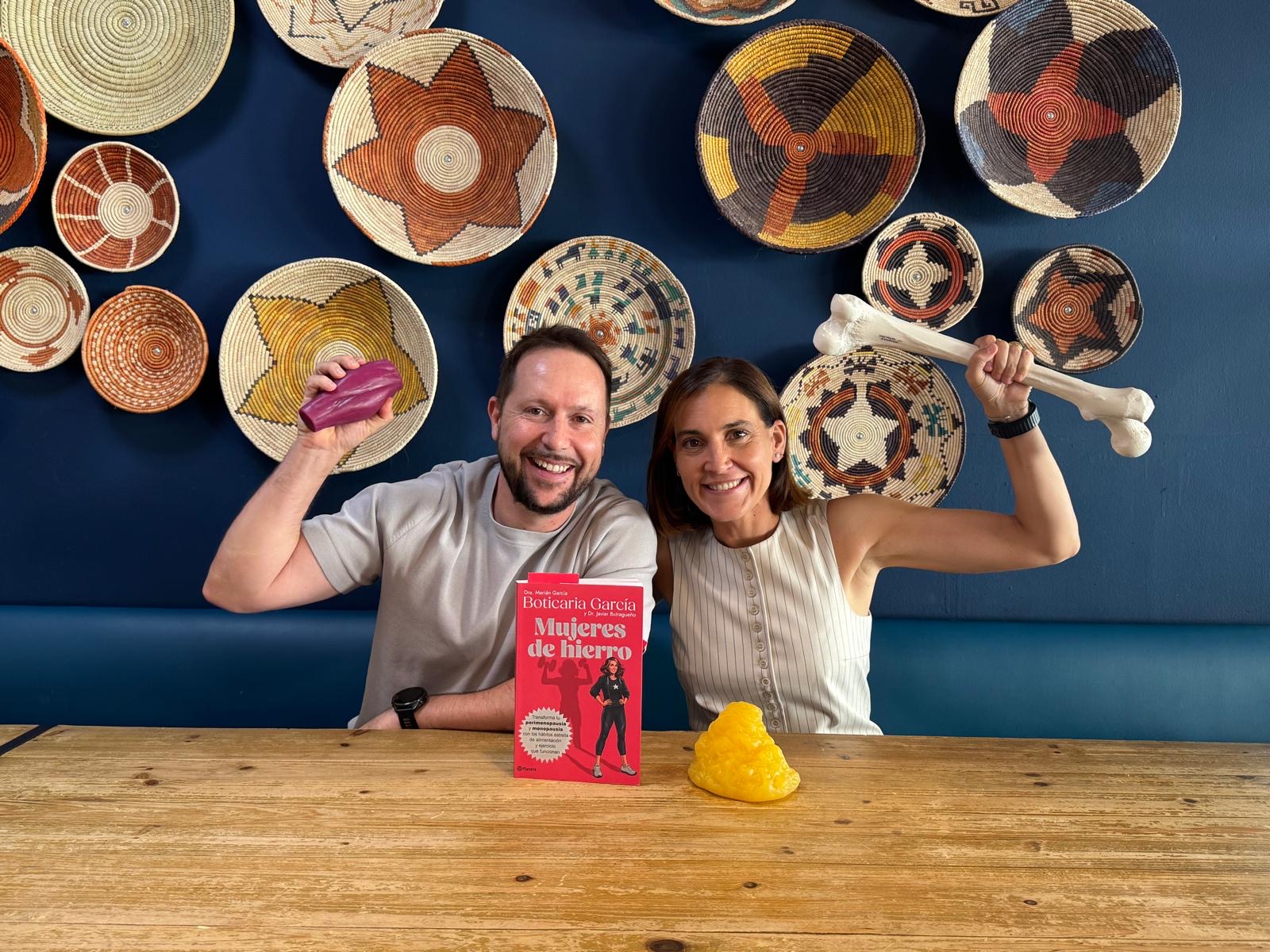
Talking about menopause isn’t just about “hot flashes”—or at least not only that. In Mujeres de hierro, Dr. Marián García (known as Boticaria García on Instagram) and Dr. Javier Butragueño set out to broaden the focus and, above all, translate science into everyday life. They do so with humor, graphics, and exercises dubbed “Mazinger Z” or “the dog’s pee.” The central theme running through the entire book is the importance of understanding what happens in the female body as the first step toward taking control and acting on it.
One of the most striking aspects of Mujeres de hierro is its accessibility—and accessibility in every sense: the language, which is approachable and free from academic jargon; the format; and even the solutions you propose and the method you’ve dubbed “Tris Tras.” Was there a conscious effort from the start to ensure the book would not only be understood but also put into practice?
Boticaria García. Yes. We wanted both the content and the format to be tailored to what a woman needs in 2026. We all have very little time, so in addition to providing information, we wanted to include fact sheets, charts, and summaries that would allow readers to quickly grasp the main ideas.
One of the first decisions was to organize it like an alphabetical guide. When you start a book and come across a fifty-page chapter, you might think it’s overwhelming. Here, you can go straight to what concerns you. If it’s nutritional supplements, go to C; if it’s libido, go to L. Obviously, we recommend reading the whole thing, but the philosophy is the same one we apply to exercise—maybe the ideal would be to work out for half an hour, but if you can only manage fifteen or twenty minutes today, do those. There’ll be time for more later.
And we’re seeing that this structure works. One of the things readers tell us most often is that the book is easy to read and a quick reference. But perhaps the best part is that women are recommending it to one another. When something clicks for you and helps you understand what’s going on inside your body, you want to share it.
In fact, there’s one idea that runs throughout the book and that I think is fundamental: “Motivation doesn’t come from a catchy Instagram quote, but from information.” You state that understanding what’s happening in your body is the first step toward taking control.
Boticaria García. Absolutely. Social media is great for sparking curiosity, but you can’t explain what’s happening in a woman’s body in fifteen seconds or a minute. And understanding it changes a lot of things. There are women who feel irritable, depressed, or run-down and who have gone to the doctor thinking they have a purely psychological problem. Sometimes there may also be a hormonal component that needs to be evaluated. The point isn’t to replace the psychologist with the gynecologist, but to broaden our perspective and understand what’s happening.
This information also helps debunk the idea that it’s all simply a matter of getting older. When you know what’s going on, you can make decisions and start taking care of yourself sooner. That’s why the book isn’t intended solely for women who are already going through menopause; we also want to reach those in their thirties or forties.
That’s one of the biggest challenges. How do you convince a woman in her 30s or 35s—who feels perfectly fine—that she needs to start thinking about something we’ve historically associated with a much later stage of life?
Javier Butragueño. It’s hard to talk about prevention when someone is feeling well. But the strategies we propose—that is, strength training, nutrition, rest—provide benefits no matter what your age. The important thing is that the information is available. Even if a woman doesn’t start taking preventive measures in her 30s, when a symptom appears, she’ll know that tools exist and where to look for them.
Boticaria García. And there’s another very powerful approach: setting an example. I have a fourteen-year-old daughter, and I know that simply telling her what to do probably won’t do much good. But growing up in an environment where she sees certain habits in practice does have an effect. We’re seeing women who work out with their daughters, their mothers, or their partners. There are mothers in their seventies or eighties who have taken up exercise because they work out with someone else. That kind of influence is probably one of the best ways to ensure that habits stick.
You talk a lot about strength training, but it can still be intimidating for a woman who’s never done strength training before. What would be the absolute minimum for someone starting completely from scratch?
Javier Butragueño. Two days a week, for fifteen or twenty minutes, can already produce improvements in someone who doesn’t usually work out. And you can start at home, in just one square meter, with very simple exercises. We’ve outlined different levels precisely because women start from very different situations. Some have pelvic floor issues, urinary incontinence, or are simply afraid to train. They start with basic exercises, learn the technique, and gradually progress. When they later go to a gym, they already recognize many of the movements and no longer feel out of place. Muscles need stimulation. With age and declining estrogen levels, changes occur, and strength training is an essential tool for preserving muscle mass and bone health.
Boticaria García. And if you’re not even ready for those fifteen minutes, start by climbing stairs. If you can, take them two at a time. If you can speed up for a stretch, do it. Accessibility also means understanding that there’s always a step before the next one. That’s why we’ve renamed many exercises. Instead of using terms that many people don’t know, we talk about Mazinger Z or the dog’s pee. It might seem silly, but if you remember the name and understand the movement, it’s much easier to incorporate it into your routine.
Javier Butragueño. And for me, there’s an even more important point: that there are people who’ve been training for two years. That’s the real success. The problem with exercise isn’t usually getting started, but sticking with it. Many women keep going because they start to notice benefits that have nothing to do with appearance. They have less pain, feel better, and have more energy. When muscles work, they release molecules that affect different systems in the body.
Boticaria García. That’s why we often say—a bit provocatively—that maybe we need fewer Sudoku puzzles and more squats. Exercising with others also helps a lot. We like to say that “superkinas” (molecules released during exercise) count double when you’re with others. Physiologically, they don’t count double, of course, but you’re much more likely to stick with an activity if you’ve made plans with a friend, if you work out with your partner, or if you’re part of a community.

We’ve seen you in some unexpected places practicing…
Boticaria García. Yes, unexpected places (laughs).
Javier Butragueño. It was super important to have someone you can relate to—in other words, there has to be someone who isn’t the typical super-fit trainer who does the exercises perfectly. Because the reality is that the people we’re targeting are those who’ve never worked out before. The videos are really interesting because I correct people based on the perspective of someone who’s just starting out.
Boticaria García. That’s been the key—people see that when I’m doing a plank and my butt sags, Javi says, “Marián, lift your butt.”
Javier Butragueño. So people often tell us, “It feels like you’re correcting me.”
There’s a deeply ingrained myth when we talk about menopause, and that’s the famous “hot flashes.” What are we leaving out when we reduce menopause to hot flashes?
Javier Butragueño. A great many things. Hot flashes can be very intense and significantly disrupt the lives of those who suffer from them, but according to the data we’re collecting, they aren’t the most prevalent symptom. Fatigue, lack of energy, anxiety, memory problems, and certain types of pain stand out as particularly common. There are also issues that are discussed even less, such as genitourinary syndrome or a loss of sexual desire associated with menopause. Since it’s a taboo subject, it seems people can’t talk about it and end up hiding it, but it’s a symptom of extreme severity for many women. Some women go to the doctor because their shoulders, backs, or legs hurt, and the test results appear to be normal. There are mechanisms related to hormonal changes, inflammation, and pain perception that we need to understand much better.
Boticaria García. We still face a huge taboo surrounding everything related to the vagina, the pelvic floor, urinary incontinence, pain during intercourse, or decreased sexual desire. These are common problems that can greatly affect quality of life, but it’s hard to talk about them.
That is precisely why we wanted to dedicate space to these topics in the book. If something affects many women and also impacts their lives, it cannot remain hidden simply because we are too embarrassed to mention it. Perhaps we need to talk a little less about hot flashes and more about other symptoms—without underestimating the severity of hot flashes and how they affect people’s lives—but there’s one important thing to know: hot flashes have a very effective treatment, which is menopausal hormone therapy; we’ve dedicated the letter “T” to it in the book.
In fact, something is growing around Mujeres de hierro that goes far beyond the book itself—a community, the “Cuerpos serranos” chair at the University of Granada, and you’re leading one of the largest studies on women’s health; you’ve spearheaded a research project in which 143,000 women have already participated. What are you discovering?
Javier Butragueño. We’ve always been committed to research—we’re both Ph.D.s—and we believe it’s essential that all this be published and then shared. What happened was that the women themselves began sharing the study, and we ended up reaching 143,000 participants. That also says something—there are so many women saying, “I want to be studied; I want to share what’s happening to me.” Women want research to be done on them.
Perhaps one of the preliminary conclusions that’s catching our attention the most is that many symptoms intensify during perimenopause—before what we traditionally identify as menopause. Anxiety, brain fog, skin changes, memory problems, fatigue, or decreased libido can appear with great intensity between the ages of forty and forty-five. And yet, the healthcare system often doesn’t focus on these issues until later—when twelve months have passed without a period or very visible symptoms like hot flashes appear. If you’ve been feeling unwell for five years before anyone starts looking into what’s going on with you, we’re already too late.
Boticaria García. That’s one of the major paradigm shifts. We have to stop thinking that everything starts at fifty. And we also need resources for research. We can mobilize a huge community, but then that data has to be analyzed, published, and turned into knowledge. That’s why we’ve also promoted collaboration with the university and established a chair. Women’s determination is there; now we need research to support it.
Throughout this journey you’ve been on—researching, training, writing together—is there any aspect where you disagree? Do you ever clash?
Boticaria García. Us? Our names (laughter)
Javier Butragueño. The reality is that I come from the academic world, so putting that into practice has sometimes been challenging for me. I’d show a graph, and Marián would look at me and say, “How can I explain this to you? No one’s going to understand this.” And she’s right. And then there’s being flexible—they teach you specific names, and Marián has changed them all. I’m used to certain terms, and suddenly she decides one is called “the dog’s pee,” and I’m like, “I don’t know what exercise this is.”
Boticaria García. That one in particular, yes, because it’s so easy… And “Mazinger Z” is perfectly understandable.
Javier Butragueño. “Mazinger Z,” yes (laughs).
Boticaria García. It’s true that whenever we’ve had a disagreement, I’ve always really empathized with Javi—he looks at me the same way I look at my bosses at TV, radio, or the newspaper when I tell them I want to talk about a topic and they tell me I have to go on air in a costume. I’ve also wanted to include charts that they wouldn’t let me use. I have to take on that role of “let’s tone it down”—there are always many levels and layers to communication. Let’s just say we’re always looking for that balance, and then I often tell him, “I told you so,” and he also tells me, “I told you so—see how they understood it in the end?”
You also dedicate some space—the letter “O,” specifically—to new weight-loss drugs, which are surrounded by a lot of hype. Are we facing a paradigm shift?
Boticaria García. I’ve been a pharmacist for twenty years, and I haven’t seen any drug with the ability to change people’s lives in as many ways as these drugs do—so yes, we are facing a paradigm shift. And the big problem is that there isn’t good communication about these drugs, mainly overshadowed by the stigma surrounding obesity. There’s a lot of misuse of the drug, but that doesn’t mean the drug isn’t a wonderful breakthrough. Our job is to explain how to use it.
Javier Butragueño. We must take advantage of the window of opportunity that this treatment opens. In people with obesity, there may be alterations in the mechanisms of hunger and satiety; if we can reduce that constant noise surrounding food, we can work more effectively on other habits. But if someone loses weight quickly without exercising and also loses muscle mass, we’re creating another long-term problem. The message remains the same: there’s no single solution—we must combine strategies.
Boticaria García. The drug is very good, but it carries risks if it’s promoted and communicated in the wrong way. We need to remove the stigma that it’s a drug “for lazy people.” I like to compare it to anti-anxiety medications; they’re a wonderful tool. I was in an accident and was a total mess; when I got to the hospital, they gave me Lexatin, and I was able to speak and explain what had happened to me. At that moment, it was fantastic—I was able to sleep that night—but if I take Lexatin every day just because I sleep better without having any healthy habits, that’s a problem.
We’re seeing people who can’t control their feeling of fullness; those people are going to have to take it for the rest of their lives because their bodies aren’t capable of regulating it. You’d see a lot of people who couldn’t stop eating, and people would say to them, “What a glutton.” The issue is that they don’t have enough hormones to control their sense of fullness. All our lives we’ve been told that if someone is overweight, it’s because they want to be and lack willpower. The thing is, appearance changes everything. Cholesterol, blood pressure, and thyroid issues aren’t linked to appearance, and there’s no stigma attached to the medication, but people with obesity are practically expected to torture themselves.
To wrap up, if you had to make sure a woman took away just one idea after reading Mujeres de hierro, what would it be?
Boticaria García. There’s a phrase we use a lot: a woman going through menopause or perimenopause isn’t in decline—she’s under construction. And a woman under construction is extremely dangerous. When you understand what’s happening to you, you regain energy, gain strength, and discover that you have tools—you’re capable of making decisions that you might not have made three months earlier.
So that would be the message: you’re not alone; you’re not in decline. You’re under construction, and there are tools that can help you.
———–
Perhaps that’s the idea that best sums up Mujeres de hierro. Faced with a stage of life that for decades has been marked by silence, resignation, or the notion that “it’s just part of getting older,” Marían and Javi propose something seemingly simple: understanding what’s happening so you can decide what to do about it. Because understanding what’s happening doesn’t solve everything, but it does radically change the starting point from which we can begin to turn the situation around.