



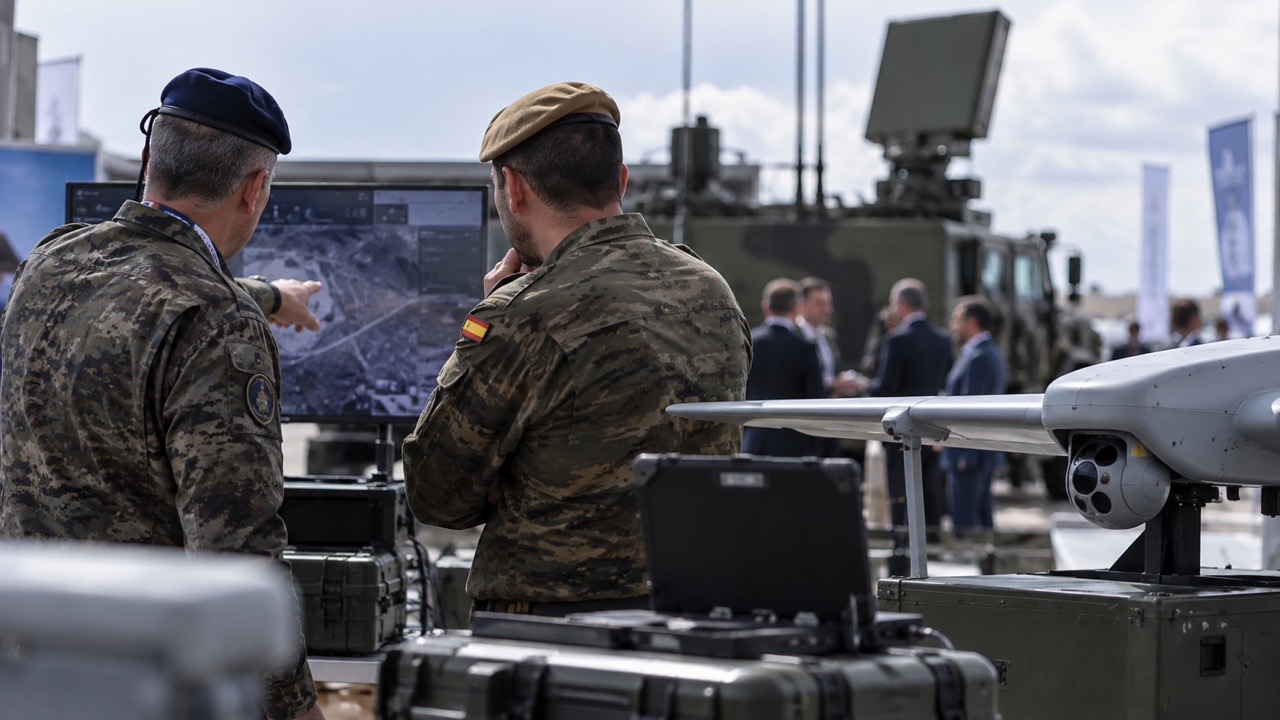
The pace at which technologies such as drones are evolving is creating a challenge for the defense industry: reducing the time between the emergence of an innovation and its conversion into a capability used by the Armed Forces. Representatives of several Spanish companies have called on the Ministry of Defense to streamline development, certification and procurement processes, while maintaining safety requirements.
The issue was the focus of part of the panel discussion Dual Technologies: From Military Strategy to Civilian Progress, held during UNVEX26. The event brought together representatives from UAV Navigation, Airbus Helicopters, EM&E Group and Arquimea, and was moderated by Vicente Torres Vázquez, deputy director general for Defense Industrial Strategy.
The discussion began with the concept of dual-use technology: developments that can have both civilian and military applications. The boundary between the two fields does not necessarily depend on entirely different technologies, but also on the requirements each system must meet according to its intended use.
Miguel Ángel de Frutos, managing director of UAV Navigation, explained that the technological foundations of civilian and military systems may be similar, but requirements increase when equipment is intended for use in a military mission. Jechu S. Loureiro, Arquimea’s managing director for Defense, likewise emphasized that a technology’s application largely determines whether it is civilian or military in nature.
Drones do not necessarily replace manned aircraft
The coexistence of manned and unmanned systems was another issue addressed. Belén García Molano, engineering director at Airbus Helicopters, argued that drones are meant to complement helicopter capabilities, rather than simply replace them.
Unmanned systems can take on certain routine missions or those involving a high level of risk to people, while manned platforms retain their role in operations requiring direct human intervention.
This integration is becoming increasingly important in the military sphere. Francisco Braco, chief of staff of the Air and Space Force, also said this week at UNVEX that the Armed Forces are working on an architecture that would combine surveillance, airspace control and counter-drone capabilities.
Braco also called on Spanish industry to move faster in innovation and in production and delivery timelines, at a time when unmanned systems are evolving particularly rapidly.
SMEs’ access to defense programs
Speed, however, is not the only challenge. The technical and certification requirements needed to take part in certain military programs can become a barrier for small and medium-sized enterprises with technologies that could potentially be applied to defense.
Rafael de Solís, CTO and director of EM&E Group’s Robotics Division, argued during the panel that large companies must act as drivers and support SMEs in turning their technological developments into capabilities that can be used by the Armed Forces.
The approach is particularly relevant given the scale and complexity of major defense programs. Participating in them requires industrial, financial and technical resources that are not always within the reach of smaller companies, even when they have innovative developments.
Collaboration between large companies and SMEs thus emerges as one way to expand the technological base involved in these programs and help innovations from smaller businesses navigate the processes required to reach military applications.
Greater speed, while maintaining certification
The call to accelerate procedures came with a warning during the discussion: shortening timelines must not mean lowering safeguards.
Loureiro argued that certification must remain a fundamental element even as innovation and production processes accelerate. Requirements are especially relevant for aeronautical systems and technologies intended to operate in conditions where a failure could have critical consequences.
The discussion reflects one of the challenges currently facing the Ministry of Defense and the defense industry. Technological advances require shorter development cycles and faster integration of new capabilities, while military systems continue to require assessment and certification processes suited to the conditions in which they will be used.
The industry is now calling for the increase in defense funding to be used to shorten some of those timelines. The challenge will be determining how far procedures can be simplified without compromising the technical and safety controls required for systems intended for the Armed Forces.