



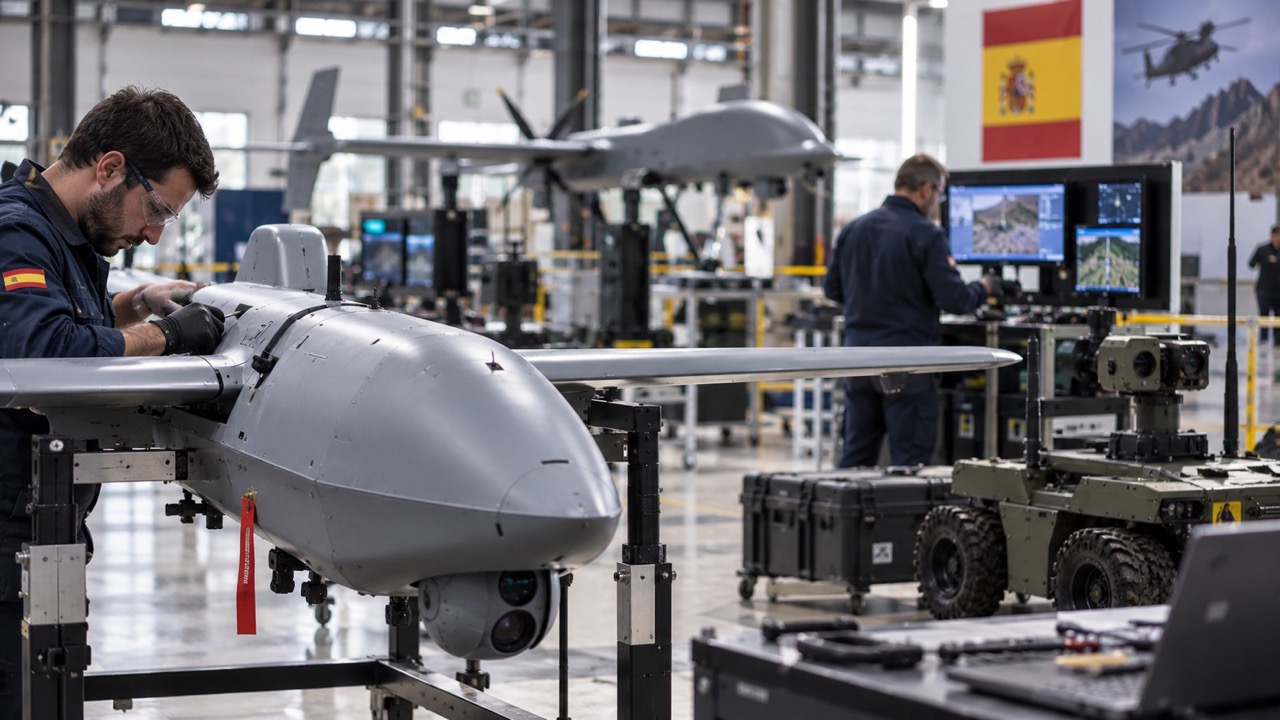
The Ministry of Defense is allocating €4.6 billion to programs involving autonomous systems as drones take on a growing role in military operations. The investment comes with a demand for industry: reduce the time needed to turn new technological developments into capabilities available to the Armed Forces.
Secretary of State for Defense Amparo Valcarce outlined these priorities at the opening of UNVEX 2026, the specialist unmanned-systems event being held in San Javier, Murcia. Her remarks focused not only on developing new technologies, but also on accelerating their validation, production, and integration into operational use.
“The challenge is execution. We need to shorten the distance between design, concept, and an available capability,” Valcarce said in her address, adding that validation and experimentation must also be included in that process.
To that end, the secretary of state called for greater collaboration among large companies, small and medium-sized enterprises, and startups. The Defense Ministry’s goal is to shorten innovation cycles and ensure that developments can evolve rapidly, integrate with other systems, and be manufactured in the required quantities.
From prototype to available capability
Speed has become a particularly important issue in the drone sector. The experience of recent conflicts has accelerated the evolution of unmanned systems, as well as technologies designed to detect and neutralize them.
For the Defense Ministry, developing a prototype or a technology demonstration does not in itself constitute a military capability. New systems must reach a sufficient level of maturity, pass the relevant validation processes, and be available when the Armed Forces need them.
Sustainment is another consideration. Valcarce called on companies to take into account, from the earliest stages, how equipment will evolve throughout its operational life, so that it can be upgraded as technologies and the Armed Forces’ requirements change.
The approach aligns with the demands voiced at UNVEX by Air and Space Force Chief of Staff Air Force General Francisco Braco. In his address, Braco urged industry to shorten production and delivery times and maintain a balance between system costs and effectiveness.
€4.6 billion for autonomous systems
Valcarce put investment in autonomous-systems programs at €4.6 billion, an area the Defense Ministry already considers one of its priorities.
The programs mentioned during her remarks included Predator, SIRTAP, SANTAM —linked to Tarsis— and Spain’s participation in Eurodrone. They are complemented by various counter-unmanned aerial system capabilities designed to protect units and infrastructure.
The growth of these technologies has two dimensions. On one hand, the Armed Forces are seeking to incorporate drones for surveillance, reconnaissance, and other missions. On the other, the proliferation of these aircraft requires the development of systems capable of detecting, identifying, and neutralizing them.
The Defense Ministry believes drones have moved beyond a limited role within military capabilities to become a common feature of today’s conflicts. This evolution also raises new challenges in electronic warfare and in scenarios where communications or satellite navigation systems may be disrupted.
The cost of downing a drone
The economic factor also plays an important role in developing new systems. The use of relatively inexpensive drones requires assessing how much it costs to neutralize them and whether defensive solutions can be manufactured and deployed at sufficient scale.
In this regard, Valcarce called for scalable and cost-effective counter-drone systems. The issue is particularly relevant when a low-cost threat requires the use of an interceptor or munition that is considerably more expensive.
The need to balance performance and cost is driving new developments across the industry. UNVEX is showcasing a range of interceptors, electronic-warfare systems, sensors, and command-and-control solutions designed to address a threat that can take very different forms.
Defense against drones is no longer conceived solely through stand-alone equipment. Representatives of the Armed Forces and security forces at UNVEX have advocated integrating sensors, artificial intelligence, command systems, and different neutralization measures within common architectures.
The Defense Ministry’s message to industry therefore combines investment with demands. Resources allocated to autonomous systems are increasing, but the ministry wants that investment to translate more rapidly into available equipment that can be manufactured at scale, evolve technologically, and be sustained throughout its operational life.