



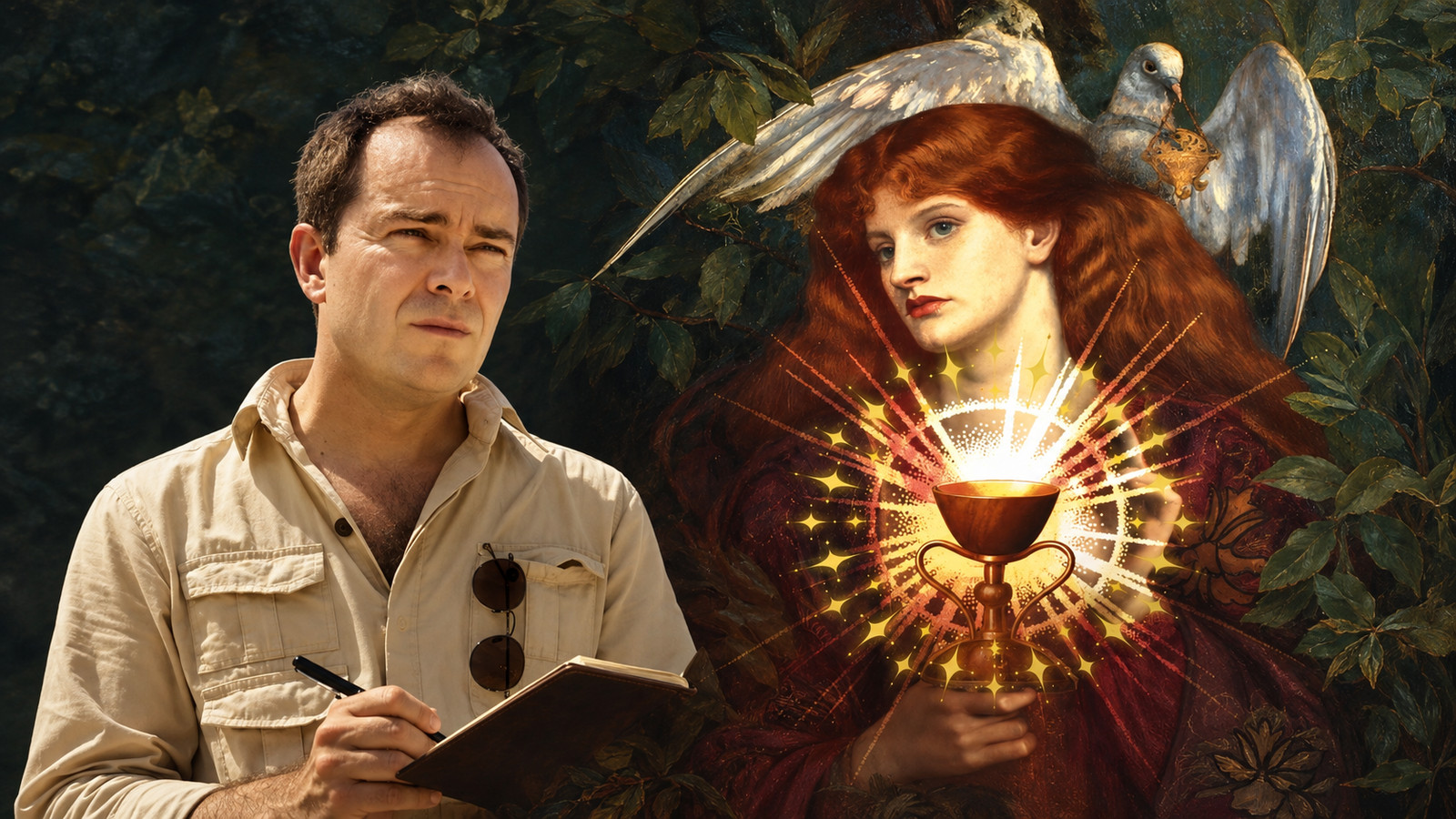
Had San Juan de la Peña burned, not only would a unique historic complex have been lost, but also the place that serves as a reference point for stories of the Grail and other legends. That concern runs through the conversation with Javier Sierra, winner of the Planeta Prize for The Invisible Fire, who has chosen the Grail as the focus of the ninth edition of Ocultura, to be held in Zaragoza from November 4 to 6.
The writer explains why Aragón holds a prominent place in medieval narratives and what he hopes to contribute through a gathering that will bring together specialists in history, literature, and religion. His appeal goes beyond relics: he proposes safeguarding the Grail as intangible heritage so future generations can continue searching for it.
At the presentation, you linked the choice of theme to the threat of fire at San Juan de la Peña. Did the fear of losing this heritage also make you think about another loss: that of the stories that give meaning to these places?
Exactly. Had San Juan de la Peña burned, we would not only have lost a unique historic complex, but also the reference point on which stories such as those of Voto, the Grail, and so many others were built. Physical places anchor us to the spiritual; they are a kind of key granting access to the realms of transcendence. And keys cannot be lost.
From November 4 to 6, you are bringing together specialists from very different backgrounds in Zaragoza. How did you shape the program? What specific questions did you want answered, and which voices did you consider essential?
For last year’s edition, dedicated to Goya, I felt that this year’s theme should also have an “Aragonese dimension.” And perhaps there is no greater mystery in our region than that of the Grail. In recent decades, experts in medieval history and literature of the period have agreed that this “exotic” territory on the western slopes of the Pyrenees provided the setting for French troubadours to create the Grail tales we admire today. The idea is not new. More than a century ago, a dean of Jaca put forward the theory that Chrétien de Troyes—the author of the first book to use the word “Grail”—was inspired by Alfonso the Battler in creating the Fisher King in his story. And this idea of Aragón as a driving force behind the Grail myth seems more than fitting for an Ocultura event.
Victoria Cirlot will open the lectures with the search for the Grail in medieval literature. Why is it so important to begin with Chrétien de Troyes’ literary Grail before discussing the chalices that now claim to be the one from the Last Supper?
Precisely in order to establish the exact frame of reference for what follows. The Grail first appears around 1180 in Troyes’ “Story of the Grail.” It is a literary matter. The Bible, surprising as it may seem, does not mention the Grail; it speaks of a chalice at the table of the Last Supper, but assigns it no special attribute and certainly no proper name. That is why it is important to begin with literature. And doing so with Victoria Cirlot, who has spent her entire life studying European Grail texts, is a real privilege.
«Physical places anchor us to the spiritual; they are a kind of key granting access to the realms of transcendence. And keys cannot be lost.»
José Luis Corral will address the Aragonese case and San Juan de la Peña. What do you hope his contribution will help distinguish between what we know from documents, what tradition conveys, and what we simply wish to believe?
I have known José Luis for years. I deeply admire his measured, well-documented approach to history. He is one of those rare professors who knows how to speak to a broad audience and has also devoted several works to studying the myths, legends, and mysteries of Aragón. He knows a great deal about the Grail of San Juan de la Peña, and I believe he is the perfect ambassador to tell us about it.
Antonio Piñero will speak on «The Last Supper and the Holy Grail.» What questions should a researcher ask of biblical texts before setting out to search for the cup beyond them?
There are many, but one in particular troubles me. The Gospel text that provides the most details about the Last Supper is one by St. Paul, who, of course, was not there to witness it. Yet much of the image we have formed of that momentous event comes from it. That leads us to ask why Paul appeared to know so much about the Supper. Antonio Piñero has studied that angle in depth and has an answer that will surprise those who come to hear him. This year, Ocultura will be full of revelations, believe me.
The program also includes Belén Luque and Cristina Monzón. What perspectives do they bring that would be missing if the gathering were limited to the mystery’s most high-profile versions?
Ocultura’s approach to the Grail would have been incomplete without presenting the current social impact of the story of this relic. That impact is especially notable in Aragón, where collective awareness has grown around preserving and making accessible the historic sites where the Holy Chalice kept in Valencia was once located. Among those sites, Jaca Cathedral stands out, regarded by some as the object’s “first reliquary.” Since the site now houses the Diocesan Museum of Jaca, we felt it was appropriate for its director, Belén Luque, to join us. Jaca is part of a modern “Holy Grail Route” linking Aragón and Valencia, which aims to be a living pilgrimage route for the 21st century. Cristina Monzón is among its most knowledgeable experts, so we thought it would be very interesting to bring the two together for a roundtable discussion.