



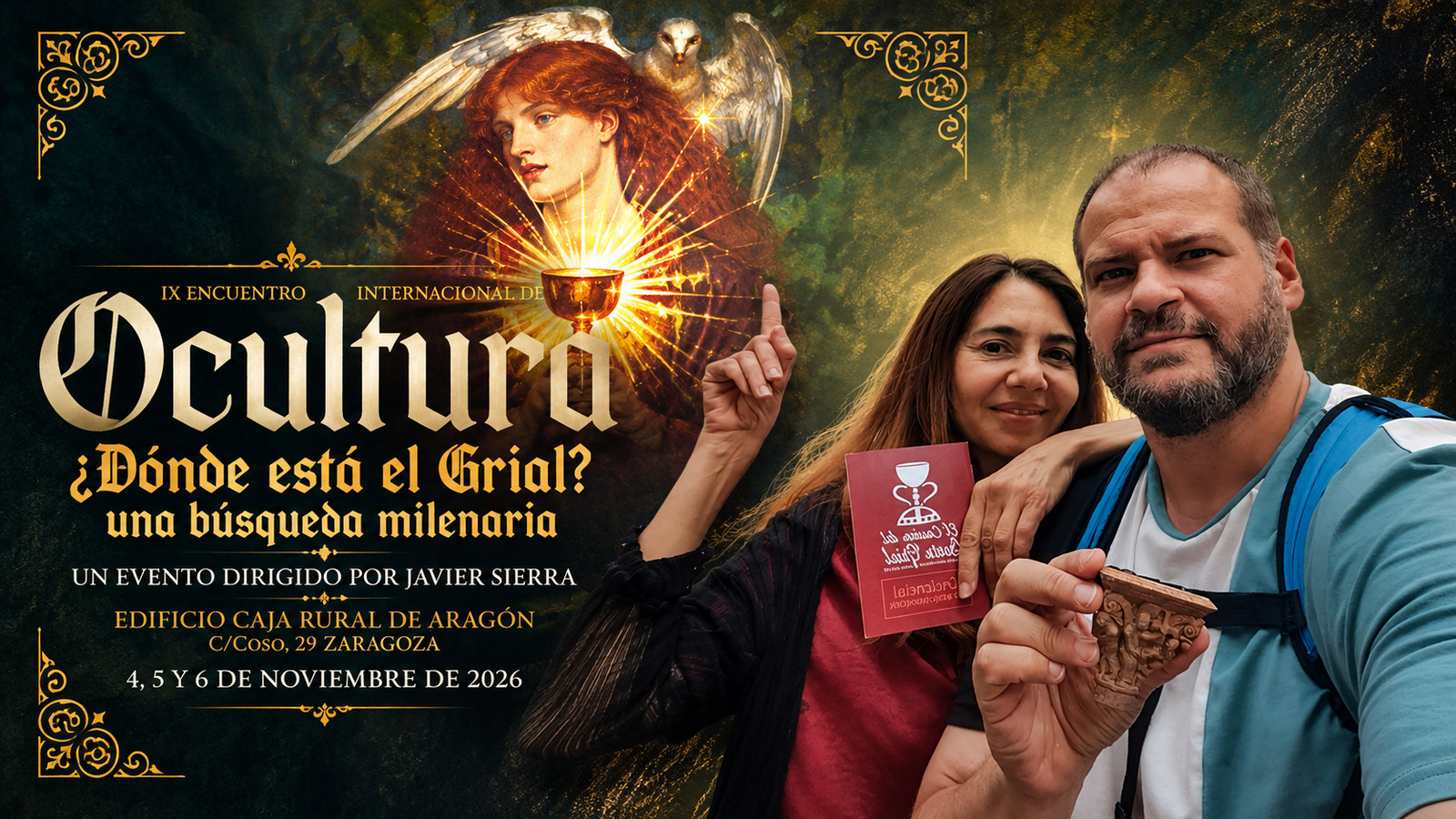
For centuries, the Grail has fueled adventures and impossible quests. In your case, you decided to go looking for it on foot. What did you expect to find when you set out on this journey?
Cristina Monzón: I had experience as a pilgrim on the Camino de Santiago, I studied tourism, and I had no idea that Valencia held a relic supported by so much evidence that it could validate it as Christ’s authentic cup. I knew there was a tradition, but I thought it was an old wives’ tale passed down from generation to generation—that people said, or told, that the Holy Chalice was in Valencia Cathedral. But in 2022, I was invited to an afternoon gathering that will always be part of my life. Dr. Ana Mafé was also there, and she laid out the evidence on which she argues that this relic contains archaeological and art-historical elements that could support its authenticity. She also explained that the Holy See had recognized Valencia as a jubilee city because of this tradition and its custody of the Holy Chalice. At the end of that gathering, she told me there was a “proto-pilgrimage” route linking the Pyrenees with the city of Valencia, but that it was just getting started and remained little known. That is where my friend Álex comes in; he has a travel YouTube channel. Without thinking twice, I said to him: “Álex, shall we grab our backpacks and walk part of the route?”
That was exactly how it happened—a crazy spur-of-the-moment decision—and we approached it very naively, because we neither researched nor prepared for it, assuming it would be like the Camino de Santiago, with everything signposted. We set off with our backpacks, unaware that from Somport onward, that first step would change our lives—not only personally, but professionally as well.
Magical things have happened to us. I know that may sound exaggerated, but I cannot find another word for it.
You covered more than 600 kilometers along a route that remains little known. What did you encounter on that adventure?
Cristina: Magical things have happened to us. I know that may sound exaggerated, but I cannot find another word for it. The Camino de Santiago also offers personal renewal and a connection with nature and oneself, but because this route sees so few travelers, it allows you to move at a pilgrim’s unhurried pace, meet local people, and uncover the clues it leaves behind—almost like a treasure hunt—about the Grail’s possible passage through those places.
I remember that it was important to me to begin with a pilgrim’s blessing. We were filming in Santa Cruz de la Serós, in a church we believed had been deconsecrated, when a priest appeared. We were reshooting scenes and drove him mad, asking him to stand here or there. Finally, he asked me: “You do not know who I am, do you?” It turned out he was the bishop of Jaca, who had come to fill in, and he ended up giving us the pilgrim’s blessing. To me, it was a wonderful sign.
Alejandro: I always say this route makes you feel like Indiana Jones. Because it is so lightly traveled, you have to keep all your senses alert to follow it. And everything you find makes you feel as though you are the first person to discover it. On our first stage, we got lost and ended up finding a monolith marking the passage of the Holy Grail. It was almost completely covered by grass, in the middle of nowhere. It was an incredible feeling. It has happened to us many times, and I think anyone who does the route with their eyes open can have similar experiences. It is a route where people still ask what you are doing or where you are going. There is not yet an accommodation network as well established as on the Camino de Santiago, and that also makes the experience very different.
I like that description of “curious pilgrims,” because knowing the story is one thing and walking through it is another. What have you discovered on the ground that you would have struggled to learn from books?
Cristina: I think it is wonderful to do your research beforehand, whether through historical novels or more academic texts, because the magic of the route is that what you have read on the page suddenly appears before you. For example, when you arrive in Jaca and see certain medieval depictions connected with the tradition of St. Lawrence, it gives you goosebumps. Christian tradition holds that, during the persecution of Christians in Rome in 258, St. Lawrence managed to save the chalice by sending it to Hispania. Then you find depictions of that story in Aragon’s heritage. At the church in Ena, where we discovered a Virgin holding a bowl, we also found a depiction of St. Lawrence with the grill, the instrument of his martyrdom. Is it a coincidence? Perhaps. But it is fascinating to discover how all these stories converge in one place.
And there is something else that deeply impressed me: the landscapes of Aragon. I did not know Huesca well, and I fell in love with it. The Pyrenees and the Pre-Pyrenees make you feel the grandeur of nature, life, the universe or God—whatever each person chooses to call it. We were also moved by the generosity of its people. On some occasions, when we could not find lodging, we slept in private homes belonging to people who opened their doors to us.
Alejandro: It is incredible to find so many of the things you have been reading about in one place. And when you walk the route, the stories stop being abstract. You are physically in those spaces; you can walk through them, observe them, and better understand what they meant.
This route makes you feel like Indiana Jones.
Indeed, one of your most surprising discoveries came in Ena, a small town in Huesca province, when you found a Romanesque carving that particularly caught your attention.
Cristina: It was one of the most powerful experiences we had. We had read The Invisible Fire, by Javier Sierra, and we had been especially interested in the iconography of certain Romanesque Virgins depicted holding a bowl. One day, we stopped in a tiny village of around 20 houses, Ena, at the foot of San Juan de la Peña. We had not even planned to stop there, but Alejandro had run out of cigarettes and needed to rest for a while, so I went over to the church, which was closed, and found a sign describing what was inside. It referred to a Romanesque carving of a seated Virgin with the Child on her lap and an object in her hand. When I saw the image, I immediately called Alejandro. It was a bowl! It did not look like an apple or an orb, which are much more common elements in these depictions. We started knocking on doors in the village until we found a young woman who had the key to the church. We got inside, photographed the image, and sent the pictures to Dr. Mafé, because we are nothing more than curious pilgrims. She was thrilled by the discovery and considered that it could be a representation linked to the iconography of Virgins carrying a bowl.
It was very exciting to discover that the route could conceal such clues. We felt a little like Indiana Jones, and it gave us even more strength to keep walking. But there was something else in that village that touched my heart even more. The young woman who opened the church for us told us she was from there, although she lived in Zaragoza. She said that if the route became a well-known pilgrimage trail, she would leave her job and return to her village to start a business. Her eyes lit up as she spoke, and I thought that we were traveling through part of Spain’s depopulated interior—a place with extraordinary landscapes, wonderful villages, and people who would like to return if economic opportunities existed. That made me understand that the route could have a significance that went far beyond the story of the Grail.
The Camino de Santiago has a tradition and identity recognized worldwide, while the Camino del Santo Grial is still being built. What makes this pilgrimage different? Do you need to believe in order to find meaning in it?
Alejandro: I have done the Camino de Santiago a couple of times, and it is an incredible experience, especially from a social standpoint. You share meals, hostels, and conversations with many pilgrims. This is a completely different route. There are many stretches where you walk alone…