


South Korean company Dongha CO., LTD. has presented in Zaragoza its technology for transforming coffee grounds and recycled plastics into materials for construction and urban furniture. The company is considering developing an initial pilot project in Aragon alongside its local partner, Sostenibilidad, Sinergias y Soluciones SL (SSS), although no facilities or investments have yet been confirmed.
Dongha considers recovering coffee grounds in Zaragoza and Utebo
The company presented its proposal on November 18, 2026, at the Santander WorkCafé in Zaragoza, during the session “Circular Economy Success Story: Coffee-Ground Recovery in Korea and Its Implementation in Zaragoza”. The event was attended by Sang Yeol OH, Dongha’s CSO Manager, and Alberto Fumanal, an SSS consultant.
SSS serves as Dongha’s local partner and representative in Spain, following a three-year collaborative relationship. The two parties are exploring a model that would collect coffee grounds generated by coffee shops and other establishments, process them, and turn them into new materials for industrial and urban applications.
Zaragoza and Utebo are among the locations under review for potential pilot projects. The company is also seeking to identify partners among coffee shops, waste management companies, industrial firms, and technology centers, as well as potential uses for materials produced in Aragon.
Coffee Deck technology incorporates up to 51% coffee waste
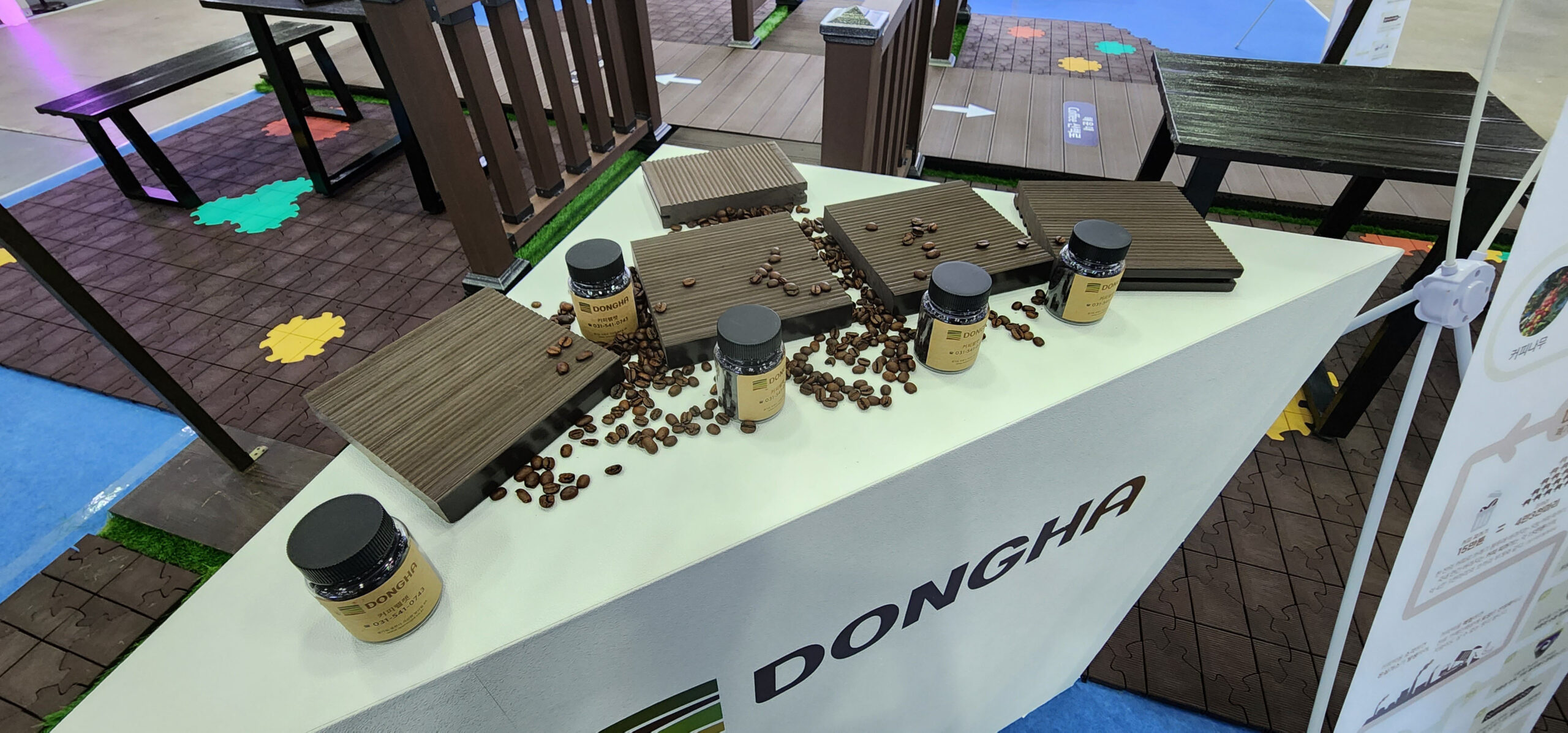
Founded in 2006, Dongha has developed a technology combining coffee grounds and recycled plastics to manufacture products for construction and urban furniture. Its flagship product is Coffee Deck, a line of eco-friendly decking that can incorporate up to 51% coffee waste, depending on the product.
The materials have been used in South Korea to create decking, walkways, benches, fences, and other urban features in both public and private spaces. The company highlights the technology’s progression from laboratory development to deployment in real-world installations.
One example presented was at the Seoul National University of Science and Technology, where around 1,052 square meters of the material have been installed. The project used approximately 15.78 metric tons of coffee grounds. Dongha has also installed Coffee Deck at six Starbucks Korea locations.
The Aragon project would move forward through collection agreements and technical testing
The proposed model would divide responsibilities between the partners. Dongha would provide the technology, production equipment, training, and technical advice, while Spanish companies could handle waste collection, manufacturing, and product marketing.
The rollout is envisaged as gradual. Initial steps would include establishing waste-collection agreements, identifying industrial and technical partners, and conducting material demonstrations. The necessary testing to meet European standards, including EN 15534, would also be assessed.
SSS is facilitating contacts with companies and organizations interested in participating in the initiative. The immediate objective is to define an initial pilot project, assess its viability, and only then consider a potential larger-scale rollout in Aragon.