



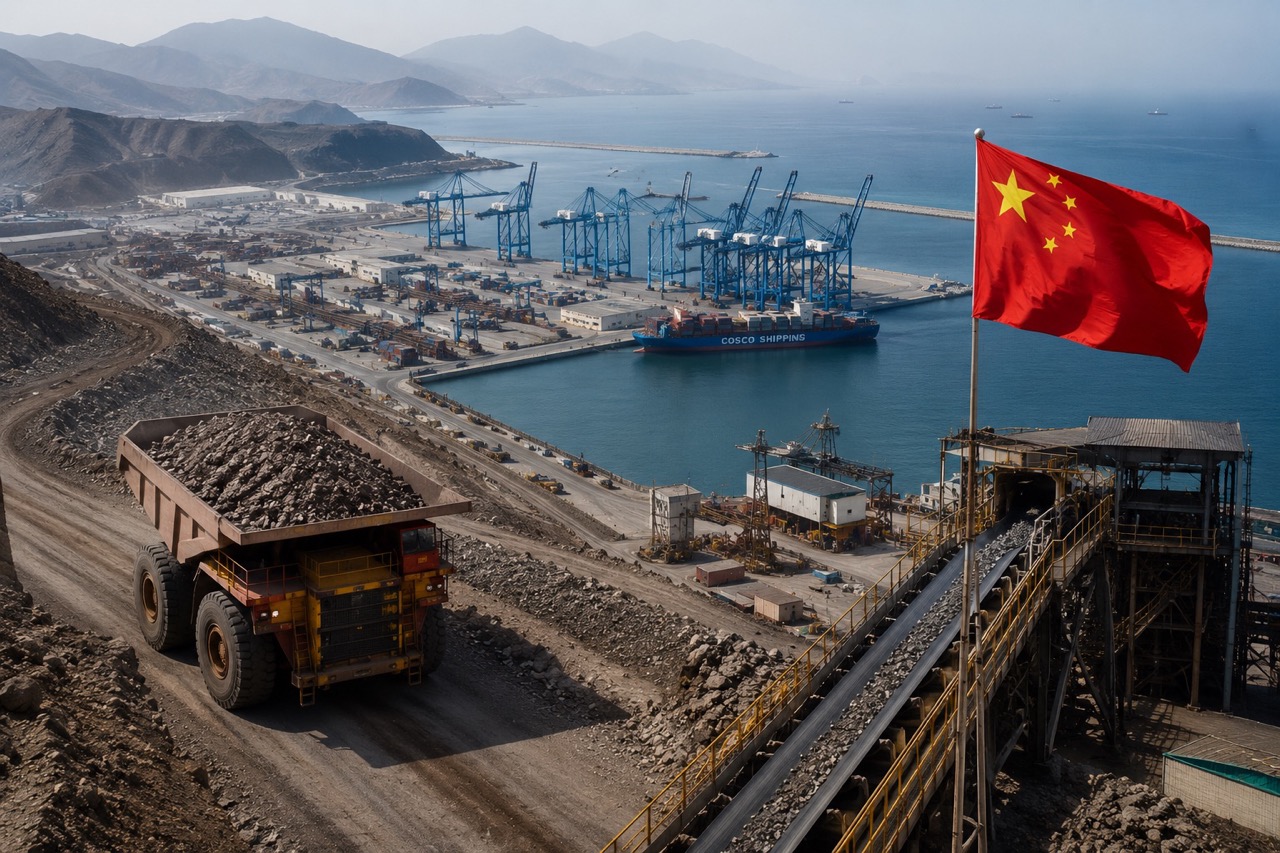
China has become Peru’s top trading partner, with its companies involved in some of the country’s key mining, energy, and logistics assets. Over 200 Chinese firms have invested in Peru, and the Port of Chancay now adds a new dimension to an economic relationship built over more than two decades.
The economic presence of China in Peru can be observed by following the journey of a commodity. Copper is extracted from several mines operated by Chinese companies, a large portion of Peru’s production is destined for the Chinese market, and starting in late 2024, the country will also have a major port predominantly controlled by COSCO Shipping Ports that directly connects the Peruvian coast to Asia.
These are not isolated projects. China is currently Peru’s biggest trading partner and, according to the Peruvian Ministry of Foreign Affairs, over 200 Chinese companies have invested in the country, particularly in mining, energy, infrastructure, and mineral resources.
The relationship has progressively expanded. First came raw materials and trade; then investments in large mining operations and other sectors followed. The Port of Chancay represents a new stage, incorporating logistical infrastructure into this economic connection.
China is Peru’s top market
The commercial dimension provides a clear starting point. In 2025, China accounted for 36.2% of Peru’s total exports, according to the Ministry of Foreign Trade and Tourism. That year, Peru achieved a record export figure of $90.082 billion, with the Chinese market again clearly established as its primary destination.
The relationship is closely linked to raw materials, particularly minerals. Copper represents approximately 30% of the value of Peru’s exports, and China receives about three-quarters of the red metal that Peru sells abroad. Between January and August 2025, this percentage reached 76.1%.
The Chinese industry requires copper for sectors ranging from construction and electrical networks to electric vehicles, renewable energy, electronics, and numerous industrial activities.
Thus, Peru, one of the world’s leading producers, has become a key supplier for this demand.
Chinese capital in the mines
The relationship does not end when the mineral leaves the country. Chinese companies are directly involved in its production.
One of the main examples is Las Bambas, one of Peru’s major copper mines, operated by MMG Las Bambas, a subsidiary of MMG Limited. Another significant project is Toromocho, located in the Junín region and developed by Chinalco.
Other historical names in Chinese investment include Shougang Hierro Perú. In 2020, the Ministry of Energy and Mines estimated that accumulated Chinese investments in Peruvian mining over the previous eleven years approached $15 billion.
This has created an economic relationship different from what would exist if China only acted as a buyer of raw materials. Chinese capital is also involved in assets producing some of the minerals subsequently demanded by its own economy.
From mining to energy and infrastructure
In recent years, this presence has diversified.
Chinese investments have expanded into energy, electricity, oil, and infrastructure. Companies from that country have been involved in significant operations within Peru’s electric power system, and firms like CNPC continue to be active in the energy sector.
Currently, the Peruvian government presents the country to Chinese investors with a portfolio that extends beyond mining. In March 2026, during a business meeting held in Beijing, Peru identified opportunities in transportation, sanitation, agriculture, and irrigation, explicitly highlighting Chancay as a platform for Chinese companies interested in operating in South America.
Thus, the relationship is beginning to encompass various sectors of the economy: natural resources, energy, infrastructure, and logistics.
It is precisely in this last area that the project symbolizing the new phase appears.
Chancay, the direct connection to Asia
About 80 kilometers north of Lima lies the Port of Chancay, inaugurated in November 2024.
COSCO Shipping Ports holds a 60% stake in the operating company, giving the Chinese group majority control of the project. Its significance lies in the ability to establish direct routes between the South American coast and China using large container ships.
Early results illustrate the importance of this connection. Between January and September 2025, 62% of Peru’s agro-exports destined for China were shipped via Chancay. During this period, China accounted for 78% of the total value exported from the new port.
Blueberries, avocados, grapes, and mandarins represent a significant portion of these operations. However, Chancay also handles fishery products, minerals, and goods from other sectors.