



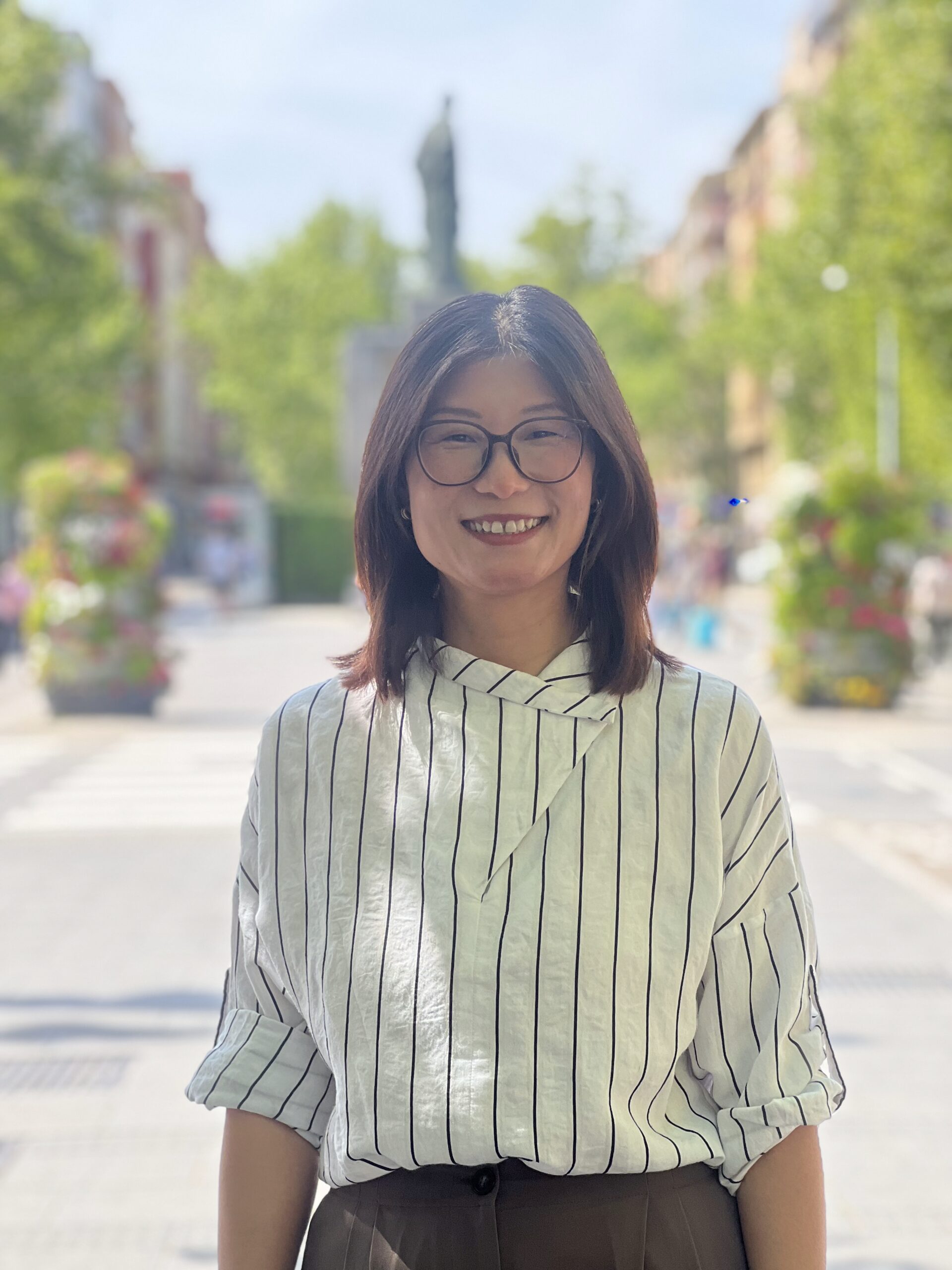
Dan Zhou, an educational psychologist born in Luoyang—a city that has been home to eleven dynasties—arrived in Zaragoza 18 years ago almost by chance, drawn by the buzz surrounding the Expo. Today she is a professor at the University of Zaragoza, a social services interpreter, and has just published the book “No son cuentos chinos” (These Are Not Chinese Fairy Tales), a work born from ten years of direct observation in classrooms, families, and social contexts, in which she applies ancient Chinese wisdom. Far from clichés or theoretical manuals, the work is built on everyday stories that reflect real childhood conflicts: from minor school frustrations to deeper identity dilemmas. She asserts that “true integration begins when the language barrier disappears.”
Zhou, who arrived in Spain nearly two decades ago from China on a student visa, has built a career marked by cultural mediation and educational support. Her perspective combines academic experience and social practice, allowing her to accurately analyze phenomena such as integration, the role of language, and the tensions faced by second-generation migrant families. In this interview, she reflects on education, identity, stereotypes, and coexistence, at a time when Aragon—and especially Zaragoza—is establishing itself as a meeting place for cultures.
QUESTION. How did a book titled “No son cuentos chinos” written by a Chinese woman come about?
ANSWER. It didn’t just come out of nowhere. I’ve been observing situations in classrooms, with children and parents, for over ten years. Small but very significant conflicts: friendships, frustrations, misunderstandings… All of that built up inside me. Writing this book is the result of a decade of observation and reflection. I came up with the title almost by chance. I was telling my Spanish friends, full of excitement, that I’d written a book about what happens in schools, in families—the friction, the conflicts… And they’d say, “Chinese tales!” And I’d say, “No, no, they’re not Chinese tales.” And I thought: that’s the title.
Q. Tell us about your book. Is it children’s entertainment or does it have an educational purpose?
A. It’s a storybook with a psycho-pedagogical approach. But it’s not a manual, nor an academic book, nor is it simply a children’s story. Each chapter is a story that addresses some aspect of children’s daily lives: at school, on the playground, at home. It has three “no’s”: it is not a Chinese language textbook, it is not an academic book on Chinese history or culture, and it is not merely a work of entertainment. What it does is connect everyday situations with the wisdom of Chinese philosophy. For example: a child loses his pen and is upset. And the father says to him: “Look, in the Song Dynasty, a thousand years ago, there was a student who found himself in a similar situation, and what he did was…” And the child suddenly realizes that what has happened to him isn’t something that only happens to him—that a thousand years ago, someone else went through something similar. And that gives him a small tool for thinking, for finding his own path.
Q. Is there a chapter that you find particularly meaningful?
A. There’s one that talks about the philosophy of “examining oneself three times a day,” which is a maxim of Confucianism. In the story, in class, some children criticize each other: “Maria hasn’t studied the vocabulary,” “Well, David is worse—he hasn’t even taken out his book.” And the lesson is: before criticizing others, look at yourself. Have you worked today? Have you given it your all? That’s universal. It’s not a Chinese value that doesn’t exist here. It’s appreciated here too. In the end, if we’re human, we’re more alike than we are different.
THE BOOK I’VE WRITTEN, “DON’T TELL ME CHINESE TALES,” HAS THREE “NO’S”: IT IS NOT A CHINESE LANGUAGE MANUAL, IT IS NOT AN ACADEMIC BOOK ON CHINESE HISTORY OR CULTURE, AND IT IS NOT JUST LIGHT READING.
Q. Who is the book aimed at?
A. Everyone. But if I break it down by age: for children, I want them to think, “This has happened to me, this is my life,” when they read about Tariq, Hugo, Clara, and Katsu. I want them to feel a connection. And for the characters to offer them a little guidance. For parents, I want them to get a glimpse of what happens at school—since they often drop their kids off in the morning and head to work without knowing what goes on in the playground. I want them to see: “Ah, these are the little conflicts my kids have. It’s normal. It happened to Tariq, too.”
Q. You’ve already sold out the first edition, and a second one is coming. How has the reception been?
A. Very well. We held a presentation at the Casa de la Cultura with a lot of support. We’ve organized activities for Book Day. We’re also going to hold a roundtable discussion that week at the Faculty of Education at the University of Zaragoza. I’m really happy, to be honest.
Q. You were born in Luoyang, a city with eleven dynasties in its history. What’s it like growing up in a place like that?
A. Culturally, I was born in a very rich land. Luoyang is an ancient city with a vast history. My father is from Beijing and my mother from Xi’an, so I have family scattered all over China. I grew up in a very diverse environment, with very different roots. Within China, there are also many differences between provinces—a lot of diversity. Then I earned my bachelor’s and master’s degrees there, and I ended up working at a university of science and technology.
Q. And how exactly did you end up in Zaragoza?
A. I wanted to pursue a PhD abroad and had several options: the United States, Australia… Destinations where I could study in English were my top priority. I even had a spot at the University of Maryland, but my scholarship was cut right before I started. So I switched to Plan B. At international research conferences, I had met a professor from the University of Valencia who really encouraged me to come to Spain. That opened a little window of opportunity for me. My father, whom we always call the wise old man, told me: “Sweetheart, since you’re going to a country where they don’t speak English anyway, take a year off, sign up for a language course, and go in a relaxed mode.” And so I came, also taking advantage of the buzz surrounding the 2008 Zaragoza Expo.
Q. What was it like to go from China to a completely different country and city?
A. I still remember arriving at Delicias station, with a little piece of paper I’d prepared with the address written on it to give to the taxi driver. I found a city where if you dropped your wallet on the street, someone would return it to you.
That blew my mind. Little by little, I started getting by in Spanish. Knowing the language is essential. Language is the tool that opens doors and windows for you.
Q. You arrive, learn the language, and stay. Was there a moment when you said, “I’m staying here”?
A. The pace of life here is like… I wouldn’t say slow, but relaxed. And that has a lot to do with the philosophy of life and the welfare state. I came from China, where from the moment you start studying, you’re seen as a very hardworking, dedicated person. Here I realized that life is also meant to be enjoyed. If it’s time to rest, you rest. If it’s time for vacation, you enjoy it. I gradually soaked up that way of life. And at thirty-three, I met my husband. So here we are.
“THE SECOND GENERATION OF CHINESE FACE A MUCH MORE COMPLICATED SITUATION: FOR EIGHT HOURS A DAY THEY RECEIVE A WESTERN EDUCATION, AND WHEN THEY RETURN HOME THEY ENCOUNTER A DIFFERENT LANGUAGE AND A DIFFERENT WAY OF THINKING”
Q. Your doctoral thesis dealt precisely with the ethnic identity of the second generation of Chinese. What did you find?
A. It’s a fascinating topic because the second generation of Chinese faces a much more complicated situation than it seems. Their parents—the first generation—arrived with no resources; they started from scratch, facing many difficulties. And they’ve managed to stabilize financially, providing more resources for their children. In that sense, the children have been luckier. But they carry a very deep identity crisis: Who am I? Where do I belong? They spend eight hours a day at school receiving a completely Western education. And then they come home to a different language, a different way of life, a different way of thinking. The first-generation parents continue to uphold their traditional Chinese model, while the children have already adapted culturally to Spanish society. They have to find that balance to be able to live between the two cultures..
Q. As an interpreter in social services, what situations have you encountered with Chinese families who don’t speak Spanish well?
A. Very difficult situations. There are families we’ve been supporting for nine years. Nine years with the same level of Spanish. And that has very serious consequences: you can’t manage your own life; you’re always dependent on someone else. But what’s most shocking is seeing a ten-year-old child handling his family’s electricity bill, talking to the utility company, acting as an interpreter for his parents. A Spanish child that age would be playing soccer in the park. It’s not the child’s fault or the parents’ fault; it’s the result of not having been able to learn the language. And that places an enormous burden on the children.
“KNOWING THE LANGUAGE IS ESSENTIAL. I STILL SEE TEN-YEAR-OLD CHILDREN MANAGING THEIR FAMILY’S ELECTRICITY BILL. A SPANISH CHILD WITHOUT THAT PROBLEM IS PLAYING SOCCER IN THE SQUARE”
Q. Why has the Chinese community taken so long to open up linguistically?
A. Because for a long time they didn’t need to. The Chinese business chain was so self-contained that there was never any need to speak with anyone from outside. The products came from China, or from department stores in Madrid, where there were also Chinese people. The store was run by Chinese people. Customers could be from anywhere, but the clerk never needed to speak fluent Spanish. It was a completely closed circle. But that is changing. We’re seeing more and more Chinese restaurants with waitstaff who aren’t Chinese, more bazaars with clerks who speak Spanish. As the language barrier breaks down, the community opens up. It’s essential.
Q. Is bullying a specific problem for Chinese children in schools?
A. Look, I see it almost the other way around. The problem isn’t with the Chinese children; it’s with the environment.
There are schools—I won’t name any—where this happens more often. And the responsibility doesn’t lie solely with the school; it’s on families and society as a whole. But we’re making progress. People are becoming increasingly comfortable seeing someone who’s different—with a different appearance or accent. Young children reflect exactly the upbringing they receive from their parents, grandparents, and their environment. And it also bothers me when some teachers, with the best of intentions, say things like “it’s just that Chinese kids are whizzes at math.” No. Congratulations on your work as a teacher: you’ve taught well. Just because you have several students who are strong in math doesn’t mean that Chinese kids are smarter at math. That’s also a stereotype.
Q. What career paths are second-generation young people choosing?
A. There’s a wide range: engineering, medicine, international trade. They have the advantage of being fluent in two languages from childhood, and many also speak English. Three languages combined with technical expertise make for a very competitive profile. Though there are also cases of young people who settle into the family business. But that’s not something specifically Chinese; it happens with Spanish kids too. And vice versa: there are parents who have struggled their whole lives to build a restaurant or a successful business and want their children to carry it on. The first generation is also making the leap: the major Chinese businesspeople in Zaragoza, those who have been here for decades, no longer face a language barrier and are investing in very diverse sectors, beyond the traditional bazaar.
WE HAVE A CONTRADICTION: CHINA PREACHES MEDITATION, TAOISM, ZEN, AND INNER CALM, YET AT THE SAME TIME IT IS ONE OF THE MOST COMPETITIVE SOCIETIES IN THE WORLD
Q. What does Chinese business culture bring to a society like Spain’s?
A. It’s hard to summarize. The values of perseverance and hard work are very strong—that much is clear. But I believe that’s changing. It’s no longer just about working long hours: the new generation of Chinese entrepreneurs is learning to better calculate profit margins, to deliver quality, and to build a better business model. They’re in transition. And then there’s the speed. China is advancing at an accelerated pace. There, if you stand still, you’ve already been left behind. That generates a lot of stress, yes, and there’s a curious contradiction: it’s a country that preaches meditation, Taoism, Zen, and inner calm, yet at the same time it’s currently one of the most competitive societies in the world.
Q. To wrap up: what would you like readers to take away from your book?
A. For children, that they feel understood. That they think: “This happens to me, I’m not alone.” And that the characters give them a little guidance, a tool. For parents, I hope they truly take a look at their children’s lives at school. And for any reader, I hope they discover that Chinese wisdom from two thousand years ago speaks to the very same things that concern us today. That we are much more alike than we think.