



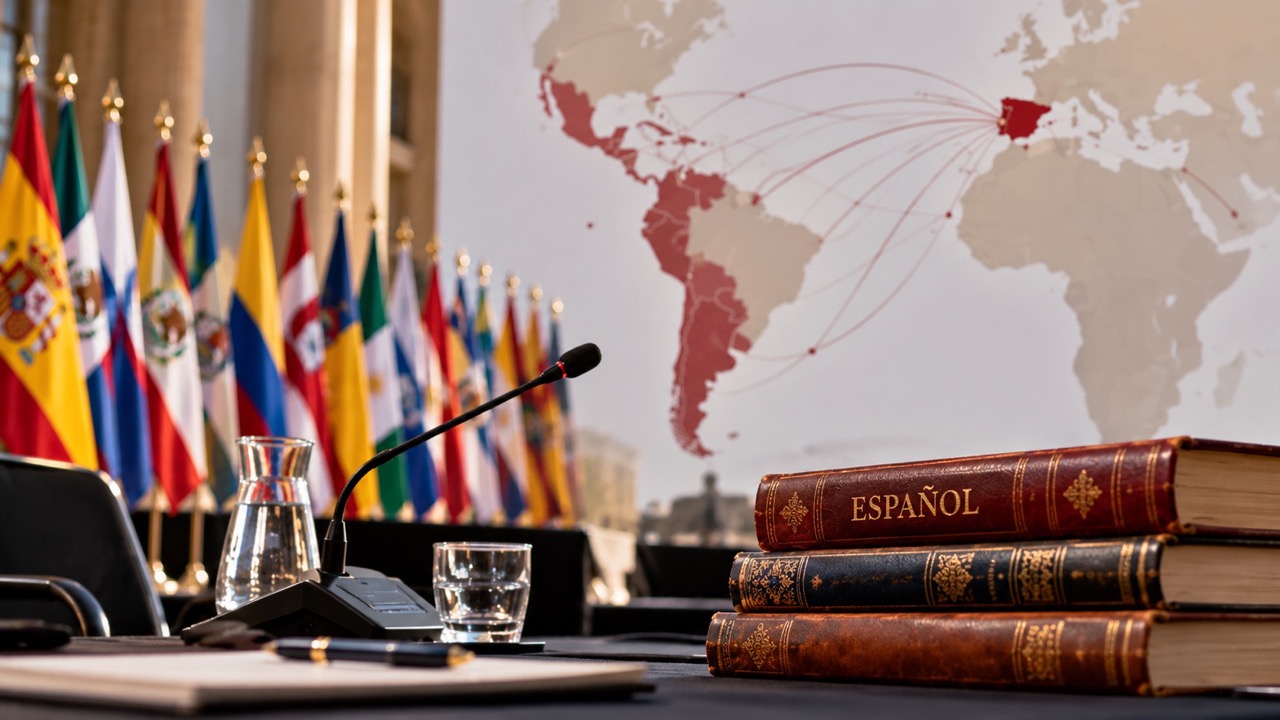
A former president of Ecuador and international negotiation specialist. One of Spain’s leading researchers on Latin America. Business leaders and publishers. Institutional officials, legal experts, cultural journalists, and a flamenco singer with a Latin Grammy. The 4th National Culture Forum will bring together a wide range of figures in Madrid on October 2 around a single question: how much capacity does Spanish have to generate political, economic, and cultural influence worldwide?
The event, organized by Fundación Cultus as part of Hispanic Heritage Week, will be held at the College of Civil Engineers, Canals and Ports. Its program is structured around three panels—geopolitics, economics, and cultural outreach—as well as a discussion specifically devoted to the Hispanic world.
Rather than bringing together experts from a single discipline, the Forum has chosen to combine different experiences. That is one of the defining features of this fourth edition: bringing together people whose work with Spanish has spanned international politics, academic analysis, media, business, and artistic creation.
Jamil Mahuad and Carlos Malamud: Latin America on the global stage
The first panel, Spanish as Global Leadership and Influence, will have a distinctly Latin American focus. One of its leading participants will be Jamil Mahuad, president of Ecuador from 1998 to 2000 and previously mayor of Quito for six years. His subsequent career has been closely linked to the study and teaching of negotiation and leadership.
Harvard Kennedy School currently lists Mahuad among its executive education faculty in leadership and negotiation and highlights his role as co-founder and senior adviser to the Harvard International Negotiation Program. His presidency also saw the signing of the final peace agreement between Ecuador and Peru, ending a long-running border dispute between the two countries.
Joining him will be Carlos Malamud, senior researcher for Latin America at the Elcano Royal Institute and professor of Latin American History at UNED. A doctorate holder in Latin American History from Complutense University, he began his academic career studying colonial economic history before specializing in 19th- and 20th-century Latin American political history and the region’s international relations.
His participation brings to the Forum a perspective closely tied to relations between Spain and Latin America. His research areas include regional integration processes as well as Spain-Latin America and European Union-Latin America relations.
Also joining the panel will be Gilberto Carrasquero, a Venezuelan lawyer and political scientist with postgraduate training at Stanford and Harvard, while journalist Manuel Campo Vidal will serve as moderator.
The format will thus bring together three distinct perspectives on the same region: Mahuad’s experience in government and international negotiation, Malamud’s academic analysis, and Carrasquero’s legal and political viewpoint.
From geopolitical analysis to a conversation on the Hispanic world
Between the first two panels, the program sets aside a session in a different format. The so-called Two-Voice Discussion will examine the Hispanic world as a cultural community built around a shared language.
The program currently published by the organizers lists Emilio del Río Sanz and Miguel Ángel Cortés Martín as participants. Cortés was secretary of state for culture from 1996 to 2000 and later secretary of state for international cooperation and Ibero-America from 2000 to 2004.
The discussion will raise a question that runs throughout the day: to what extent can a shared language also create a common space when its speakers belong to very different societies, countries, and political realities?
Business leaders and publishers assess the economic value of Spanish
The second panel will shift the focus. While Spanish will be examined through the lens of international relations in the morning, the debate will turn to its economic dimension beginning at 12:30 p.m.
Eduardo Sánchez Pérez, director, editor, and president of ¡HOLA! magazine and head of the publishing group, will take part in a discussion in which media and cultural industries emerge as some of the most visible expressions of Spanish’s ability to cross borders.
He will be joined by Hilario Alfaro, chief executive of Alfaro 1926 and founder and president of Madrid Foro Empresarial. His participation brings a business perspective to a panel designed to examine how a linguistic community can facilitate trade ties, innovation, tourism, education, and cultural industries.
The current version of the program also includes Paula Jiménez Tamayo and Alfonso Serrano, secretary-general of the People’s Party of Madrid, senator appointed by the Madrid Assembly, and vice president of the Popular parliamentary group in the Madrid Assembly. The session will be moderated by José Luis Latorre Martínez, an executive specializing in business management, innovation, and digital transformation.
The range of participants ensures that the discussion is not confined to the economic output generated directly by the language. The underlying issue is broader: what it means for companies, media organizations, institutions, and professionals to be able to address a linguistic space spanning Europe and the Americas, with a growing presence in other regions.
Arcángel, Jesús García Calero, and culture as international outreach
The final panel will likely bring together the most diverse range of backgrounds. Literature, journalism, heritage, artistic creation, public administration, and law will converge in Artistic Creation as an Expression of a Universal Culture.
Its participants will include Arcángel, one of the leading contemporary voices in Spanish flamenco. His career includes the Latin Grammy for Best Flamenco Music Album for Al Este del Cante, awarded in 2018.
He will be joined by Jesús García Calero, director of ABC Cultural and culture editor-in-chief at ABC. A journalist and writer, he has devoted much of his professional career to history, heritage, and underwater archaeology. His presence brings another dimension of cultural outreach to the panel: not creation itself, but the way heritage, literature, and the arts are explained and disseminated through journalism.
Judith Piquet, mayor of Alcalá de Henares and president of the Federation of Municipalities of Madrid, will also participate. Her participation carries particular significance because of Alcalá’s ties to the history of Spanish and to Miguel de Cervantes.
The fourth announced participant is lawyer Javier Cremades, founder and president of Cremades & Calvo-Sotelo and president of the World Jurist Association. The panel will be moderated by Esther Ciudad, president of Fundación Cultus and director of the National Culture Forum itself.
One language seen through very different experiences
The program for the 4th National Culture Forum thus outlines a deliberately cross-cutting journey. Mahuad can speak about the Ibero-American sphere from his experience as a president and negotiator; Malamud, from decades of research on Latin America; Sánchez Pérez and Alfaro, from business and publishing; García Calero, from cultural journalism; and Arcángel, from an artistic expression that has achieved international reach far beyond its place of origin.








