



Aragon’s Agri-Food Research and Technology Center (CITA) is leading ECOPESIA, a European Horizon Europe project that proposes compensating farmers and livestock producers for the benefits they provide to ecosystems. The initiative begins with eight pilot projects in six countries and aims to mobilize private financing for climate- and biodiversity-related actions.
CITA coordinates European project to pay for environmental results
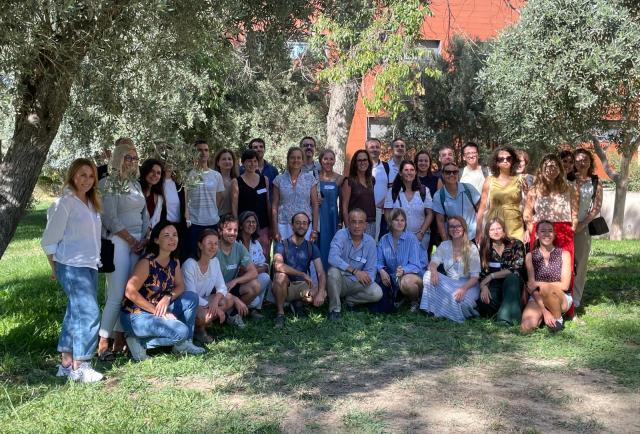
CITA’s headquarters hosted the launch meeting for ECOPESIA on September 23 and 24, attended by more than 40 participants from 20 scientific institutions across 11 countries. The project brings together agricultural producers, companies, public authorities, nongovernmental organizations, technology developers, and researchers.
Alberto Bernués, a researcher in CITA’s Animal Science Department and the project coordinator, said many farmers provide environmental services of value to society without receiving compensation because they are public goods. These services include biodiversity conservation, improvements in soil and water quality, carbon sequestration, and reduced wildfire risk through land management.
ECOPESIA will promote new Payments for Environmental Services (PES), financial incentives linked to actions that benefit the environment. The project is based on the premise that agriculture and livestock farming not only produce food but can also help improve ecosystems and address climate change.
The initiative seeks to move beyond instruments such as the European Union’s Common Agricultural Policy eco-schemes, which are based on specific farming practices and have limitations in demonstrating the environmental results achieved. ECOPESIA aims to design and finance schemes tailored to each area and tied to tangible environmental outcomes.
Eight ECOPESIA pilots to test solutions in Spain and five other countries
The project’s solutions will be tested through eight demonstration pilots across Spain, Portugal, France, the Netherlands, Croatia, and Romania. In Spain, the case study will focus on reducing biomass in forest areas through extensive livestock grazing.
The Portuguese pilot will address the management of montado, or dehesa, systems and cork oak regeneration for cork production. In France, the work will focus on conversion to organic farming in drinking-water catchment areas, while the Netherlands will examine biodiversity in dairy-farming landscapes.
Croatia and Romania, meanwhile, will develop crowdfunding schemes linking biodiversity, rural tourism, and local community participation. According to Bernués, ECOPESIA will work with farmers, livestock producers, and other stakeholders to ensure that payment approaches can be scaled up, creating value for farms and the natural environment.
Digital tools and €300,000 to verify environmental services
The new payment systems will rely on digital tools to track environmental outcomes and strengthen transparency in the management of compensation. ECOPESIA will launch a €300,000 call to select five technologies for measurement and verification developed by European small and medium-sized enterprises, which will be installed on pilot farms.
By the end of the project, the initiative expects to involve at least 175 farmers and livestock producers and mobilize €1 million in private financing to support climate- and ecosystem-friendly actions.
The findings will be submitted to public authorities through recommendation reports for Common Agricultural Policy programs after 2027, the European Green Deal, and the Nature Restoration Regulation.