



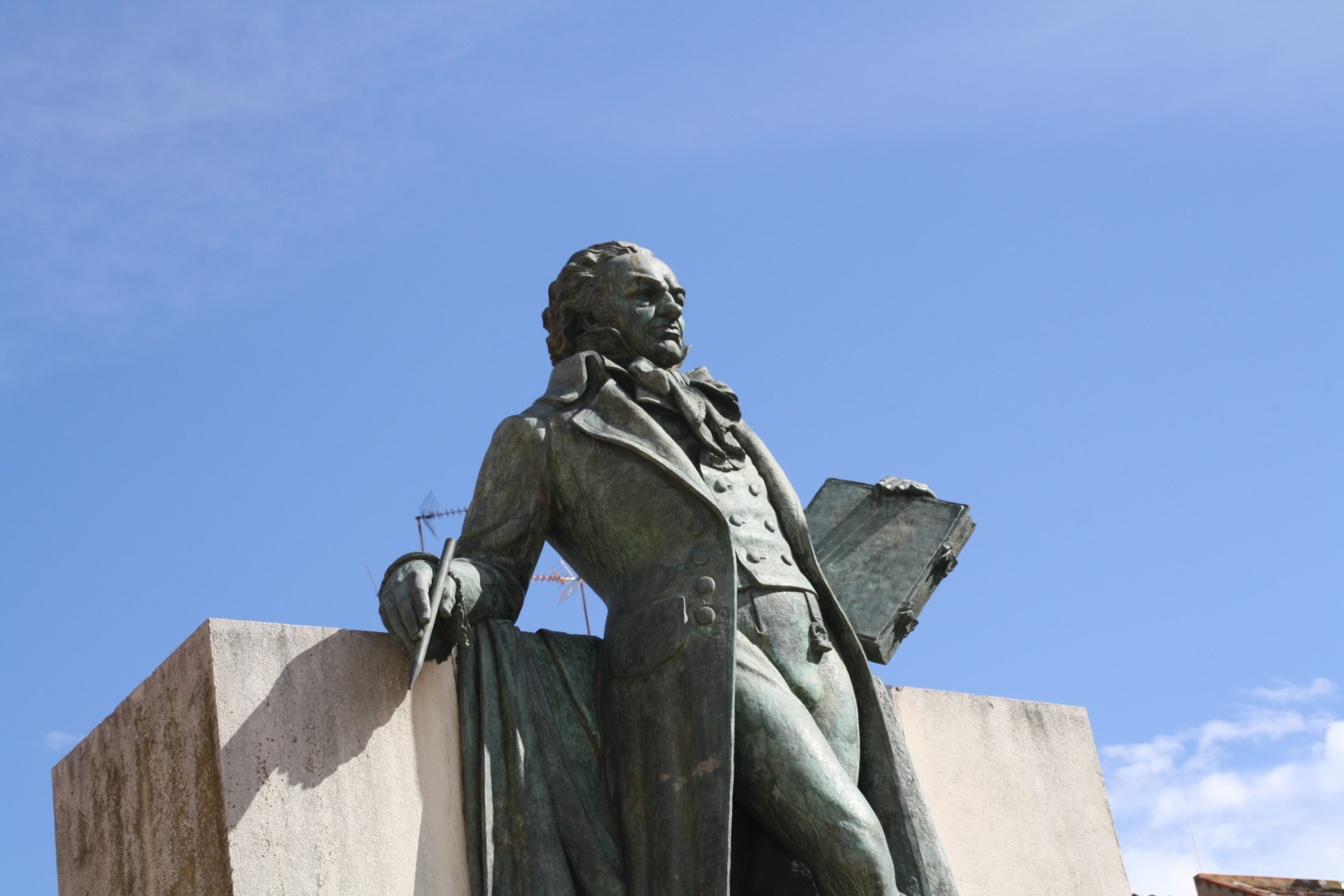
In 2028, the bicentennial of the death of Francisco José de Goya y Lucientes will be commemorated, marking one of the most fascinating and complex artists in art history. Born on March 30, 1746, in Fuendetodos, a small village in Aragon, and passing away on April 16, 1828, in Bordeaux, France, Goya was not only a witness to his time but also captured it with astonishing honesty and modernity.
The son of a gilder and a woman from a well-off rural family, Goya grew up between Zaragoza and Fuendetodos. At the age of fourteen, he began his training with José Luzán in Zaragoza. His restless nature led him to attempt to gain admission to the Academy of San Fernando in Madrid on two occasions, both unsuccessfully. He traveled to Italy between 1770 and 1771, and upon returning to Zaragoza, he created his first major works: the frescoes of the Basilica del Pilar and the Cartuja de Aula Dei.
In 1773, he married Josefa Bayeu (Pepa), sister of painters Francisco and Ramón Bayeu. The marriage lasted until Josefa’s death in 1812 and produced several children, although only Javier survived. This union facilitated Goya’s access to the royal court. Starting in 1775, he designed cartoons for tapestries at the Royal Factory of Santa Bárbara, filled with Rococo cheerfulness. His rise was rapid: he became the painter to King Charles III in 1786 and court painter to Charles IV in 1789. His portraits of the royal family are masterful: outwardly elegant, yet imbued with sharp inner irony.
In 1792-1793, a serious illness left him completely deaf. This personal blow coincided with the French Revolution and marked a significant turning point. In 1799, he published Los Caprichos, a fierce social satire, and was appointed first court painter. The Peninsular War (1808-1814) inspired masterpieces such as El dos de mayo and El tres de mayo de 1808, as well as the harrowing series Los desastres de la guerra.
Following the restoration of Ferdinand VII, Goya retired to the Quinta del Sordo, where he painted the unsettling Black Paintings. In 1824, he voluntarily exiled himself to Bordeaux, accompanied by Leocadia Zorrilla and his daughter Rosario. He continued to create there until his death at the age of 82.
Goya was both a courtier and a rebel, a brilliant technician and a precursor of modernity. His influence extends to this day.
And precisely today, May 29, 2026, a significant step has been taken toward this celebration. The Ministry of Culture, in conjunction with the Government of Aragon, has presented in Zaragoza the official program for the Bicentennial of Goya’s Death. During the event held at the Cartuja de Aula Dei, the National Commission was formally constituted, and the main lines of the program were outlined: an ambitious plan of exhibitions throughout the national territory, with special emphasis on Zaragoza and Madrid.
Among the highlighted projects is the loan of works from the Prado Museum to various autonomous communities in 2028, the major exhibition «Two Hundred Years with Goya» planned for the Lonja de Zaragoza in 2027 (which will explore the universal influence of the painter), and an immersive exhibition in the same city. Additionally, the establishment of a Goya Center and numerous cultural, tourism, and educational activities will take place throughout 2027 and 2028.
This program promises to place Goya, and particularly his Aragonese homeland, at the center of international attention. A two-year countdown has already begun with great momentum.