



Patricia Ramirez, better known as @patripsicologa, and Perico Herraiz (@pericoherraiz), set out to redefine what it means to be good, resulting in this illustrated storybook: I Am a Good Person. Structured over 12 months and 12 values, the authors reflect in this interview on education as a means of changing the world, the need to differentiate kindness from obedience or weakness, the syndrome of a busy life, the lack of time and reflection for many of us, and the aggression and anger exhibited by some on social media.
Known throughout Spain for her activities as an educator, psychologist, writer, and speaker, @patripsicologa continues to reinvent ways to disseminate psychology: from consultations to radio, workshops, conferences, books, online clubs, and, recently, in theater. Perico Herraiz has years of experience in education and international volunteering.
Courage, generosity, love, compassion, effort, justice, respect, gratitude, patience, forgiveness, and kindness. Twelve values that Patricia Ramirez and Perico Herraiz have carefully selected to create an illustrated storybook, with weekly activities aimed at being read together as a family, among children, parents, and educators. Many adults would benefit greatly from reading it and applying it in their lives, both comment with laughter.
We both believe that education is the best way to change the world. Imagine trying to change adults now; it’s complicated. Each one has their quirks, their habits, or their negative dynamics. If you work with children, it’s much simpler to create or educate in values and establish habits. This is not a book for children to read alone, but with their parents and teachers; it can generate very good conversations, and very good dynamics with the exercises we have proposed, reflections among parents and children, or even between teachers and students.
We have chosen the 12 values that we consider -Patricia and Perico emphasize- most linked to seeking that kindness: generosity, the value of love, compassion, justice… All aimed at fostering an attitude connected to being a good person. Values that young people can work on with their parents and teachers.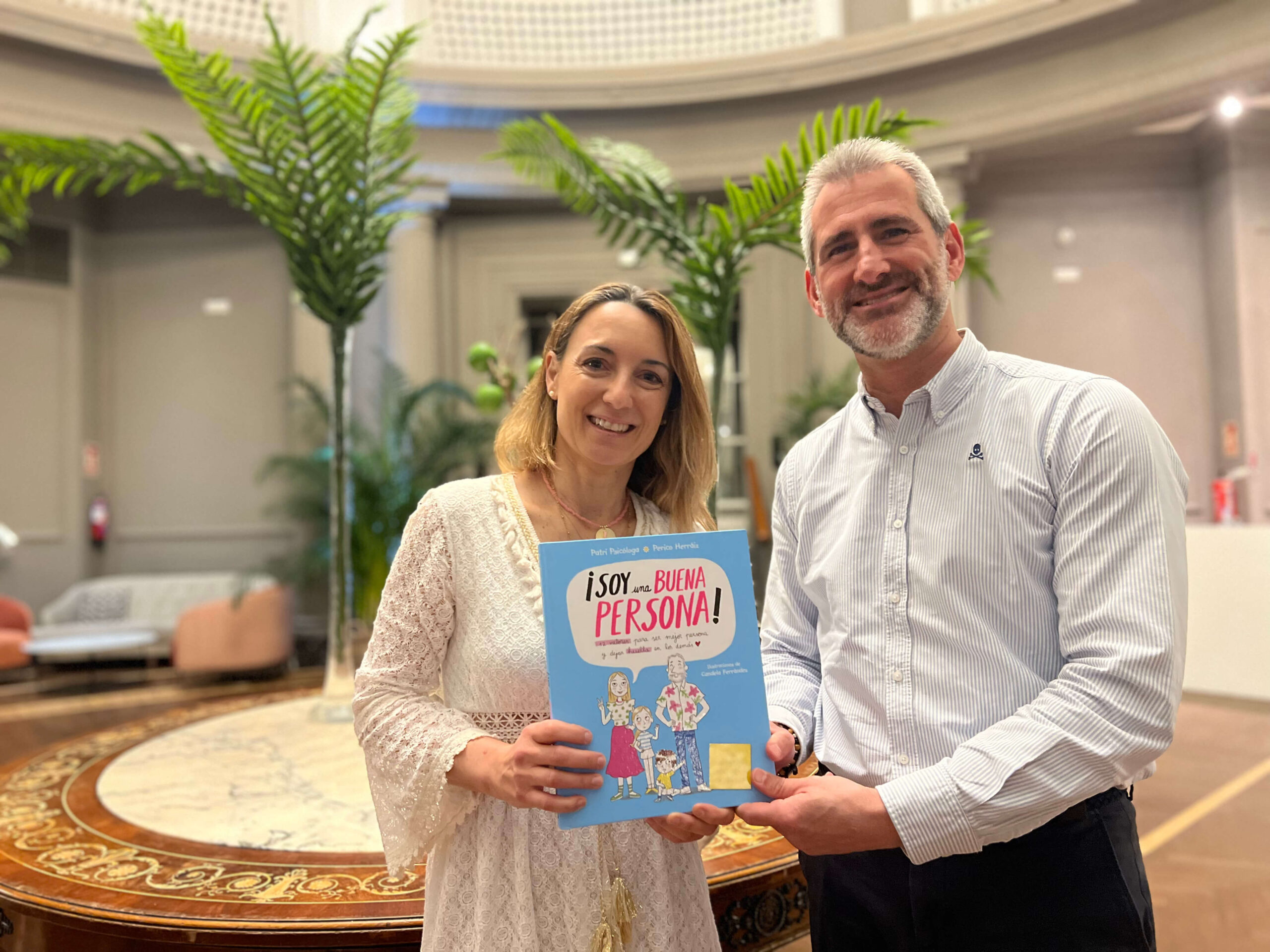
What does it mean to be a good person?
PATRICIA.- Being a good person is an attitude of courage, where you accept the risk of trusting people who may let you down. I believe it’s worth taking the risk because there are many people who, after a failure in a romantic relationship, or in their relationships with others, or when a business partner has let them down, tell themselves, «I won’t let this happen to me again!» and there arises the armor that protects you from many people who can hurt you but also distanced you from knowing wonderful people.
“Education is the best way we know to change the world”
Considering someone good was very close to defining them as weak or even foolish. Kindness has not had a very good reputation, to say the least.
PATRICIA.- We have inherited a completely misguided American business model, based on absolute competitiveness, where anything goes, and on individualism. And in this American dream of aspiring to acquire as many material possessions as possible, you cannot have many values.
PERICO.- It is true that there has existed a relationship between being good, being weak, and being easy. In the book, we specifically reflect that if you want to be truly good, you need effort, courage, and strength, which are virtues of a strong person, precisely, not something fragile.
The term «being good» is not well understood. When you are a parent, what do you really want for your child? You want them to be a good person, capable of establishing healthy relationships, with a positive way of thinking, not being conflictive or toxic, and for that, you have to be a good person; for that, you have to work on yourself, have self-control, and those are not values of a weak person.
Is being good about doing good deeds? Is this a simplistic view? Do you lose by being good?
PA: An important point is that being a good person is not merely about being someone who does not do evil, but rather one who intentionally does good. It’s about thinking about how you relate to others, with work, and with yourself, promoting good. I also believe we should dissociate between being good and being obedient, because sometimes we educate in absolute obedience and turn our children into submissive individuals who learn to feel loved when they do the good you impose on them. Then, they carry those dynamics to their friends and, to avoid losing them, they allow themselves to be pressured into behaviors that sometimes are no longer so positive. In order to not disappoint, I must continue to be obedient and good. But I don’t know if it is the good we are talking about, rather it is about planting the seed of kindness, which helps others without expecting a reward.
“Being a good person is not merely the one who does not do evil but the one who intentionally does good”
PE: “In a case of bullying, for example, in a primary school. Your child is not directly receiving harassment but is in the group of children. What do you do? If you are a good person, you act, speak up, defend the weak, and very few people do that. That is the courage we define as an essential and basic value for being a good person.
Is success at odds with kindness?
PERICO.- It’s the concept you wake up to and go to bed with, but it also gets you into trouble. The concept of being good, as Patricia referred to when talking about the American mentality, is sometimes at odds with success. A girl wrote this on Amazon or Instagram after buying our book, and told us that she had been educated in success, success, and she herself had decided to stop: “Enough, now I need to educate my children to be good people!” If being good leads to my success, great, but if it does not lead to my success, I set it aside. It’s a utilitarian view.
We live rushed, overwhelmed, seeking to stand out. How is our mental health as a society?
PATRICIA.- We are in a lifestyle that generates an aggressiveness reflected today on social media. If the majority of the population is running around all day, they do not have time to think, and thinking is very important. If you don’t have time to think, you also don’t have time to remain calm, to reflect, to make correct choices because everything is done on the go… that lifestyle generates a lot of aggression and a lot of anger.
What are the consequences?
PATRICIA.- Our emotions also need a rest, our minds need rest; if we do not provide them the nourishment they need – to exercise, take a nap, have a moment to breathe, or rest for 15 minutes to let the mind recover… – it’s normal for you to be on edge all day.
“The current lifestyle generates the aggression and anger that we see today on social media”
What do you think is the cause of so many gratuitous insults on social media?
PATRICIA .- Social media has allowed all the egos that were previously hidden to come out. But social media has this invisible side to it, and many people take advantage of it to say whatever they want. And then there’s the group of “offended people”; they read a comment with a fine-tooth comb, take it out of context, and leave their mark. If you use inclusive language and talk about women, they ask you why you don’t include men. There’s always something to criticize; people don’t know how to let things go. They don’t have that compassionate side, that reflection that the person I follow on social media nourishes me in many ways and offers me free content every day about psychology, health, or decoration. And if one day I don’t agree or don’t like what they post, just let it go! That’s what being a good person is all about. But no, they have to show that they disagree and often express their opinion without having seen the whole video.
PERICO .- One of the activities we have in the book is to be good news reporters. We are convinced that it is very important to educate the way we look at things, but first parents have to re-educate themselves. It is important to have that childlike perspective. The conversations between parents and children will probably also benefit teachers and the parents themselves, because we, in the end, accumulate wounds, negative things, experiences that children do not have. Most people on social media don’t attack or insult others; most people are incredible. And it’s also important to have that childlike perspective.
As a psychologist, how do you train the mind?
PA: Training the mind is learning to talk to yourself in a certain way, because most people sabotage themselves, mistreat themselves, and when we talk to ourselves, we are always criticizing ourselves. We have to learn to talk to ourselves in a respectful and loving way, as if you were talking to a friend. If you talked to a friend the way you talk to yourself, you would lose them.
“Most people spend all day running around, from one place to another, they don’t have time to think. And thinking is very important. You have to know how to stop and reflect.”
And why do we talk to ourselves so badly?
PA: We have been educated to punish. And that is a mistake. When you do something wrong, you punish yourself, but there is not a single scientific study in psychology that shows that punishment works. The consequences of doing something wrong are useful, and you try to make amends and do it right. If a child fails at school and their parents punish them by taking away their cell phone, all they achieve is making the child feel bad, without knowing whether the reason for the failure is the cell phone, a concentration problem, or a lack of organization.
Punishment always tends to make people feel bad, thinking that this will make them reflect, but this is not the case. Forgiveness, forgiveness, people find it very difficult to forgive.
“Training the mind is learning to talk to yourself in a certain way, because most people sabotage themselves, they mistreat themselves. It’s learning to talk to ourselves in a respectful and loving way.”
Does evil exist?
PA: Without a doubt. Psychopathy is a reality, and it doesn’t just turn people into murderers, you know? It affects people who may be right next to us, without any empathy. Of course, there are many variables, but it ranges from someone who steals from a cash register to other types of crimes. This inability to recognize that they have done wrong, because they don’t see it that way, placing themselves above good, is not a disease. Pathologies that lead to mental health problems are another thing.
PE.- What we have been observing for many years is that conflictive profiles, surrounded by hostile environments, react very well when you can intervene educationally and recognize their worth. Volunteering, in this sense, plays a very positive role.
Can we improve our lives and ourselves? How do we stop, how can we take the first steps?
PA.- What people don’t have is time. Many of the people who come to our workshops and read our books then say to us: “OK, but now how do I do it?” I think, but you have it right here, I’ve just told you, you just have to do it, apply it. The truth is that most people want everything spoon-fed to them, and they end up accumulating a lot of theory in their heads but continue to do things wrong.
To stop and reflect, you have to make sacrifices, you have to choose. And we live in a society where people don’t want to give anything up, because we also have a constant showcase on social media, offering us “the five getaways you can’t miss in 2025,” or the three vegan cafes you have to visit, etc.
You have to strike a balance, be in the world without isolating yourself, but without driving yourself crazy. In my case, I try to make a lot of sacrifices, and more and more, based on my scale of values, which clearly defines my priorities.
What is @patripsicologa’s latest “adventure”?
PA.- Thinking about other ways of disseminating information, I spoke to a colleague and we both thought: hey, how can we change the way psychologists disseminate information a little? We decided to try dramatizing a conference, and that’s how it all started. We talked to a theater director, he dramatized a talk for us, and from there I started working with him and the play “Anxiety Doesn’t Kill, But It Tires You Out” came out, a comedy in which there is an anxious character and a psychologist who gives him recommendations throughout the play to treat his anxiety. We turned all these psychological tools into comedy, giving them a storyline, and from there, others have emerged: one about relationships, another about children, etc. I’m very interested in finding different ways to disseminate psychology.