


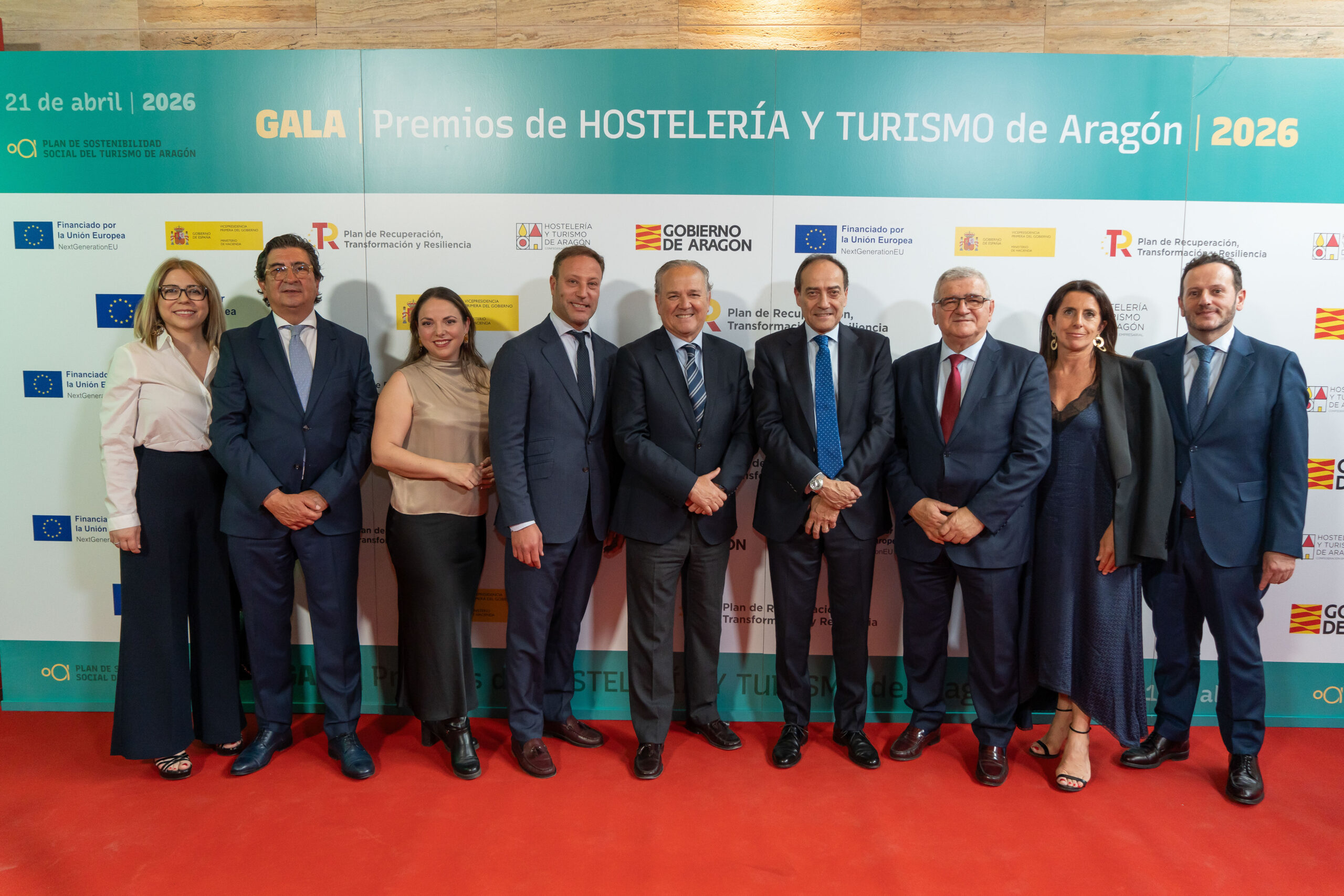
The city of Huesca has hosted one of the most significant events in the Aragonese tourism sector: the gala for the Hospitality and Tourism Awards of Aragon, organized by the Confederation of Hospitality and Tourism Entrepreneurs of Aragon. This gathering, framed within the Social Sustainability Plan for Tourism in Aragon, has highlighted the transformative role of tourism when focused on social, sustainable, and territorial impact criteria.
With over 200 attendees, the gala combined institutional presence and warmth, establishing itself as a space for recognition, reflection, and projection of the sector’s future. The event was led by presenter Toño L’Hotellerie, who brought dynamism to an evening marked by collective commitment.
A Transforming Sector: Tourism as a Social Engine
The event featured prominent authorities who concurred on the crucial moment that tourism in Aragon is experiencing. The mayor of Huesca, Lorena Orduna, opened the speeches by emphasizing the importance of the city as a host and the value of sustainable tourism as a tool for local development.
For his part, the president of CEHTA, Fernando Martín, highlighted the sector’s evolution in Aragon, focusing on its capacity for adaptation, internal cohesion, and sustained growth. In his speech, he particularly emphasized the importance of public-private collaboration as a key element in tourism progress.
From the regional institutional perspective, Jorge Moncada noted the pioneering nature of the Social Sustainability Plan, highlighting its impact on transforming the tourism model towards more responsible parameters.
The closing remarks were made by Jorge Esteban, who emphasized the role of investments linked to the Recovery, Transformation and Resilience Plan, highlighting sustainability, efficiency, and territorial cohesion as fundamental pillars of current tourism development.
Acknowledgment of Commitment: Awardees that Set the Path
One of the central moments of the gala was the award presentation, which recognized exemplary initiatives in various categories related to sustainability, innovation, and social impact.
In the provincial category of Teruel, the award went to the Bodas de Isabel de Segura Foundation, renowned for its work in cultural and tourism promotion through historical recreations that generate significant economic and social impact.
The Circular Economy / Kilometer 0 award highlighted projects that promote local consumption and social value generation. The recognitions went to the Hotel Restaurante Torre del Compte (Teruel), Camping Zaragoza, and the Cinca Medio Hospitality Group – Mas Farré (Huesca), showcasing the sector’s commitment to more sustainable models.
In the province of Zaragoza, the award went to Embou, whose work in connectivity has been key for territorial integration, especially in rural areas.
Meanwhile, the Social Investment award distinguished Viajes Godó, Hotel Ibis Style of Zaragoza, and Camping Laspaúles, recognizing their commitment to quality employment, inclusion, and reinvestment in the territory.
In Huesca, the recognition went to the Guayente Hospitality School, noted for its role in training professionals and dignifying the sector.
Beyond the Awards: A Collective Movement
The gala served not only to reward specific initiatives but also to showcase a broader movement within the sector. More than 100 establishments adhering to the Code of Good Practices in Hospitality were recognized as examples of commitment to sustainability, consolidating a network of actors aligned with the values of the plan.
Furthermore, the Government of Aragon received special recognition for its institutional support of the Plan, underscoring the importance of public backing in transforming the tourism model.
A Strategic Plan to Redefine Tourism
The Social Sustainability Plan for Tourism in Aragon, promoted by the Ministry of Industry and Tourism and financed with Next Generation funds, represents a decisive commitment to redefining tourism from a social perspective.
Among its main objectives are:
- Improving the well-being of local communities, ensuring that tourism positively impacts the territory.
- Raising the quality of employment in the sector, promoting stability and professional dignity.
- Reinforcing the social value of tourism, establishing it as an engine for cohesion and economic development.
This approach suggests a paradigm shift: tourism is no longer understood solely as an economic activity but as a tool for social transformation.
Aragon, a Reference in Responsible Tourism
The celebration of this gala in Huesca is not coincidental. Aragon is positioning itself as a benchmark territory for sustainable tourism, thanks to initiatives that integrate social, economic, and territorial dimensions.
The coordinated work among administrations, businesses, and social entities is allowing progress towards a more balanced model, where tourism growth does not compromise the well-being of communities but rather reinforces it.
In this context, events like the CEHTA Awards not only recognize the present but also project the future of the sector: a tourism that is more human, more conscious, and more committed to the territory.