



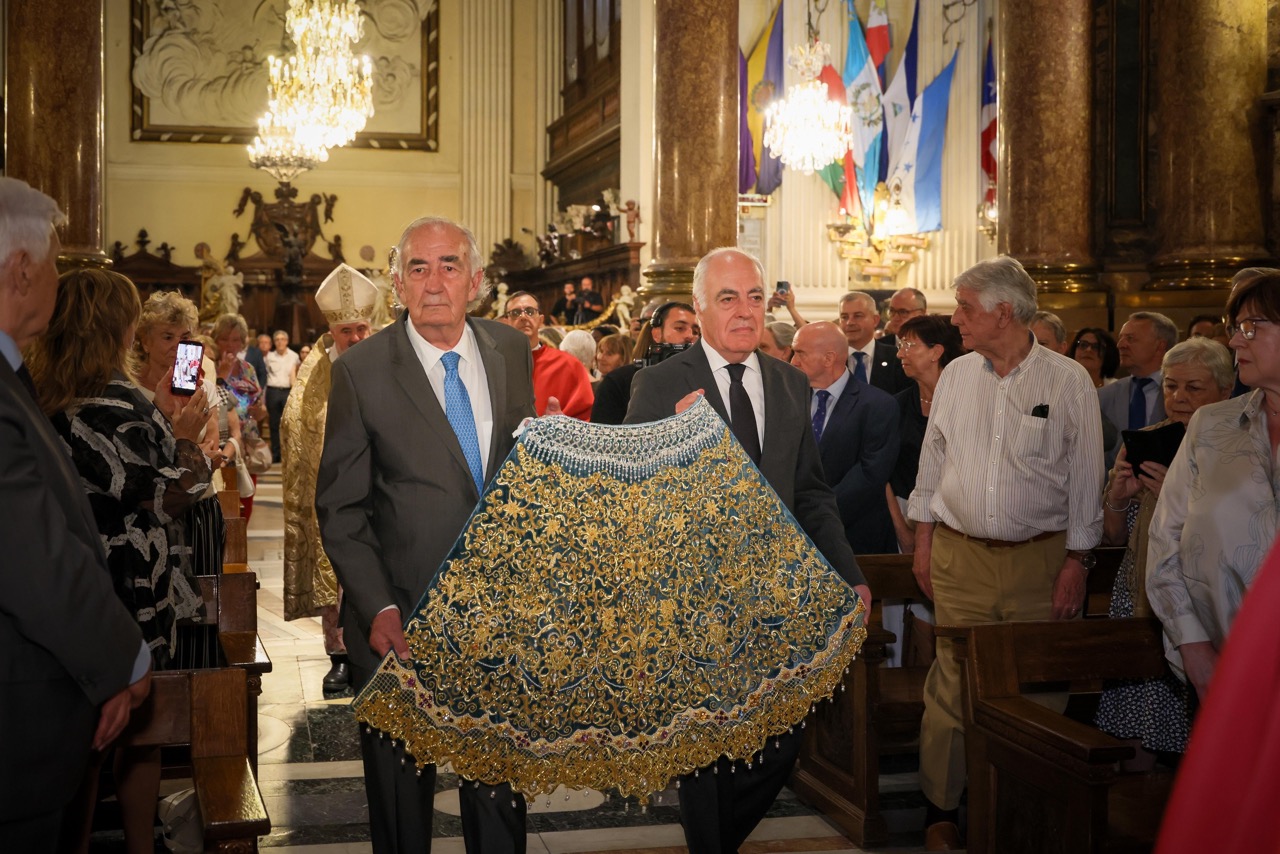
Some anniversaries are celebrated with numbers, balance sheets, or institutional speeches. Others seek to express themselves through symbols capable of transcending generations. Fundación Ibercaja has chosen the latter route to commemorate its 150 years of history by presenting a jeweled mantle to the Virgen del Pilar during a ceremony held in the Santa Capilla of the Zaragoza Basilica, one of the most emblematic spaces in Aragón.
The event brought together institutional representatives, entity officials, and civil and religious authorities in a ceremony steeped in historical and cultural significance. The presentation was carried out by Amado Franco, president of Fundación Ibercaja, and José Luis Rodrigo, its general director, coinciding with the exact date marking the 150th anniversary of the founding of the former Caja de Ahorros y Monte de Piedad de Zaragoza, the predecessor of the current Foundation.
Beyond its religious dimension, the gesture reaffirms the bond the institution has maintained with Aragón since the late 19th century. The history of Fundación Ibercaja is closely linked to the economic and social evolution of the autonomous community, a relationship the entity aimed to reflect through a work specifically conceived for this anniversary.
The piece presented to the Virgen del Pilar stands out for its elaborate craftsmanship and the symbolic richness it embodies. Created by the renowned Taller Orobordado in Seville, which specializes in religious textile art, it combines traditional techniques of Spanish Baroque embroidery with visual references that evoke the Aragonese identity and the historical trajectory of the institution.
Far from being merely ornamental, the design of the mantle unfolds as a visual narrative. Among its elements are references to the original Monte de Piedad that gave rise to the entity, motifs inspired by the Aragonese Mudejar heritage, and symbols linked to the landscape and culture of the territory.
The three Aragonese provinces find representation in the composition. References to the Pyrenean peaks evoke Huesca; the central elements connected to the Virgen del Pilar symbolize Zaragoza; while Mudejar-inspired details remind us of the historical legacy of Teruel. Added to this are allusions to the Ebro River as the backbone of the territory and a series of pearls that represent the various Aragonese counties.
The ceremony was attended by the president of the Government of Aragón, Jorge Azcón, the Justicia de Aragón, Concepción Gimeno, members of the regional Executive, representatives from Fundación Ibercaja and Ibercaja Banco, in addition to various civil, military, and ecclesiastical authorities.
Following the handover of the mantle, a solemn Eucharist was held at the Main Altar of the Basilica del Pilar, presided over by the Archbishop of Zaragoza, Carlos Escribano, as part of the commemorative acts for the anniversary.
The choice of the Basilica del Pilar as the main venue for this celebration is not coincidental. Few institutions represent Aragonese collective identity as profoundly as this Marian temple, which has been a spiritual, cultural, and heritage reference for the community for centuries.
In this context, the offering takes on a dimension that transcends the institutional sphere. It serves as a gesture of recognition towards a shared tradition and towards a society with which Fundación Ibercaja has maintained a steady relationship over a century and a half.
Founded in 1876, the entity has evolved from its origins as a savings bank to become a foundation focused on social, cultural, and educational development. Over these 150 years, it has accompanied the economic and social changes in Aragón, participating in initiatives related to education, culture, innovation, and territorial development.
The presentation of the mantle symbolizes precisely this historical continuity. An anniversary that not only invites reflection on the path traveled but also on the role that deeply rooted institutions can play in building the future.
Because sometimes, the best way to celebrate a long journey is not just to look back but to recognize the roots that have allowed us to reach the present. And few images better encapsulate that idea than a mantle woven with symbols of Aragón, offered in the heart of Zaragoza by an institution that is part of the contemporary history of the community.