



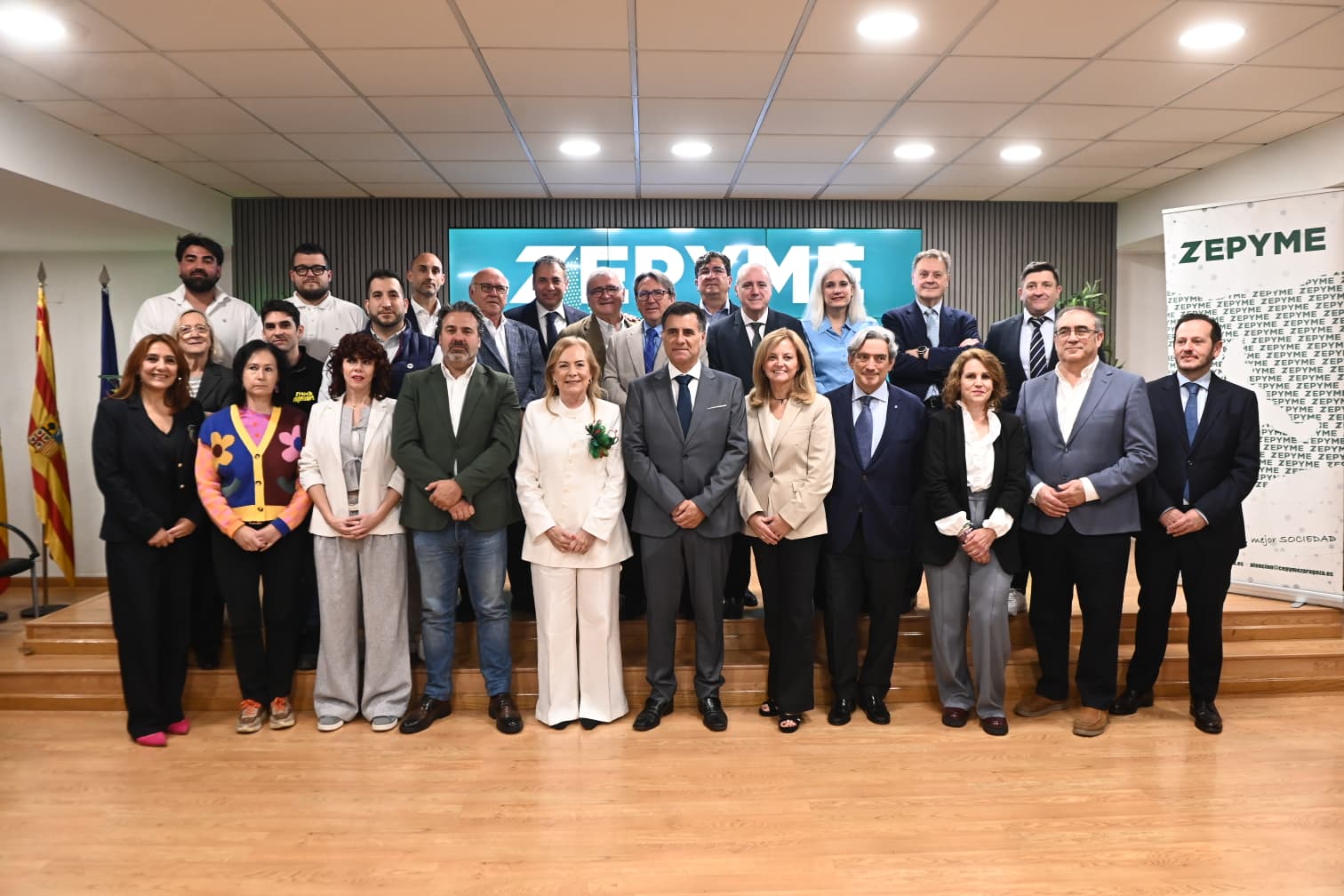
The reelection of María Jesús Lorente Ozcáriz at the helm of ZEPYME Zaragoza comes at a time when small and medium-sized enterprises (SMEs) in Spain are undergoing a silent yet profound transformation. Beyond the major industrial and technological announcements dominating the economic debate, a significant portion of the actual competitiveness of the territory continues to depend on thousands of medium-sized and small companies that are simultaneously required to adapt to digitalization, talent shortages, generational change, and increasing regulatory complexity.
Lorente has been reelected as president of the Confederation of Small and Medium Business of the Province of Zaragoza for a new five-year term, consolidating a phase marked by the internal modernization of the organization and a clear attempt to strengthen the dialogue of Aragonese SMEs both at the regional and national levels.
The proclamation event, held at the organization’s headquarters in Zaragoza, brought together institutional representatives, social agents, and business leaders in an image that reflects the growing weight of the employers’ association in the Aragonese economic ecosystem. The presence of the president of the Cortes of Aragon, María Navarro, and the vice president of the regional government, Mar Vaquero, further underscored the strategic significance that administrations currently attribute to the SME sector.
But beyond the institutional component, Lorente’s speech hinted at what the priorities of this new stage will be. The president positioned talent attraction and retention as one of the main immediate challenges facing Aragonese companies, alongside administrative simplification, taxation, generational change, and technological transformation.
These are not abstract issues. Aragon is experiencing an increasingly visible contradiction: while the community gains industrial and logistical prominence due to new investments linked to automotive, energy, technology, and data centers, many small businesses are facing growing difficulties in filling technical vacancies, ensuring business successions, or making the necessary technological investments to remain competitive.
For the past few years, Lorente has insisted on an idea that now seems to be consolidating as a strategic axis of ZEPYME: business associationism as a tool for economic resilience. “Sharing experiences and continuing to learn” was one of the expressions used during her speech to advocate for cooperation among associations and business organizations in an environment she defined as “uncertain and volatile.”
The message is significant at a time when many regional employers’ associations are trying to redefine their practical utility. Institutional representation is no longer sufficient on its own. Companies demand real support in the face of concrete problems: access to financing, automation, training, digitalization, absenteeism, or internationalization.
One of the symbols of this transformation has been precisely the change in corporate identity driven during Lorente’s term. The organization recently replaced the traditional “C” of CEPYME with the “Z” of Zaragoza, officially adopting the ZEPYME brand as a gesture of territorial linkage and institutional differentiation.
This may seem like a minor detail, but it reflects a broader trend: business organizations are seeking to strengthen identity and proximity at a time when companies demand more agile, useful, and less bureaucratic interlocutors.
Currently, ZEPYME groups nearly a hundred sectoral, intersectoral, and territorial associations, representing over 20,000 SMEs and self-employed individuals in the province of Zaragoza. The new Executive Committee, presented during the proclamation event, will be composed of 40 representatives from various economic sectors and regions in the province, in an effort to broaden representation and business diversity.
Lorente’s trajectory explains part of that cross-cutting vision. A businesswoman and CEO of the BIOK Group, her profile combines business experience, institutional activity, and…