



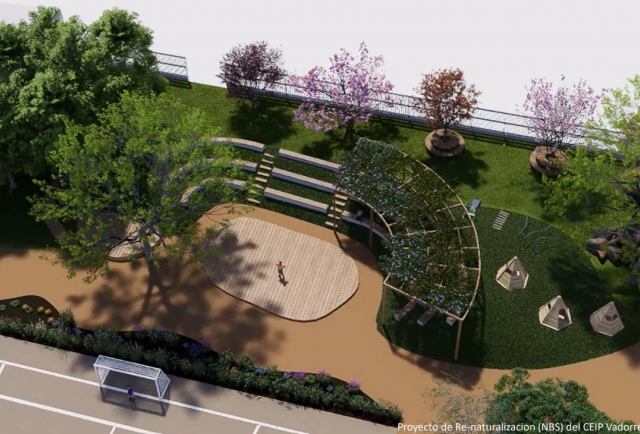
The Government of Aragón has launched an ambitious project to renaturalize the courtyards of two schools in Zaragoza, funded with European funds from the Horizon Europe program. With a budget of 239,941 euros, the work will focus on transforming the outdoor spaces of CEIP María Moliner and CEIP Vadorrey Les Allées to better adapt to high temperatures.
Aragón’s Participation in the CARDIMED Project
Aragón is one of the nine demonstration sites for the CARDIMED project in the Mediterranean, an initiative that seeks to apply nature-based solutions to address climate change. The General Directorate of Environmental Education of the Government of Aragón collaborates with the CIRCE Foundation and more than fifty European partners in this consortium. This effort is based on the previous experience of the Patios X El Clima program, which had already developed projects for both schools.
Technical Details and Execution Timeline
The contract for the work is divided into two lots: 112,830 euros for CEIP María Moliner and 127,110 euros for CEIP Vadorrey Les Allées. The opening of bids will take place on May 5, 2026, with the closing on May 3. The work must be completed within a maximum of two months, finishing before December 15, 2026. It is expected that the interventions will be carried out in the summer to avoid interference with school activities.
Interventions in School Courtyards
At CEIP María Moliner, located at Camino de Miraflores 10, two main areas will be developed. The Forest Wedge Zone will include a wooded area with distinct islands for educational and recreational activities, while the Northern Limiting Zone will have wooden structures and climbing plants to enhance thermal comfort.
On the other hand, CEIP Vadorrey Les Allées, on Alfonso Zapater Cerdán Street, will see the construction of a hill with an agora for events, covered with climbing plants and equipped with misting systems. In addition, the access will be redesigned, and the transit space will be improved with new surfaces and refuge areas.
The implementation of these projects aims not only to improve thermal comfort in the courtyards but also to provide innovative and sustainable educational spaces. The results will be measured using sensors installed in the schools, which will continue to record data to assess the impact of the interventions.