



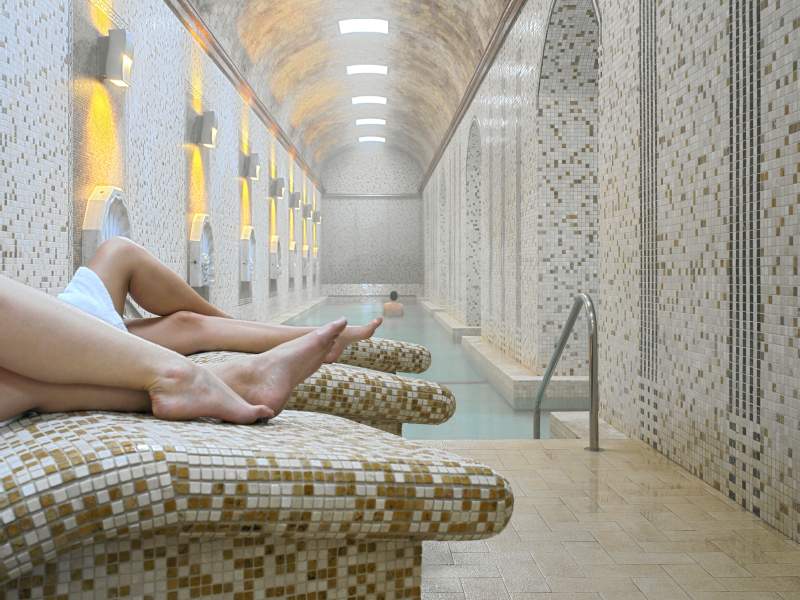
Thermalism is rooted in the origins of modern tourism. Visiting thermal baths for a few days of relaxation, while accompanying healing therapies with various cultural and leisure activities, is not a new concept. However, in the past, such stays at spas and the hotels that sprouted around them were only affordable for the wealthiest classes. Over time, this has changed, and increasingly, a healthy activity like thermalism has been democratized. This evolution is evident in the various thermal establishments available in the province of Zaragoza.
Interestingly, all of them are located within a relatively small radius and are integrated into the Calatayud Community District, as thermalism in Zaragoza develops in the towns of Alhama de Aragón, Paracuellos de Jiloca, and Jaraba. All three municipalities boast natural springs extraordinarily rich in minerals and therefore in waters with medicinal properties.
These springs have been known for a very long time and have been exploited since ancient times. However, the true tourist development began in the mid-19th century. Since then, their hotels, leisure and cultural offerings, facilities, and, of course, their medicinal and aesthetic therapies have evolved to meet modern demands. Now, these are 21st-century spas that are well-connected thanks to their location near the A-2 motorway, which links Madrid and Zaragoza.
Thermas Pallarés in Alhama de Aragón is a fabulous example of all that has been mentioned. This establishment is now part of the Balnearios Relais Termal group, but its history dates back much further. Officially opened in 1863, it became a benchmark for thermalism in Spain, largely due to its frequent visitors from the Royal Family.
This sense of history and glamour still permeates its facilities and the various hotels within the complex: Gran Hotel Cascada, Hotel Termas, and Hotel Parque. It is also evident in old buildings such as the former casinos and cinema. Additionally, Termas Pallarés possesses a natural gem that is the emblem of the spa. It consists of an outdoor thermal lake that invites bathing at any time of the year, as its waters maintain a constant temperature of 28ºC.
And without leaving this locality, one can also choose the Hotel Balneario Alhama de Aragón. This establishment appears much more modern than its neighbor. However, this does not mean it lacks a long thermal history. In fact, the same springs that supply the spa are known to have been used by the forces of El Cid to recuperate from their exploits in the area.
In homage to those distant times, its most emblematic facilities are the baths of the Moor and the Moors. Nevertheless, the entire complex radiates modernity and offers a wide range of therapies based on water circuits, steam baths, and the latest trends in thermalism. Health and vacations are united by waters of immense mineral wealth.
A few kilometers from Calatayud, the capital of the district, another emblem of thermalism in the province of Zaragoza can be found. This is the Balneario de Paracuellos de Jiloca, the oldest of the Aragonese spas, established in 1848. Although the area of sulfurous waters was already known prior to this date, a quality that makes them ideal for treating respiratory and dermatological conditions, as well as therapies related to the musculoskeletal system.
The treatments offered at this expansive spa do not end here, as it features numerous thermal circuits, hydrotherapy rooms, and spaces for beauty treatments. Not to mention its two natural lakes, gardens, and long promenade. Relaxation is assured.
To conclude this tour of thermal tourism locations in Zaragoza, it is worth mentioning the town of Jaraba, which is home to three different spas. Currently, however, the only operational one is the Balneario de La Virgen. Its location in the heart of the Mesa River canyon alone makes it worth a visit.
Once there, it is essential to take advantage of its highly therapeutic thermal waters. These always flow at temperatures ranging from 30 to 34 degrees Celsius and offer a very interesting mineralization due to their bicarbonate, chloride, sulfate, calcium, and magnesium content. In other words, they are perfect for various treatments and therapies.
Other mineral-medicinal springs arise in different areas of Jaraba, which is why the Balnearios de Serón and Sicilia are also located in this town, both connected by a long landscaped promenade. Both are currently closed as they undergo renovations to reintegrate into the thermal offerings of the province of Zaragoza as soon as possible.








