



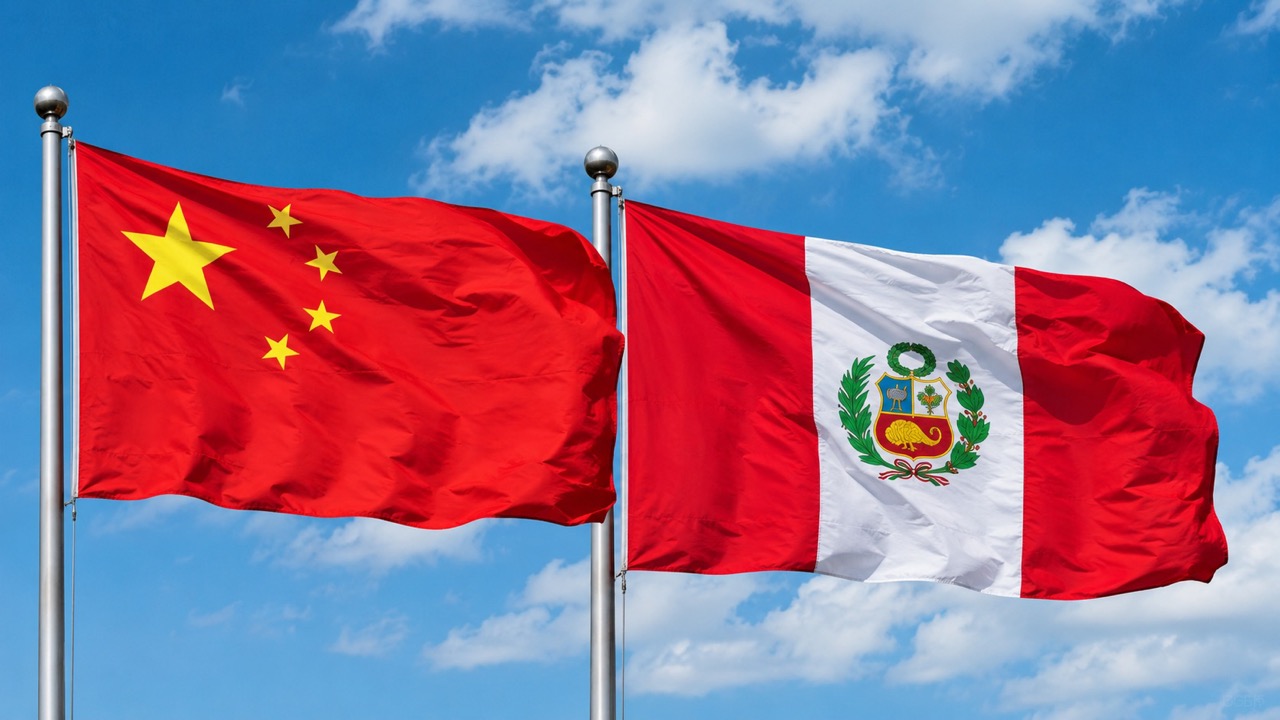
The economic presence of China in Peru has progressively expanded across various sectors of the economy. What began primarily as a trade relationship based on Peru’s export of raw materials has evolved into a framework that includes business investments, mining operations, electricity distribution, infrastructure, and, starting from late 2024, a direct port connection with Asia through Chancay.
China is currently the largest trading partner of Peru. The Peruvian Ministry of Foreign Trade and Tourism estimates that it accounts for around 35% of the country’s foreign trade. Additionally, in 2025, it represented 36.2% of all Peruvian exports.
The relationship also has a solid institutional framework. Both countries have maintained a Free Trade Agreement since 2010, and in November 2024, they signed a protocol to modernize it. Peru completed its internal procedures for ratification in July 2026, incorporating issues such as digital economy, customs cooperation, services, and investment.
Trade as the Starting Point
Raw materials are a fundamental part of Peru’s exports to China. Copper, gold, lead, and fishmeal are among the products most frequently exchanged.
In the first two months of 2026, China received 39% of all Peruvian exports, valued at $6.936 billion. The growth was driven specifically by increased shipments of minerals and fish products.
The trade relationship also works in the opposite direction. China supplies the Peruvian market with vehicles, machinery, technology equipment, industrial products, steel, chemicals, and numerous consumer goods.
This exchange has undergone a remarkable transformation over the last two decades. According to the National Prospective Observatory of Peru, China represented only 9.5% of Peruvian exports in 2006. By 2024, it already absorbed approximately one-third.
Chinese Companies Entering Peruvian Mining
The next step was direct investment. Mining serves as one of the primary examples.
Chinese companies and consortiums are involved in some of the large mining operations in the country. These include Las Bambas, one of Peru’s major copper mines, operated by MMG; Toromocho, connected to Chinalco; and the operations of Shougang Hierro Perú in Marcona.
This presence is largely due to the existing complementarity between the two economies. Peru has significant mineral reserves, while the Chinese industry requires large amounts of raw materials for sectors such as construction, automotive, electronics, electrical grids, and renewable energies.
The result is a relationship where China acts not only as a buyer of Peruvian minerals but also directly participates in their production.
From Mines to Electricity
Investments have subsequently extended into the energy sector.
Chinese groups have acquired significant assets in electricity generation and distribution in recent years. Among the most notable operations are Luz del Sur, acquired by China Yangtze Power, linked to China Three Gorges, and the former Peruvian distribution assets of Enel, acquired by China Southern Power Grid.
These operations are complemented by investments in hydroelectric generation and other energy projects.
Chancay Incorporates Logistics
The Port of Chancay represents a new stage.
Inaugurated in November 2024 and located about 80 kilometers north of Lima, the port is 60% controlled by COSCO Shipping Ports, belonging to the state-owned group China COSCO Shipping.
Its main function is to facilitate a direct maritime connection between Peru and Asia with large container ships. The reduction of stops allows for shorter routes and enhances Peruvian exports to Asian markets.
Chancay has also been envisioned with a regional dimension. Peru aims for it to consolidate goods from other South American countries for later transport to Asia. The Peruvian Ministry of Foreign Affairs presents it explicitly as a hub to improve connectivity between the two continents and as a regional platform for companies interested in operating from Peru.
Technology, Telecommunications, and Services
The presence of Chinese businesses also extends to other fields.
Companies such as Huawei and ZTE have been operating in the Peruvian telecommunications and technology market for years, providing equipment and solutions for operators, businesses, and institutions.
There is also a presence in financial services and other activities related to the growing volume of trade and investment between both countries.
The number of companies gives an idea of the diversification achieved. The Peruvian Ministry of Foreign Affairs indicated in March 2026 that more than 200 Chinese companies had invested in the country, particularly in mining, energy, infrastructure, and mineral resources.
Peru is also looking to expand these investments into new areas. Authorities have presented Chinese investors with opportunities related to transportation, sanitation, agriculture, and irrigation for the 2026-2028 period.
A Relationship Built Over Decades
Diplomatic relations between Peru and the People’s Republic of China were established in 1971, but economic integration accelerated particularly during the early decades of the 21st century.
The growth of the Chinese economy increased the demand for minerals and other Latin American raw materials. Peru, as one of the main mining producers on the continent and a country situated on the Pacific coast, progressively increased its exchanges with the Asian market.
The 2010 FTA reinforced this trend. Since then, new business investments and asset acquisitions have followed, while Peruvian exports to China have increased significantly.
The ongoing update of the commercial agreement incorporates a new generation of issues related to digital trade, investment, and economic cooperation.
An Increasingly Diversified Presence
The economic relationship between the two countries can now be observed at different points along the production chain.
China purchases Peruvian minerals and agricultural products; Chinese companies participate in mining and energy assets; technology manufacturers supply equipment and services; and COSCO primarily controls a port designed to directly connect the South American Pacific with Asia.
Peru, for its part, continues to promote trade and the arrival of new Chinese investments while developing economic relations with the United States, the European Union, and other Asian markets.
Trade data illustrates the magnitude of this relationship. China went from accounting for less than 10% of Peru’s exports in 2006 to surpassing one-third today. In 2025, it again emerged as the leading destination for Peruvian exports.