



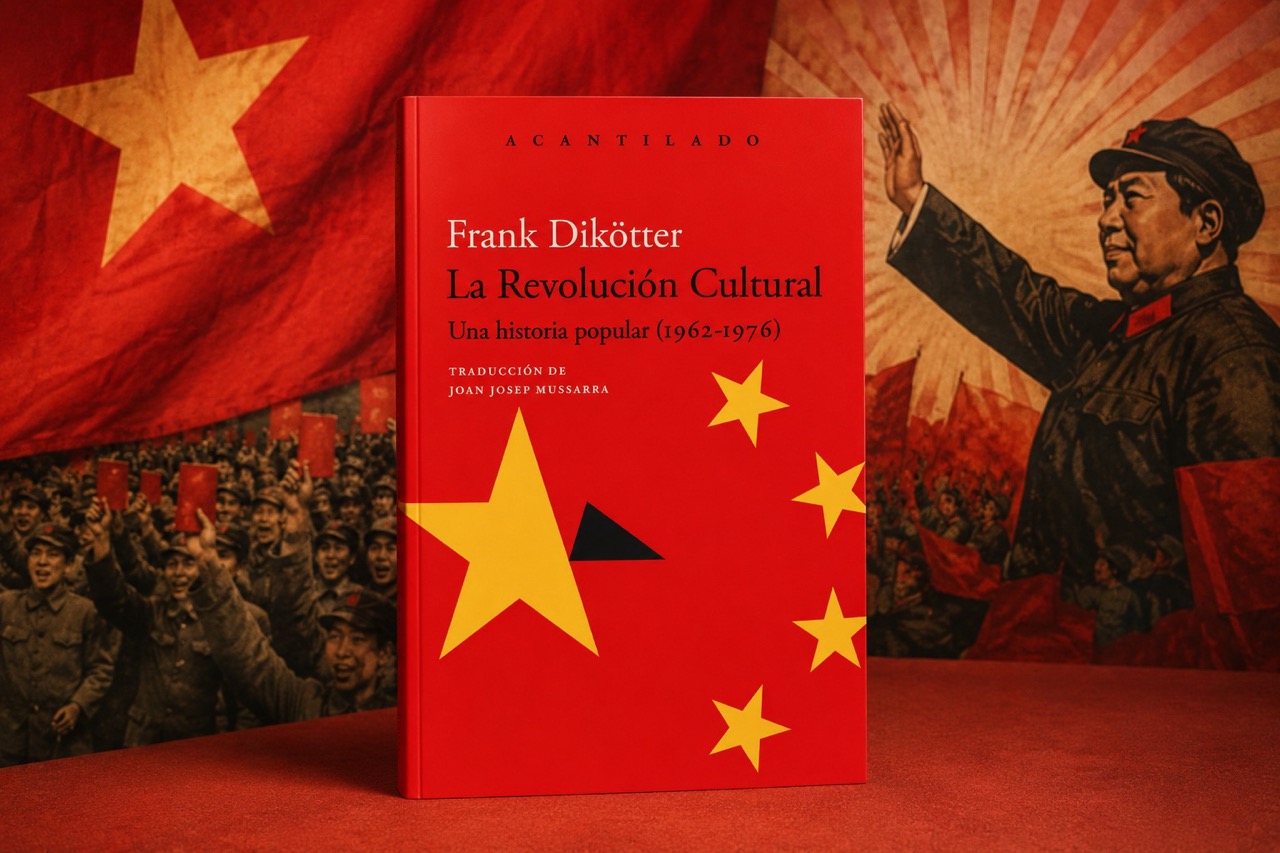
Review of The Cultural Revolution: A People’s History (1962-1976) by Frank Dikötter
In August 1963, Mao Zedong hosted a group of African guerrillas in Beijing. One of them, from Southern Rhodesia, asked whether China would also betray the revolution, as he believed the Soviet Union had done. Mao listened, took a puff from his cigarette, and replied that he could not offer such a guarantee: China needed to find a way not to become «corrupt, bureaucratic, and revisionist.»
Three years later, Mao himself would initiate the Cultural Revolution.
This episode, recounted by Frank Dikötter in the preface of The Cultural Revolution: A People’s History (1962-1976), encapsulates a significant part of the paradox that runs through the book. A campaign presented as a defense of the revolution ultimately triggered an explosion of violence, internal conflicts, purges, and cultural destruction. It aimed to save the Maoist project, but ended up undermining its foundations.
The work concludes the trilogy that Dikötter has dedicated to Mao’s China. After examining the catastrophe of the Great Leap Forward and the early years of the People’s Republic, the Dutch historian focuses here on the period from 1962 to 1976. He does not merely reconstruct the decisions made at the top of the Chinese Communist Party; he seeks to trace their consequences in schools, factories, villages, and families.
The starting point is Mao’s increasingly fragile position following the failure of the Great Leap Forward. The famine had exposed the cost of his policies, and some leaders began to hold him responsible for the disaster. Liu Shaoqi and Deng Xiaoping, among others, attempted to restore some economic and administrative normalcy. Mao perceived these changes as a threat. He feared that China would follow the path of the Soviet Union after de-Stalinization and that, after his death, someone would denounce his legacy as Nikita Khrushchev had denounced Stalin’s.
The response was a new revolution aimed at combating the remnants of bourgeois culture and the so-called revisionism. However, beneath that rhetoric, Dikötter also identifies Mao’s desire to regain control of the Party and settle scores with his adversaries. In his interpretation, ideology and personal ambition are not incompatible explanations. Mao blurred the line between his own authority and the fate of the revolution: any critique aimed at him could be presented as a threat to socialism.
One of the book’s strengths lies in explaining how a carefully prepared political operation ultimately spiraled out of the control of its initiator. Mao turned to the youth to attack leaders deemed counter-revolutionary and encouraged the public to «bombard the seats» of power. The Red Guards took those directives literally. Soon, they began to confront one another, while different factions within the Party used the mobilization to protect their allies or eliminate their rivals.
The expression «raising the red flag to fight the red flag» aptly describes that maze. Everyone claimed to act in Mao’s name. Everyone asserted they represented the true revolutionary line. Yet, factions competed for power, accused one another, and dragged the populace into a spiral of violence that in some areas took on characteristics of civil war.
When the army intervened in 1967, it did not end the crisis but initiated another phase. Revolutionary committees placed much of the administration under military control. This was followed by «re-education» campaigns, the relocation of youth to the countryside, and new purges against those who had participated in the first phase of the Cultural Revolution. The enemies changed names—bourgeois, traitors, renegades, spies—but the logic remained intact: any word, personal relationship, or family background could become a proof of guilt.
Dikötter pays special attention to ordinary people. The book relies on hundreds of archival documents, many used for the first time, as well as autobiographies, interviews, police reports, statistics on purges, and documents about life in the countryside and factories. This variety of sources helps correct an overly simplistic image of Chinese society as a completely subjugated and uniform community.
The population could not choose freely, but it did not always react in the same way. There were those who participated, convinced they were defending the revolution; those who took advantage of the chaos to settle scores with former enemies; those who pretended to obey while protecting their own interests; and those who tried to remain unnoticed. Fear did not negate all decisions: it forced them to be made under extreme conditions.
The last part of the book is particularly revealing. As the population grew weary of chaos and repression, a «silent revolution» emerged, especially in the countryside. Villagers resumed traditional practices, opened illegal markets, redistributed collective goods, and established small factories outside of the planned economy. These were discreet gestures, difficult to organize as political opposition, but sufficient to erode state control.
In this unintended consequence lies one of Dikötter’s most interesting arguments. The Cultural Revolution not only left millions of victims and profound cultural devastation; it also weakened the planned economy and emptied much of Maoist ideology of its content. The society that Mao sought to lead toward a purer form of communism ended up seeking, in many cases, its own paths to survive and thrive.
The book is not a light read. Its length and the abundance of names, campaigns, and episodes may require considerable effort. At times, the succession of purges and confrontations creates a sense of accumulation that detracts from the narrative’s fluidity. But this density also reflects the complexity of a process that did not unfold uniformly across the country.
The author’s perspective is severe and decidedly critical of Mao. He does not intend to paint a balanced portrait of the leader but rather to highlight the responsibility he bore in creating and prolonging…
Book Details
Frank Dikötter, The Cultural Revolution: A People’s History (1962-1976)
Translation from the Spanish by Joan Josep Mussarra.
Published by Acantilado.
First edition: April 2025.
592 pages.
ISBN: 978-84-19958-54-9.