



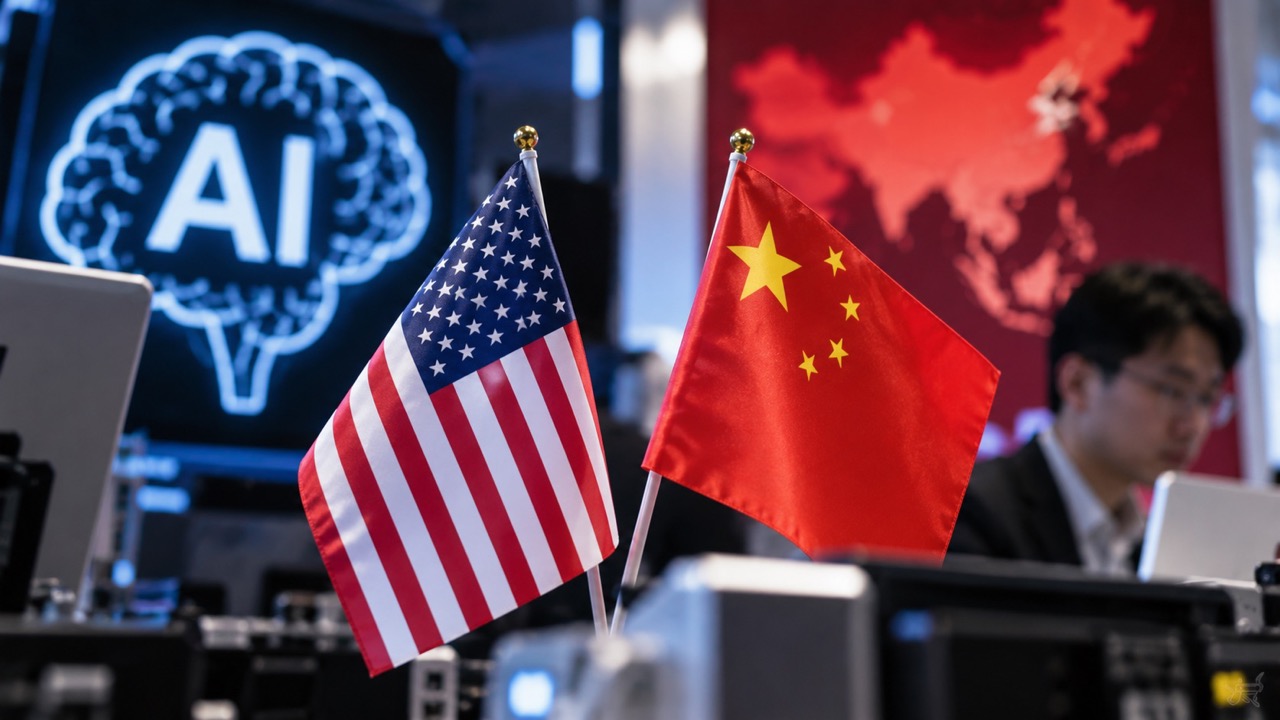
The gap between the United States and China in the artificial intelligence business is clear when comparing the annualized recurring revenue of their leading companies. According to Rhodium Group estimates cited by Quartz, Anthropic is operating at an ARR run rate of about $65 billion, while OpenAI stands at $40 billion. Chinese companies remain far behind: ByteDance is at around $4 billion; Alibaba, $2.4 billion; Z.AI, $1.8 billion; Moonshot, $1 billion; MiniMax, $800 million; and DeepSeek, about $500 million.
The comparison requires an important clarification. ARR — short for annual recurring revenue — is not equivalent to revenue recognized at the end of a fiscal year. It is a projection based on the recent pace of revenue and is useful for measuring the commercial momentum of companies growing very rapidly, but it should not be confused with audited annual accounts.
Even with that caveat, the gap is wide. The leading Chinese companies analyzed together generate only a fraction of the revenue attributed to OpenAI, and even less than Anthropic. It might therefore appear that the United States has established a lead in artificial intelligence that will be difficult to close.
But that conclusion tells only part of the story.
China is succeeding in getting its models used increasingly beyond its borders. And much of that progress rests on a strategy that, precisely, makes it harder to generate substantial direct revenue from each user: inexpensive, open-weight models that are easy to adapt.
More use, less revenue
During 2025, models developed by Chinese companies and institutions exceeded 2 billion downloads on Hugging Face, one of the leading international platforms for open models. They accounted for 41% of the total, compared with 31% for U.S. developers.
Qwen, Alibaba’s model family, alone accumulated more than 1.4 billion downloads, while DeepSeek reached 484 million. The picture is very different from that reflected in revenue figures: U.S. companies dominate paid artificial intelligence services, but Chinese models have gained a significant foothold among developers, companies, and technical communities around the world.
The difference lies largely in the business model.
Major U.S. companies have built much of their business around proprietary systems. Companies and individuals access them through subscriptions, applications, or APIs; the provider retains control of the infrastructure and charges for use of the service.
Chinese developers, by contrast, have promoted open-weight models. Their parameters can be downloaded, run on proprietary infrastructure, and tailored to specific needs. They are not always fully open software in the strict sense, since licenses may impose conditions on use, but they offer far greater flexibility than closed models.
For a company, the difference is significant. It can run the model on its own servers, retain greater control over sensitive information, adapt it to its internal processes, and reduce its dependence on an external provider. In certain applications, it can also substantially lower the cost of operating artificial intelligence.
Price as a selling point
Rhodium Group notes that some companies are reserving the most advanced U.S. models for particularly complex tasks — reasoning, sensitive analysis, advanced programming, or high-value content generation — while using cheaper open alternatives for routine or high-volume work.
Not every task requires the most powerful model available. Classifying documents, summarizing reports, extracting information, automating internal responses, processing large volumes of text, or generating repetitive code can be handled by cheaper systems if the quality level is sufficient.
The key is to allocate requests according to their complexity. A company can use an advanced model for work requiring maximum precision and turn to a lower-cost model for repetitive operations. In certain cases, this combination can reduce inference costs by as much as 90%, although the ultimate savings depend on the type of task, the volume of use, the infrastructure, and the system selected.
Coinbase features in the analysis as one of the clearest examples. The company managed to cut its internal artificial intelligence spending by roughly half while substantially increasing its developers’ use of tokens. The measures it adopted included using lower-cost Chinese models by default, such as Zhipu AI’s GLM and Moonshot’s Kimi, for work that did not justify resorting to more expensive models.
The limits of open models
China’s competitive advantage comes with a trade-off. A model that anyone can download and run independently is harder to monetize than a proprietary service that users must connect to every time they use it.
Companies can charge for cloud services, technical support, enterprise versions, development tools, or commercial licenses. However, they capture less revenue when a significant share of users have downloadable models that they can run on their own infrastructure.
Some Chinese developers are trying to address that weakness through more restrictive licenses or paid services. The balance is not straightforward: tightening the terms may improve revenue, but it may also reduce the appeal of models that have spread precisely because of their low cost and ease of adaptation.
The issue matters because developing the next generation of artificial intelligence requires enormous investment. Training new models requires data centers, electricity, advanced processors, technical talent, and financial capacity that is difficult to sustain without growing revenue or public and private backing.
The barrier of chips
China also faces U.S. restrictions on exports of advanced semiconductors. These measures limit Chinese laboratories’ access to the computing capacity needed to train and operate large-scale models.
Companies such as Alibaba and Zhipu have acknowledged that disadvantage. At the same time, manufacturers such as Huawei are seeking to develop domestic alternatives and expand production capacity for chips and computing systems. The challenge is not limited to manufacturing processors: it also requires software, networks, energy, integration capacity, and sufficient availability to supply major developers.
The battle does not end with the model
Rhodium’s analysis raises a question that goes beyond immediate revenue. Getting a model used on a massive scale can also have strategic value, even if its developer does not generate substantial revenue from each installation.
If companies in different countries build applications, products, and internal processes on a specific family of models, that technology begins to become part of their digital infrastructure. Qwen, for example, has become an important foundation for derivative models: Hugging Face has counted tens of thousands of variants linked to Alibaba’s family.
China also has a strong industrial position in areas that may intersect with artificial intelligence: telecommunications, electronics, b