



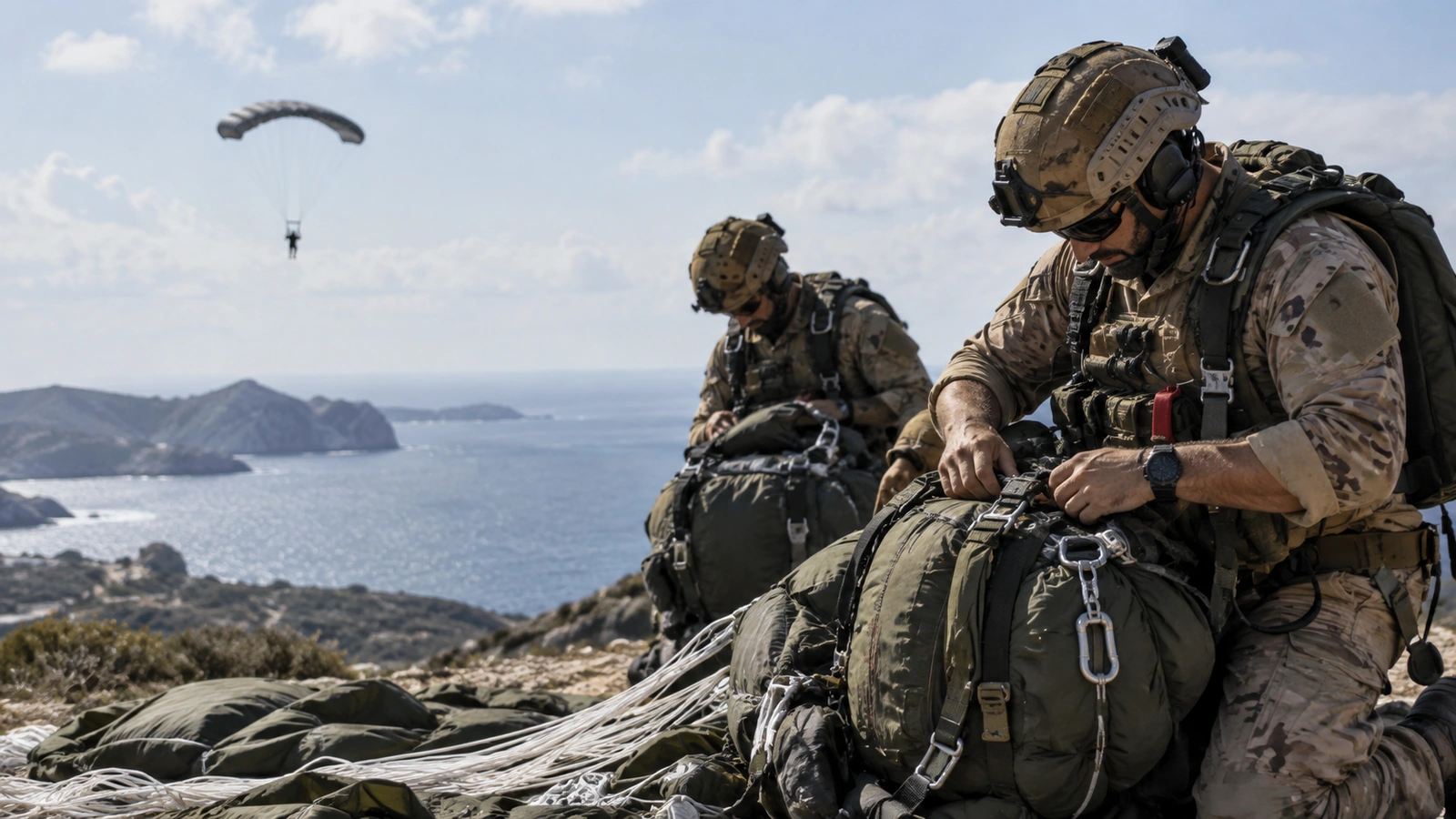
The Spanish Navy will replace part of the parachute equipment used by the Marine Corps with the acquisition of 48 new systems for both training and operational use. The contract includes 24 TP-2Z personal back parachutes and another 24 RTP-26Z reserve systems, manufactured by Spanish company CIMSA Ingeniería de Sistemas.
The contract is valued at €225,756.96, including taxes, and addresses equipment replacement and renewal needs planned for 2026. CIMSA was the only company to submit a bid in the open tender and must complete delivery before December 30 of this year. The equipment will carry a 36-month warranty.
The new parachutes may be used by units including the Tercio de Armada and the Naval Special Warfare Force (FGNE), for which parachute jumps are part of their deployment and infiltration capabilities. In the case of the FGNE, the Navy includes daytime and nighttime jumps over land and sea among its training activities, alongside other specialized capabilities such as combat diving.
Equipment for more precise operations
The main system being acquired is the TP-2Z, developed by CIMSA for airborne forces and special operations units. It is a configurable system for different mission types, designed both for troop drops and for operations where controlling landing accuracy is particularly important.
The configuration selected by the Navy uses a canopy with a nominal diameter of 35 feet and a surface area of 88.9 square meters. The equipment weighs about 13 kilograms and has a maximum operational weight of 160 kilograms, including the parachutist and any equipment carried.
The system can be used from a minimum operational altitude of 125 meters above ground level and supports a maximum operating speed of 150 KEAS. Its design also incorporates a deployment bag intended to improve the protection and storage of suspension lines and facilitate packing operations.
The TP-2Z units will be accompanied by RTP-26Z reserve parachutes, also developed by CIMSA. The latter use a 26-foot polyconical canopy, weigh approximately six kilograms, and maintain a maximum operational capacity of 160 kilograms. Their minimum operating altitude is 75 meters.
The reserve system incorporates mechanisms designed to enable rapid activation in an emergency, including an easily identifiable activation ring and a deployment-assist device intended to facilitate canopy inflation under different descent conditions.
Renewing the Armed Forces’ parachute equipment
The transaction comes amid a broader renewal of such equipment across Spain’s Armed Forces. This summer, the Defense Ministry finalized a framework agreement to acquire around 2,400 parachutes for various Army, Navy, and Air and Space Force units, with a base budget of nearly €17 million.
The Navy’s specific purchase will renew equipment used by a Marine Corps that needs to maintain parachute capability for both its training programs and airborne operations. That capability is particularly relevant to the Naval Special Warfare Force, a unit tasked with carrying out special operations primarily in maritime and coastal environments and which includes parachuting among its combat-support capabilities.
CIMSA has a long track record as a supplier of this type of equipment to the Armed Forces. The Spanish company designs and manufactures personal and tactical parachutes, emergency aeronautical systems, and other military textile equipment, and has maintained cooperation programs with the Defense Ministry for years to develop, test, and certify its products.