



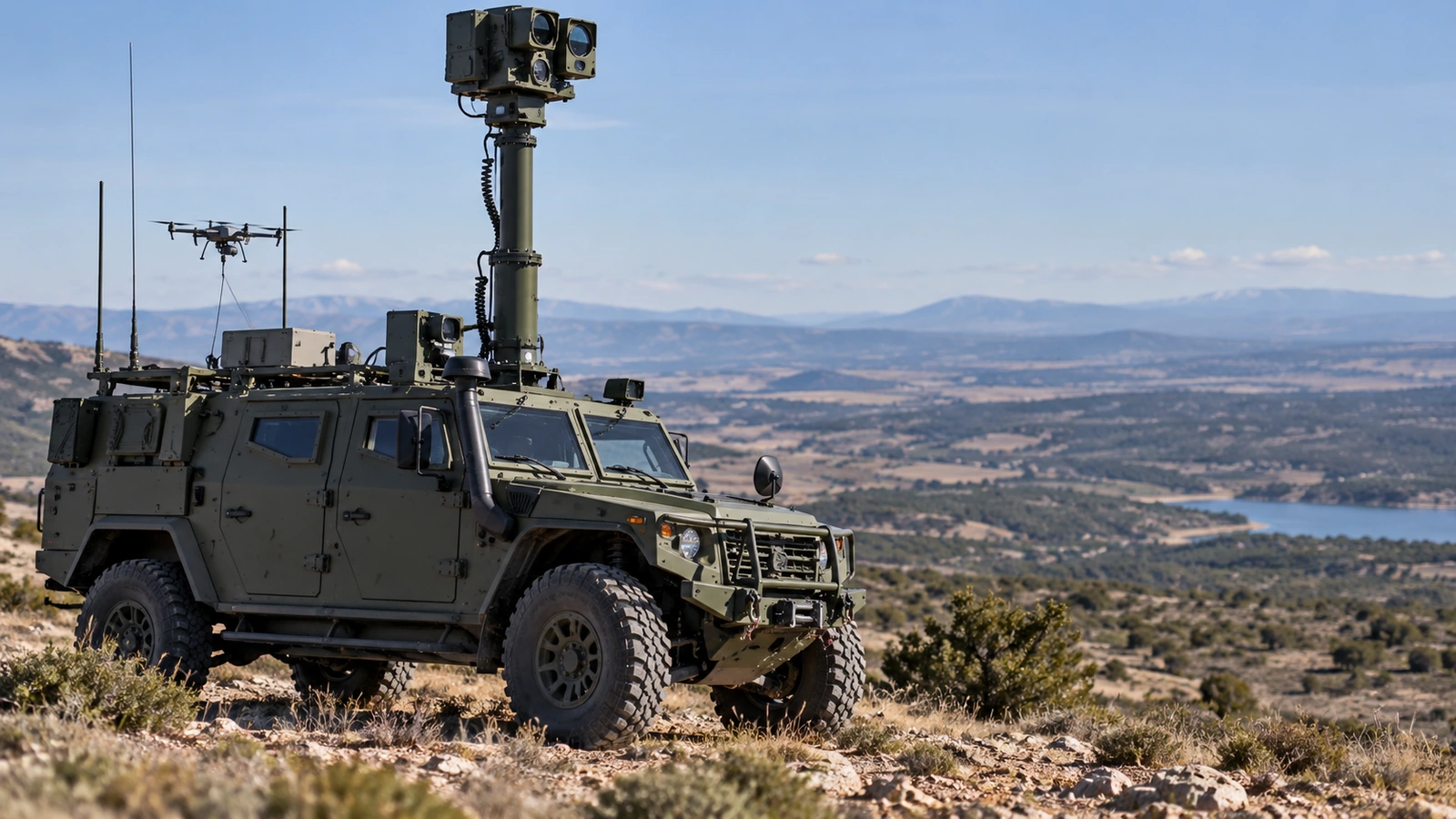
The Spanish Army’s new Ground Reconnaissance and Surveillance Vehicle (VERT) will be able to detect people at distances of up to 20 kilometers and use artificial intelligence to locate, recognize, and classify potential targets. These capabilities will be part of SERT 2.0, the system developed by Navantia that will serve as the sensor and information-management core of the 100 new VAMTAC ST5 vehicles ordered from Urovesa.
The program represents an investment of €321.4 million, with Galicia-based Urovesa as the prime contractor. Navantia, meanwhile, has signed a €120 million contract with the company to integrate 100 SERT systems into the vehicles. The two companies had already worked together on an initial phase of the program, which led to the delivery of 16 VERT vehicles to the Spanish Army under a contract signed in 2014.
The new generation marks a technological leap over those vehicles. One of the most significant changes is the range of its sensors. According to data provided by Navantia, the new system will be able to detect people at distances of up to 20 kilometers, compared with about 10 kilometers for the first version.
The goal is consistent with the VERT’s role within Cavalry units: to observe and survey terrain, identify potential threats, and relay that information to other units while keeping the vehicle itself as far as possible from direct exposure. The operational philosophy is captured in an idea that has accompanied the program since its earliest stages: “see without being seen.”
Sensors and artificial intelligence on a mast
The most visible element of SERT 2.0 will be a gyro-stabilized pedestal mounted on a telescopic mast. By raising the sensors above the vehicle, operators can observe the terrain while keeping the platform protected behind obstacles or taking advantage of the landscape itself.
The assembly will integrate electro-optical cameras for day and night observation, a laser rangefinder, inertial navigation systems, and GPS. The vehicle will also be equipped with a ground-surveillance radar, weather station, secure communications, and a system responsible for managing and distributing the information collected.
Artificial intelligence will play an increasing role in that process. SERT will incorporate tools designed to accelerate the detection of potential targets and subsequently help recognize and classify them. The aim is to reduce operators’ workload amid the volume of information generated by the different sensors.
Spanish company GTD is participating in this part of the program with BOX-AI, an artificial intelligence-based video processor designed to detect, identify, and track threats in real time. The company presented the technology at the Eurosatory 2026 trade show in Paris as part of its involvement in the future VERT.
The stations for the observer, gunner, and mission-system control will also be interchangeable, a configuration intended to provide greater flexibility for the crew.
A drone to expand the surveillance area
The new VERT will not rely solely on sensors installed on the vehicle. Navantia’s planned configuration also includes a tethered drone, one of the requirements set by the Spanish Army for this second phase.
This type of aircraft remains physically connected to the platform, allowing it to remain above the vehicle for extended periods and lift sensors to a significant altitude. Its incorporation will extend the surveillance horizon beyond what can be achieved by equipment mounted directly on the mast.
The vehicle will also feature a remote weapon station supplied by Spanish company Escribano Mechanical & Engineering (EM&E), intended primarily for self-protection. GTD will provide the video processor, while other suppliers will contribute different components that Navantia will integrate into the overall system.
The combination of ground sensors, cameras, radar, artificial intelligence, and airborne assets reflects the changing nature of military reconnaissance. Capability no longer depends solely on seeing farther, but on gathering information from different sources, processing it quickly, and distributing it to other units to support decision-making.
One hundred vehicles by 2030
Navantia will integrate the systems at its facilities in San Fernando, Cádiz. The VAMTAC ST5 vehicles will arrive from Urovesa with certain components already installed, including the remote weapon station, and SERT will be added there before the vehicles return to the manufacturer’s plant to complete the process ahead of delivery to the Ministry of Defense.
The timetable calls for two SERT prototypes in 2026 and two pre-series units in 2027. The bulk of deliveries will subsequently be concentrated between 2028 and 2030.
The 100 new vehicles will expand this capability across the Spanish Army’s Cavalry units. The VERT is designed for combat and deep-reconnaissance missions, surveillance, and tactical security, providing information to the brigades it supports.
The program’s significance therefore lies less in the VAMTAC platform itself than in the systems it will carry. The vehicle becomes a mobile information-gathering and transmission node capable of combining ground- and air-based sensors, processing their data, and sharing it with other units. On a battlefield where drones and sensors are making it increasingly difficult to conceal movements, detecting earlier and transmitting that information quickly is becoming an essential capability.