


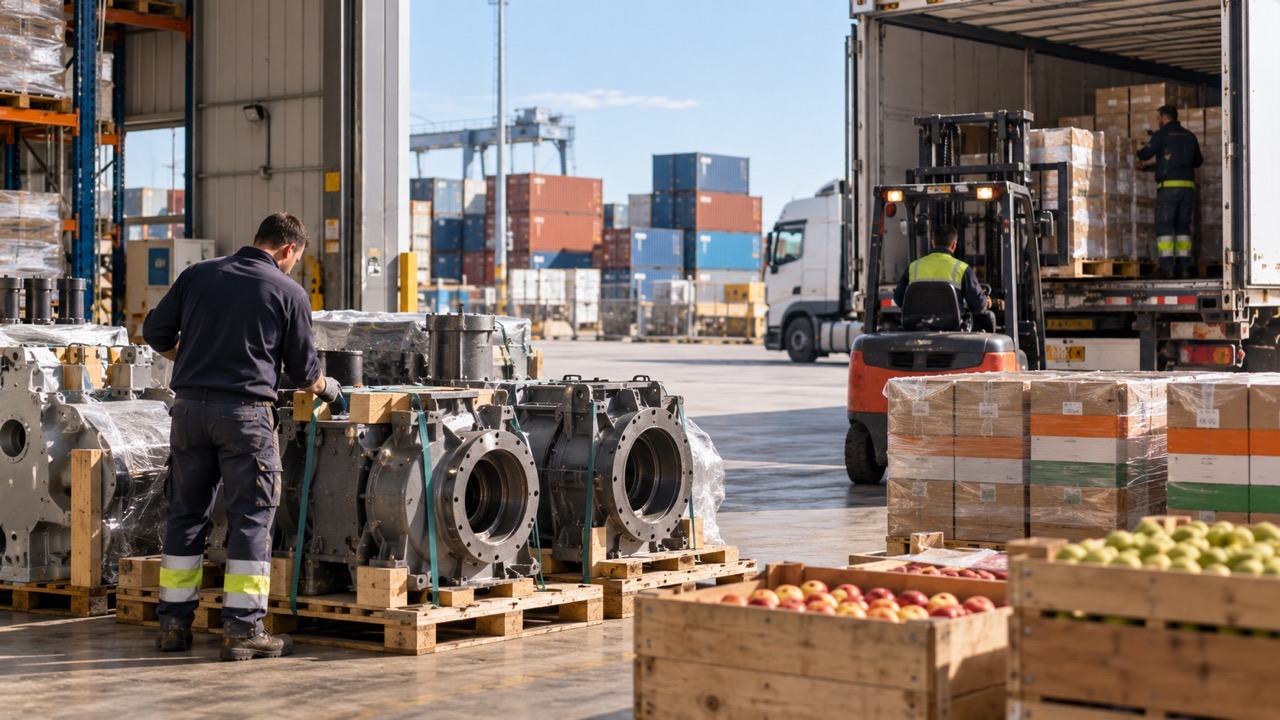
Machinery and chemicals, which already lead Aragón’s sales to the Asian country, are among the sectors set to benefit from tariff cuts. The Indian market still accounts for a small share of Aragón’s exports, and the agreement must still complete the process required to enter into force.
The free-trade agreement reached between the European Union and India could alter the conditions under which companies from Aragón gain access to one of the world’s largest markets. The gradual reduction of tariffs affects sectors with a significant role in Aragón’s economy, including machinery, the chemical industry, automotive components and certain agri-food products.
The starting point, however, is modest. Aragón’s exports to India still account for a very small share of the region’s foreign trade, while imports from the Asian country are considerably higher. That gap reflects both Aragón’s limited current presence in the Indian market and the room for more companies to explore the destination.
The European Union and India concluded negotiations on the treaty on January 27, 2026. According to the European Commission, India will eliminate or reduce tariffs on 96.6% of EU goods exports once the various liberalization schedules have been completed. Brussels estimates that European companies could save up to €4 billion a year in customs duties.
The agreement is not yet in force. The published texts remain subject to legal review, and the treaty will become binding only once it has been signed and both sides have completed the necessary internal procedures.
Machinery and chemicals already lead Aragón’s sales to India
The structure of Aragón’s exports to the country identifies two sectors particularly exposed to tariff changes. According to an analysis published by the Government of Aragón using Customs data, machinery and equipment manufacturing accounted for 26.6% of Aragón’s sales to India in 2025. The chemical industry ranked second, with 18.6%.
Both sectors are among those benefiting from the trade agreement. In machinery, India will liberalize roughly half of tariffs upon entry into force and progressively eliminate the rest over periods that may extend to 10 years. More broadly, the European Commission says current tariffs on machinery and electrical equipment can reach 44% and will be eliminated for nearly all such products.
In the chemical sector, where tariffs can currently reach 22%, the elimination will affect nearly all products, a large share of them from the treaty’s entry into force.
The overlap between these sectors and Aragón’s main current sales to India makes the reduction of barriers a relevant factor for companies already operating in the country and for those considering entering it. That does not remove other obstacles: logistics, administrative procedures, regulatory differences, and the need for partners or local knowledge remain among the challenges cited by Aragón’s own internationalization support organizations.
Automotive sector to see gradual opening
Another area of interest for Aragón is the automotive industry. The agreement provides for a gradual reduction of Indian barriers for certain vehicles and their components.
For auto parts, the European Commission expects most tariffs to disappear over periods of between five and 10 years. For finished vehicles, where current tariffs can reach 110%, the agreement provides for a reduction to 10% within a quota of 250,000 units.
In Aragón, where the automotive industry is one of the leading industrial sectors and an extensive supplier network is linked to Stellantis’ plant in Figueruelas, developments in the Indian market could be of particular interest to manufacturers of components, industrial equipment and technologies related to production processes.
In any case, this is neither an immediate nor a complete opening. The schedules established by the agreement require differentiation by product and time frame, while market entry will depend on each company’s commercial strategy.
New terms for certain food products
The agreement also changes market-access conditions for several European agri-food products, although it does not entail broad liberalization of the sector.
One of the most notable changes affects olive oil and other vegetable oils, which currently face tariffs of up to 45% and will fall to 0%. Duties will also be eliminated on certain processed foods, such as pasta, chocolate, bakery and pastry products, which can currently face tariffs of up to 50%.
For Aragón’s agri-food sector, these reductions could facilitate market entry for certain higher-value-added products. Their real impact will nevertheless depend on each product category and on companies’ ability to find distribution channels in the Indian market.
In parallel, the European Union and India are maintaining separate negotiations on geographical indications. That process will be relevant for European products tied to designations of origin and other quality labels, but it is not yet part of the trade agreement concluded in January.
Aragón had already turned its attention to India
Business interest in India from Aragón predates the conclusion of the treaty. Aragón Exterior and the Zaragoza Chamber of Commerce launched the India Plan in 2025, a program designed to support companies seeking to begin, strengthen or consolidate their operations in the country.
Data used at the time by both organizations showed a still-limited business presence. About 150 companies from Aragón exported to India in 2024, but only 56 exceeded €50,000 in sales. That year, Aragón exported €20.8 million worth of goods and imported €277.5 million in Indian products.
The initiative combines training, consulting and advisory services to address issues including logistics, the legal framework, the search for suppliers or partners, and business establishment. In April 2026, Aragón Exterior also organized a specific event on the EU-India treaty and its implementation timetable.
The existence of these programs takes on greater importance in a market that offers opportunities but also access difficulties. The Zaragoza Chamber itself has cited bureaucracy, logistical complexity and differences in business culture among them.
An agreement arriving in the Spain-India Dual Year
The commercial rapprochement also coincides with a year of increased institutional activity between Spain and India. The two countries are celebrating the Spain-India Dual Year in 2026, marking the 70th anniversary of the establishment of diplomatic relations.
The initiative, agreed by the governments of both countries in 2024, focuses primarily on culture, tourism and artificial intelligence, although it also includes business, scientific and academic activities.
For Aragón, the new landscape does not mean that India will immediately become one of its major foreign markets. The gap with its main European trading partners remains very wide. The relevant change lies in market-access conditions: sectors that already sell from Aragón to the country, particularly machinery and chemicals, will face a substantial reduction in tariff barriers that until