



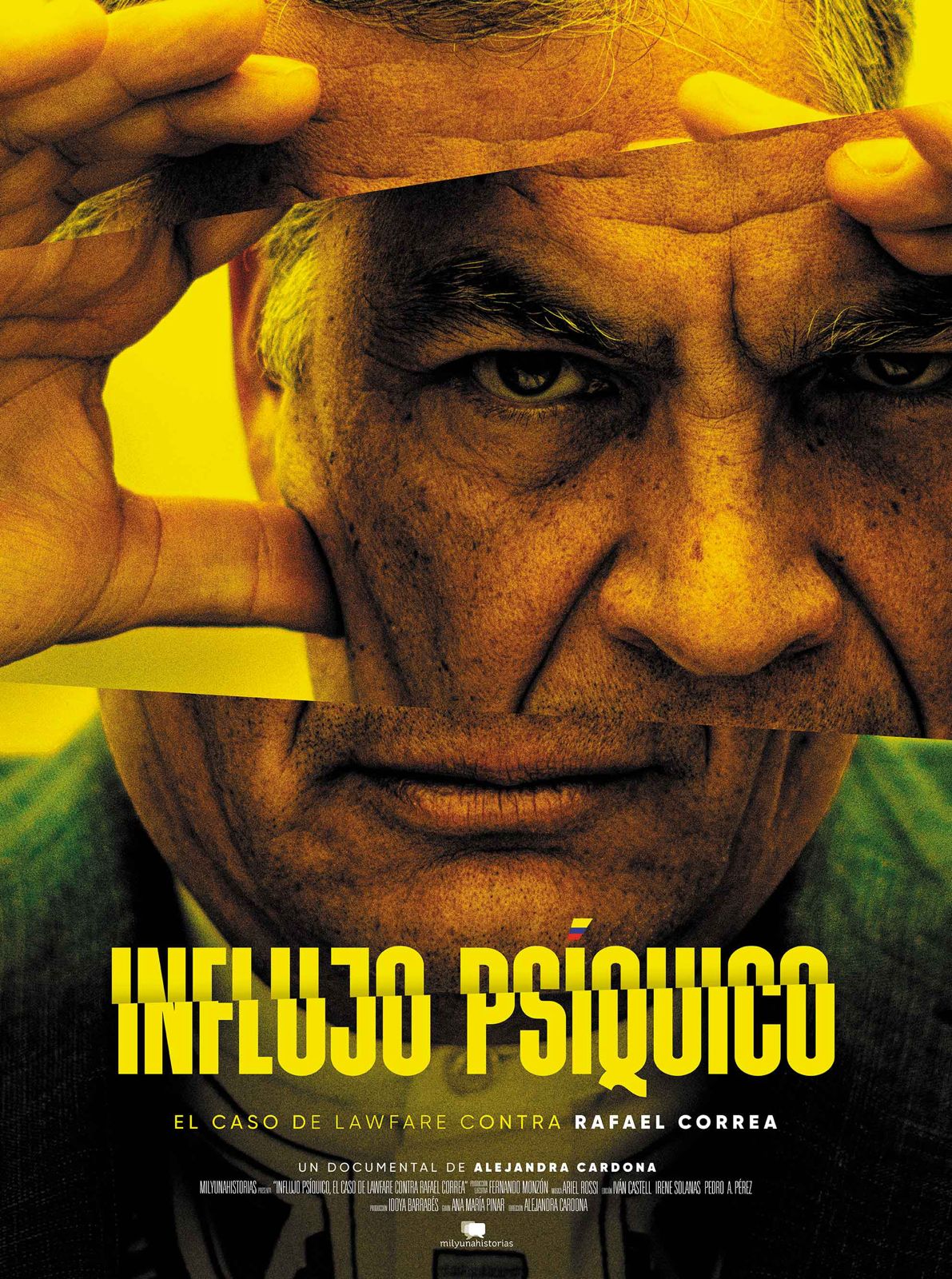
Influjo psíquico, the feature-length documentary directed by Alejandra Cardona and produced by Milyuna Historias, will arrive at Madrid’s Palacio de la Prensa next Thursday, October 1. The screening will begin at 7 p.m. and will be followed by a panel discussion on lawfare and the relationship between justice, politics, and power.
The film uses the legal proceedings against former Ecuadorian President Rafael Correa as its narrative thread to examine a phenomenon that has become increasingly prominent in Latin American political and legal debate: the use of judicial proceedings and institutions in contexts of political confrontation. This is the documentary’s starting point as it raises questions related to the rule of law, due process, and the political and human consequences that can arise from such circumstances.
The project also has strong ties to Aragón. Milyuna Historias is based in Zaragoza, and its head of production, Idoya Barrabés, recently described in an interview with GoAragón the lengthy process involved in bringing the film to fruition, which took the team to both sides of the Atlantic.
Three years of filming in eight countries
Influjo psíquico was filmed over three years in Ecuador, Mexico, Venezuela, Colombia, Spain, Belgium, Israel, and Canada. The research incorporates testimony from legal scholars, political scientists, psychologists, people involved in the proceedings, and individuals directly affected, as well as documentation and archival material gathered during production.
The film’s title comes from the concept of «psychic influence,» used in the legal reasoning behind Correa’s conviction in the so-called Bribery Case. The documentary uses the expression as a starting point to broaden its examination of the relationship between justice and political power.
As Barrabés told GoAragón, the team’s aim was to address lawfare without tying it to any particular flag or ideology. That approach led the filmmakers to seek out different perspectives during the research and to expand their work beyond the specific case of the former Ecuadorian president.
The film is therefore not limited to reconstructing a legal proceeding. Drawing on the testimony and materials collected, it raises questions about procedural safeguards and what happens when a legal case unfolds alongside intense political and media confrontation.
From Zaragoza to the film circuit
Before its presentation in Madrid, Influjo psíquico had already appeared at various creative, exhibition, and film-industry events. The project took part in RECLab and MAFIZ, the industry section of the Málaga Film Festival, and was also featured at professional gatherings linked to the San Sebastián International Film Festival and the Bordeaux Latin American Film Festival.
Its journey has also included the Zaragoza Film Festival, a particularly significant appearance for a production developed in the Aragonese capital. The project’s trajectory also reflects the international reach achieved by a Zaragoza-based production company, with filming spanning eight countries and a subject matter focused primarily on Latin America.
The film’s core team is led by Alejandra Cardona as director, Ana María Pinar as screenwriter, and Idoya Barrabés as production director.
Screening and panel discussion at the Palacio de la Prensa
The Madrid presentation will take place on Thursday, October 1, at 7 p.m. at the Palacio de la Prensa. The screening will be followed by a panel discussion featuring representatives from the legal and journalism fields, as well as members of the film’s team. Organizers said the participants will be announced shortly.
The event is supported by the Commissioner for the Celebration of 50 Years of Spain in Freedom, an initiative promoted by the Spanish government through the Ministry of Territorial Policy and Democratic Memory as part of its cultural and educational activities.
The Madrid event marks a new stage for a documentary developed in Aragón and built on international research. After three years of filming, Influjo psíquico will bring to the Palacio de la Prensa the issues at the heart of the film: the relationship between justice and politics, the safeguards of the rule of law, and the debate over lawfare.