



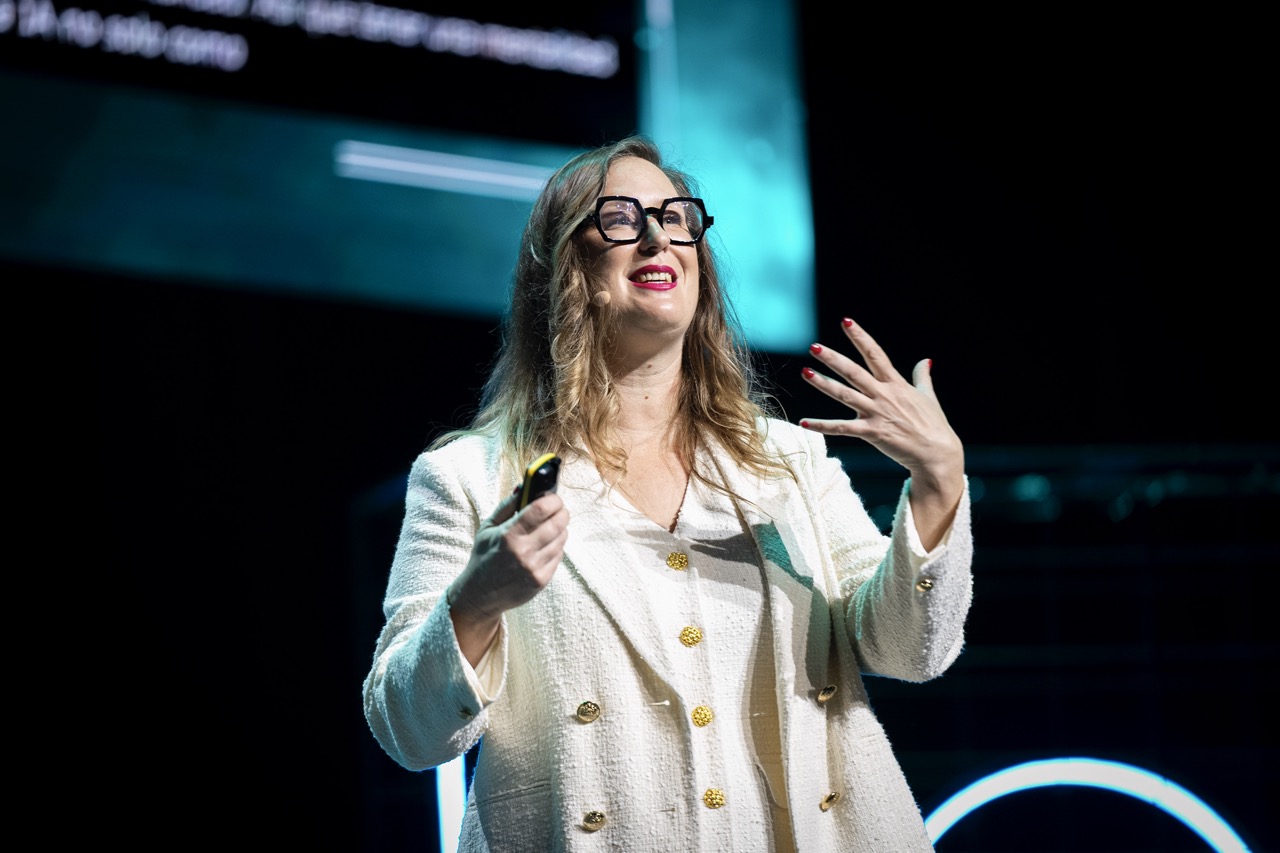
The Director of Public Policy for Generative AI in EMEA at Amazon Web Services (AWS), Sasha Rubel, was a key speaker at the second day of the The Wave 2026 conference. In her presentation at the Palacio de Congresos in Zaragoza, she praised the Aragonese model of technological transformation and presented it as a benchmark for the entire European Union.
“I am glad to be here today in Zaragoza because I believe what is happening here and in Aragon is exemplary and a lesson learned for the rest of Europe. From Aragon to the world,” Rubel stated emphatically.
Europe at a “crucial moment” for AI
During her intervention, Rubel positioned Europe at a turning point regarding generative artificial intelligence. She presented updated data on its adoption:
- In 2024, 33% of European companies had adopted AI.
- In 2025, the figure rose to 42%.
- By 2026, it will reach 54%.
Moreover, awareness of AI among European citizens has increased from 50% to 80% in just two years, while daily usage has risen from 20% to 36%.
“The speed of AI evolution is accelerating, innovation is progressing rapidly, and adoption must keep pace,” the AWS executive warned.
The vast untapped economic potential
Rubel emphasized the enormous economic value of full adoption of generative AI: it could generate over $600 billion (over €600 billion) in gross value added for the European Union by 2030, a figure equivalent to the total of the European construction industry.
She cited the case of Cruz Roja Española, which uses AI to combat loneliness among the elderly, having already helped over 180,000 older adults.
The main challenges: talent, regulation, and mindset
The executive identified several key inhibitors for faster adoption:
- Lack of digital skills: 51% of companies acknowledge they lack the necessary profiles and typically take an average of seven months to hire them.
- Fragmented regulation: She called for a true single market for AI that would replace the 27 national regulatory systems with a harmonized framework, balancing safety, innovation, and responsibility.
- Role of the public sector: She argued that administrations must lead the adoption of AI to build trust among citizens.
Rubel insisted that businesses and society need to combine technical skills with human competencies such as critical thinking, creativity, empathy, and the ability to solve problems alongside AI. “Not everyone will be an AI programmer, but everyone will interact with it,” she noted.
Aragon, a European model
Sasha Rubel’s remarks reinforce the positioning of Zaragoza and Aragon as a reference point in southern Europe for artificial intelligence and data centers. Her praise for the Aragonese ecosystem coincides with the strong presence of AWS in the region and the record participation at The Wave, which has surpassed 20,000 registered participants for this edition.
The session on Thursday, April 16, will especially focus on young audiences, aiming to continue inspiring technological vocations and consolidate local talent as a future driving force.