



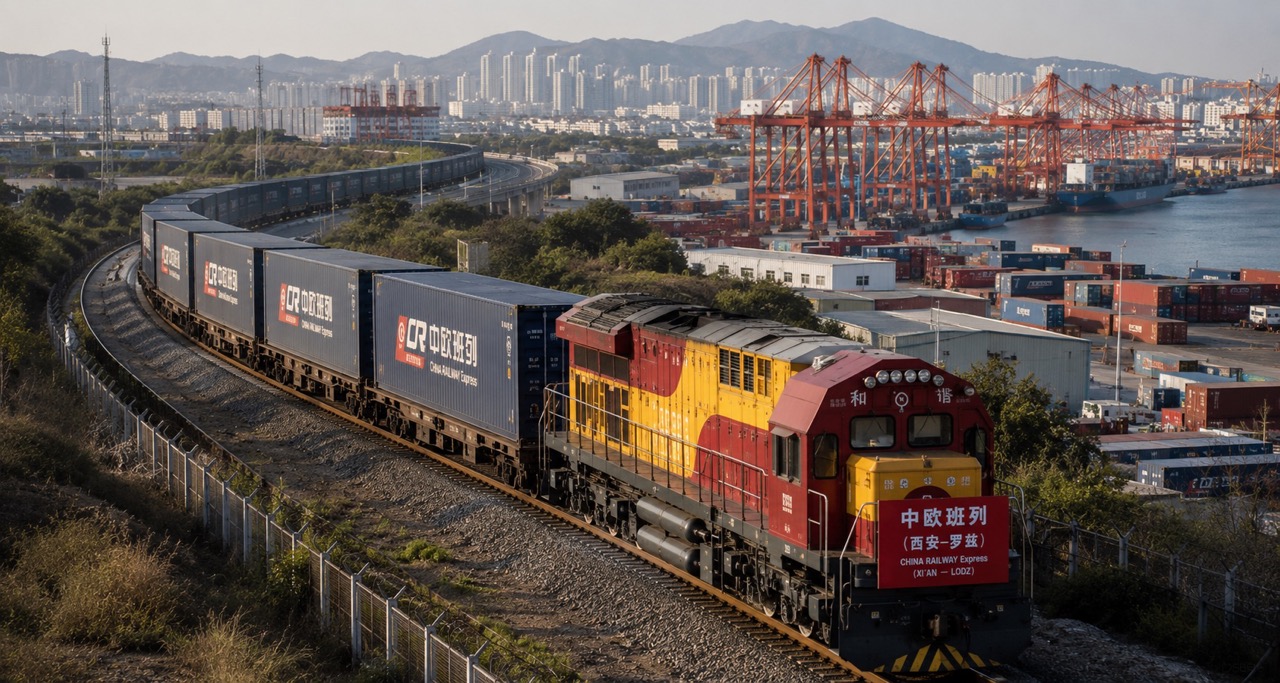
Ports, railways, roads, energy, telecommunications, and trade corridors are part of the Belt and Road Initiative, a project launched by China in 2013 to enhance its economic connections with the rest of the world. For businesses, understanding the new Silk Road helps clarify why Chinese companies are increasingly involved in ports, infrastructure, and industrial projects from Asia to Latin America.
When discussing the new Silk Road, it may seem to refer to a major road or a railway line linking China with Europe. The reality is much broader. There is not a single route, but rather a network of land and maritime corridors, infrastructure, and cooperative agreements aimed at facilitating the movement of goods, investments, and services between China and numerous international markets.
Its official name is Belt and Road Initiative (BRI), although it is commonly referred to as the New Silk Road in Spanish. It was introduced in 2013 by Chinese President Xi Jinping, drawing historical references from the ancient trade routes that for centuries connected China with Central Asia, the Middle East, and Europe.
The initiative has two main dimensions. On one side is the Economic Belt of the Silk Road, fundamentally based on land connections through railways, roads, oil pipelines, gas pipelines, and logistics centers. On the other is the 21st Century Maritime Silk Road, centered around ports and maritime connections. Over the years, other areas related to telecommunications, energy, e-commerce, and economic cooperation have also been included.
A network for easier movement of goods
For a businessman, perhaps the simplest way to understand the Silk Road is to envision a vast international logistics network. A company needs roads to transport its products to a railway terminal or a port; facilities to store them; ships or trains for transport; customs systems that allow crossing borders; and digital and financial networks that facilitate operations.
China aims to enhance precisely those connections. The project includes ports, railways, roads, and other infrastructure designed to reduce physical barriers that hinder trade between countries. The World Bank has noted that improvements in connectivity associated with these corridors can reduce transportation times and costs and, when accompanied by appropriate policies, increase trade and investment.
However, the initiative is not solely about construction. It also includes trade agreements, coordination of economic policies, financial cooperation, customs procedures, technical standards, and exchanges between countries. From the outset, the Chinese project envisioned integration that extended beyond mere infrastructure.
What does China aim to achieve?
From an economic standpoint, one of its goals is to improve connections between Chinese companies and international markets. China is a major exporting power and, at the same time, needs to import vast quantities of oil, gas, minerals, agricultural products, and other raw materials. Having different land and maritime corridors facilitates both movements.
Infrastructure plays a fundamental role here. A port capable of accommodating large vessels, a new railway line, or a faster land connection can lower the cost of transporting goods and make feasible trade routes that were previously too expensive or slow.
There is also a business dimension. Large construction companies, port operators, electric companies, banks, and Chinese tech groups have found international opportunities linked to the development of this infrastructure. Companies such as COSCO Shipping, China Merchants, China Railway, PowerChina, or China Communications Construction Company are involved in projects abroad.
The official Chinese strategy continues to prioritize the development of trains between China and Europe, Eurasian land corridors, the integration of ports and maritime and commercial services, and the so-called Air Silk Road. It also envisions greater cooperation in e-commerce and the digital economy.
From the railway between China and Europe to major ports
The physical dimension of the initiative helps to understand its scope. The land corridors traverse Central Asia and connect China with various European markets through freight trains. There are also connections to Southeast Asia, Pakistan, and other regions.
At sea, ports gain similar importance. The Maritime Route seeks to improve connections between China and Southeast Asia, the Indian Ocean, the Middle East, Africa, and Europe. The involvement of Chinese companies in international port terminals is part of this expansion of trade and logistics networks.
For businesses, what matters is not just who builds a port. The emergence of new infrastructure can alter routes, transportation times, costs, and economic influence areas. A well-connected port can attract warehouses, logistics companies, processing industries, and distribution centers around it.
What is the relevance for Latin America?
The initiative was primarily launched with a Euro-Asian focus, but cooperation linked to the BRI gradually extended to other regions, including Latin America. This is where projects like the Port of Chancay in Peru illustrate what this strategy means in practice.
Chancay is 60% controlled by COSCO Shipping Ports, part of the state-owned China COSCO Shipping group, and was designed to facilitate direct connections between the South American coast and Asia. Its goal goes beyond Peruvian trade: it aims to progressively function as a logistics center capable of consolidating goods from other markets in the region.
Nonetheless, the presence of Chinese businesses in Latin America is broader than the Silk Road, and not all investments made by a Chinese company should automatically be classified as a BRI project. It is essential to maintain that distinction. Companies from the Asian country invest in mining, electricity, automotive, telecommunications, infrastructure, and technology for commercial reasons that may exist independently of the initiative.
What does it mean for a Spanish or Latin American company?
The Silk Road is relevant for entrepreneurs because it touches on a fundamental issue: how goods circulate and where supply chains are located.
A new railway connection between Asia and Europe may provide an alternative to maritime transport for certain goods. A port on the Latin American Pacific can change the routes used to export food to China. New energy infrastructure can facilitate industrial installation, and a logistics corridor can increase the appeal of specific cities or regions for distribution centers.
It can also create new opportunities for local providers of engineering, construction, maintenance, logistics, technology, and professional services. At the same time, each project must be analyzed individually, as financial conditions, profitability, environmental impact, and indebtedness can vary considerably. The World Bank has pointed out both the potential commercial benefits of new infrastructure and the need to address issues related to transparency, debt sustainability, and social and environmental effects.
An economic infrastructure that transcends roads
More than








