



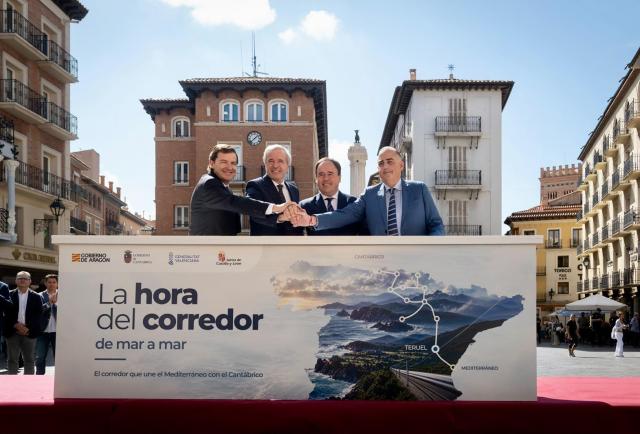
Aragón, the Valencian Community, Castile and León, and Cantabria have joined forces to call on Spain’s central government to deliver a high-performance Cantabrian-Mediterranean Corridor along its entire route. The Teruel Declaration, signed on September 29, 2026, calls for double-track, electrified and interoperable infrastructure capable of carrying both passengers and freight.
Four regions call for an integrated rail corridor between the Cantabrian coast and the Mediterranean
The president of Aragón, Jorge Azcón; the president of the Generalitat Valenciana, Juan Francisco Pérez Llorca; the president of Castile and León, Alfonso Fernández Mañueco; and Cantabria’s regional minister for public works, Roberto Media, have signed a joint document advocating for the corridor as an integrated infrastructure project rather than a collection of independent sections.
The signatories envision a rail artery capable of connecting the regions and supporting competitive freight and passenger transport. The declaration rejects making single track a permanent solution, arguing that it would constrain growth capacity and the connection’s strategic potential.
The agreement was signed at Teruel’s Plaza del Torico, following the event The Corridor’s Time: From Sea to Sea, held at the Exhibition and Conference Center. The gathering brought together institutional representatives, companies, port authorities, and rail and logistics experts.
The agenda addressed the position of cities, the corridor’s technical assessment, the role of ports and logistics platforms, multimodality, and business expectations. Also participating were Teruel Mayor Emma Buj; the president of the Provincial Council of Teruel, Joaquín Juste; and the mayors of Zaragoza and Huesca, Natalia Chueca and Lorena Orduna.
Regions question the planned single-track line between Teruel and Sagunto
Jorge Azcón devoted part of his remarks to the feasibility study for the Teruel-Sagunto section, which envisages a single track, maximum speeds of 140 kilometers per hour, and 100 kilometers per hour on the Teruel bypass. The Aragón president argued that the proposal falls short of the standards required for the corridor as a whole.
Azcón called for the current study to be withdrawn and replaced with one that addresses the corridor’s present and future needs, as well as the requirements of the Trans-European Transport Network. He also asked Transport Minister Óscar Puente to explain the shift from earlier plans based on double track.
Juan Francisco Pérez Llorca said the project must operate as a network linking the Mediterranean, the Atlantic, and the Cantabrian coast for both freight and passengers. He noted that the corridor was announced in 2011 and that several decisions in the Valencian Community were made on the understanding that the infrastructure would provide high performance along its entire route.
Alfonso Fernández Mañueco called for rail planning with a comprehensive vision, while Roberto Media demanded a definitive investment designed for the long term. The Cantabrian official warned that investment would lose its purpose if the final result did not deliver a robust corridor.
The Teruel Declaration calls for double track, standard gauge, and urgent implementation
The document calls for the future Cantabrian-Mediterranean Corridor to be a high-capacity, seamless, and fully interoperable infrastructure, with double track and standard gauge. The four regions also seek its inclusion in the European Transport Corridors and urgent implementation that goes beyond the upgrades, modernization, and electrification carried out in recent years.
The declaration links this demand to European Regulation 2024/1679 on the development of the Trans-European Transport Network. It also argues that public investment should uphold territorial balance and equal opportunity, preventing short-term decisions from constraining regional development.
Aragón, the Valencian Community, Castile and León, and Cantabria have pledged to maintain a common position in calling for the necessary investment. The text says the corridor has the potential to strengthen the industrial, logistics, port, tourism, and agri-food development of the connected regions.
The Teruel Declaration concludes with a message to Spain’s central government: the signatory regions reject bare-minimum solutions and call for rail infrastructure with the capacity to serve the coming decades, grounded in territorial cohesion and equal opportunity.