



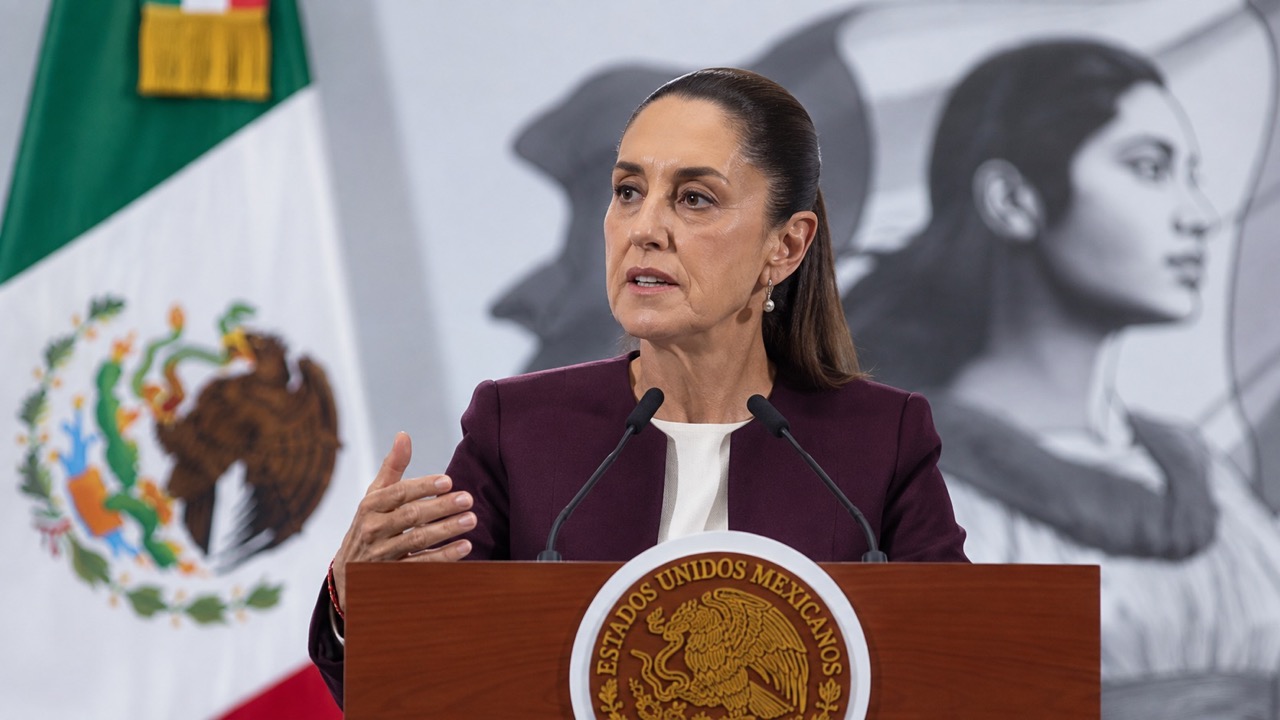
Mexican President Claudia Sheinbaum has called for a relationship with the United States based on cooperation and mutual understanding, while stressing respect for Mexico’s sovereignty. She addressed ties with Washington at an event in Monterrey as part of a tour reviewing her first two years in office.
Sheinbaum said Mexico aims to maintain a good relationship with Donald Trump’s administration, citing the understanding that existed between the current U.S. president and Andrés Manuel López Obrador during Trump’s first term, from 2017 to 2021. The Mexican president summed up her position with a phrase she has used to define the limits of bilateral cooperation: “cooperation always, subordination never.”
The statement comes at a time when relations between the two countries combine close economic interdependence with political differences on particularly sensitive issues. Mexico and the United States face ongoing disputes over trade and security as they move forward with the review of the United States-Mexico-Canada Agreement (USMCA), one of the central pillars of their economic relationship.
Sovereignty and mutual understanding
During her remarks in Monterrey, Sheinbaum acknowledged that the relationship with Washington has faced difficulties, though she insisted that her government remains committed to seeking mutual understanding. The president said cooperation between the two countries rests on four principles: respect for sovereignty and territorial integrity, shared but differentiated responsibility, mutual trust, and cooperation without subordination.
She also linked that position to different periods in the shared history of Mexico and the United States. She recalled the relationships between Benito Juárez and Abraham Lincoln, Lázaro Cárdenas and Franklin D. Roosevelt, and, more recently, López Obrador and Trump.
The message takes on particular significance in September, the month in which Mexico commemorates the beginning of its independence movement. Sheinbaum used that context to emphasize that maintaining relations of friendship and cooperation with Washington does not mean, in her government’s view, abandoning political principles or the defense of national sovereignty.
Security, trade and an inevitably close relationship
Security is one of the areas where differences have become most apparent. Washington has increased pressure on Mexico in the fight against drug trafficking. Recent episodes include U.S. allegations of suspected links to organized crime involving Sinaloa Governor Rubén Rocha Moya, who is currently on leave, and other senior state officials.
Sheinbaum has refused to take action against Rocha Moya unless sufficient evidence exists to support the allegations under Mexico’s legal system. The issue reflects one of the balances currently facing the bilateral relationship: the need to maintain security cooperation while also managing differences over the limits and procedures governing that cooperation.
Trade is the other major area of negotiation. Mexico, the United States and Canada are engaged in the USMCA review process, involving an agreement that shapes much of North America’s economic relationship and means that any political dispute between Washington and Mexico City also carries significant business implications.
Sheinbaum’s remarks reflect that dual reality. Mexico is seeking to preserve close ties with the United States on trade, security and other strategic issues, while the Mexican government seeks to publicly establish the political limits of that cooperation. In that context, the concept of “cooperation without subordination” has become one of the formulations used by the president to define the relationship she intends to maintain with the Trump administration.